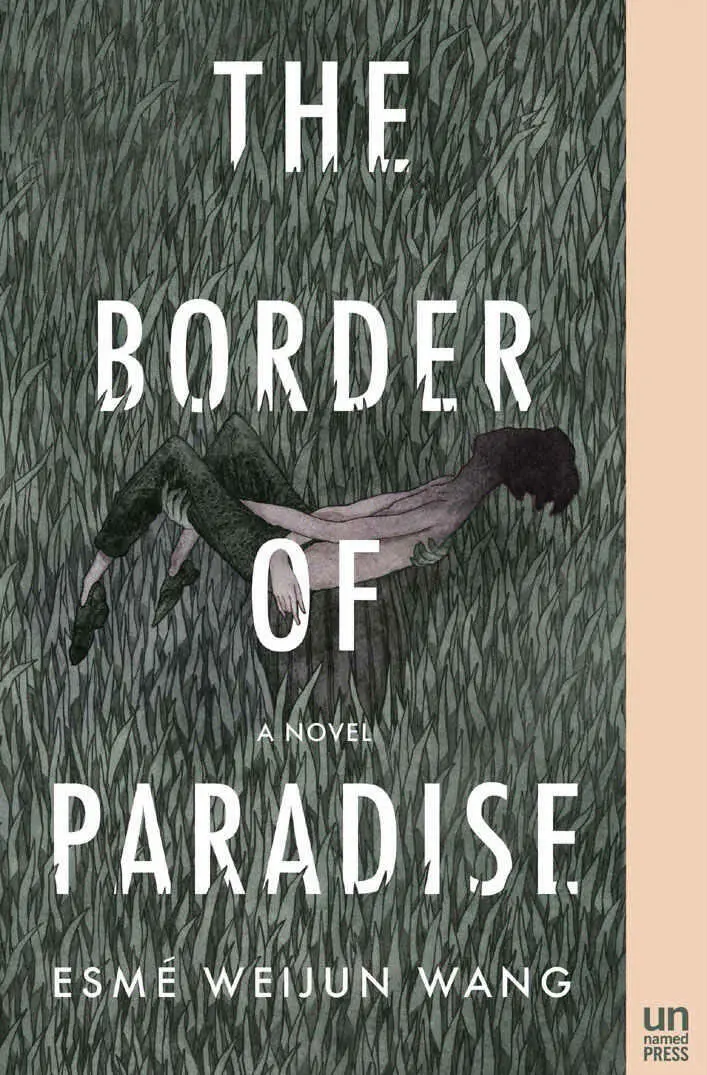
Esmé Wang - The Border of Paradise
Здесь есть возможность читать онлайн «Esmé Wang - The Border of Paradise» весь текст электронной книги совершенно бесплатно (целиком полную версию без сокращений). В некоторых случаях можно слушать аудио, скачать через торрент в формате fb2 и присутствует краткое содержание. Год выпуска: 2016, Издательство: The Unnamed Press, Жанр: Современная проза, на английском языке. Описание произведения, (предисловие) а так же отзывы посетителей доступны на портале библиотеки ЛибКат.
- Название:The Border of Paradise
- Автор:
- Издательство:The Unnamed Press
- Жанр:
- Год:2016
- ISBN:нет данных
- Рейтинг книги:3 / 5. Голосов: 1
-
Избранное:Добавить в избранное
- Отзывы:
-
Ваша оценка:
The Border of Paradise: краткое содержание, описание и аннотация
Предлагаем к чтению аннотацию, описание, краткое содержание или предисловие (зависит от того, что написал сам автор книги «The Border of Paradise»). Если вы не нашли необходимую информацию о книге — напишите в комментариях, мы постараемся отыскать её.
transports readers into the world of an iconoclastic midcentury family.
In booming postwar Brooklyn, the Nowak Piano Company is an American success story. There is just one problem: the Nowak’s only son, David. A handsome kid and shy like his mother, David struggles with neuroses. If not for his only friend, Marianne, David’s life would be intolerable. When David inherits the piano company at just 18 and Marianne breaks things off, David sells the company and travels around the world. In Taiwan, his life changes when he meets the daughter of a local madame — beautiful, sharp-tongued Daisy. Returning to the United States, the couple (and newborn son) buy an isolated country house in Northern California’s Polk Valley.
As David's mental health deteriorates, he has a brief affair with Marianne, producing a daughter. When Marianne appears at their doorstep, the couple's fateful decision to take the child as their own determines a tragic course of events for the entire family. Told from multiple perspectives,
culminates in heartrending fashion, as the young heirs to the Nowak fortune must confront their past and the tragic reality of their future.
The Border of Paradise — читать онлайн бесплатно полную книгу (весь текст) целиком
Ниже представлен текст книги, разбитый по страницам. Система сохранения места последней прочитанной страницы, позволяет с удобством читать онлайн бесплатно книгу «The Border of Paradise», без необходимости каждый раз заново искать на чём Вы остановились. Поставьте закладку, и сможете в любой момент перейти на страницу, на которой закончили чтение.
Интервал:
Закладка:
In Taiwan I was staying in an apartment above a teahouse. Marty, of all people, had handled my arrangements, having joined the navy immediately after graduation. Though I waited, bereft, for a letter from Marianne, it was Marty whom I received a letter from that June, which began with apologies: for his father’s violence, his parents’ scheming, his sister’s behavior. Crede mihi, he wrote, when I say that Marianne has less control over her life than you think. He then went on to describe his life in Taiwan, which intrigued me — so many bicycles! Stray animals everywhere underfoot! Banana farms, and did I know bananas grew in bunches on trees? The letter ended by saying, I know this must sound crazy, but I wanted to see if we could have a correspondence.
I didn’t write back to Marty right away. I felt that I should wait until I heard from Marianne before I spent any energy on her brother. His letter sat in a desk drawer while I tended to Matka, making her gin and tonics with just a splash of olive juice, the yellowy tinge clouding against the ice cubes. So many gin and tonics there were, and no letter came for one month, and then two months, and then three months, at which point I stopped hoping, or convinced myself that I had stopped hoping to hear from Marianne Orlich.
So I wrote Marty back; after all, I was lonely, too. I asked, among other things, if he could tell me anything about where Marianne was, or how she was doing. The reply, which took weeks to arrive, made no mention of his sister. I knew it was a deliberate omission, but what could I do? Soon Taiwan became so appealing that I asked if he could help me make arrangements. Really, though, it could have been anywhere. I just wanted to get away.
He’d planned my stay by contacting his former lieutenant, who was still active in the American intervention. I would meet Lieutenant Archibald Winner at a given day and time, and he would show me to my apartment. When the lieutenant had a spare moment, he would help me to acclimate myself to my surroundings. On the fourth day, I planned to meet up with Marty, who would be returning from a tour of the nearby seas.
The lieutenant liked me well enough. His smile was avuncular when I first met him, as though I were an old relative that he had grown up with, or perhaps lived on the same block as, for years. He was happy to do me favors. He was the sort who would have done well as one of Proust’s bourgeoisie, so aware of and respectful of class was he. He called Michigan a shitty place, and referred to New York City as the center of the world with reverence. He was Protestant, but appeared to have no problem with Catholics. He was not Polish, but respected the Polish community “for their brio,” and was disappointed to hear that I didn’t speak Polish. This disappointment faded when he learned of my predilection for Latin. The lieutenant was in his late thirties, but had already gone entirely silver-gray, and had three deep lines permanently carved into his forehead regardless of facial expression. For long stretches of time he would disappear, I presumed due to his naval duties, and then he would show up at my flat above the teahouse, out of his navy whites, looking small and ordinary in a fresh T-shirt and khakis with dusty shoes on.
About the Golden Lotus he’d said, “It’s a place to go, if you want to meet pretty girls.”
“And you don’t?”
“Ah, well, it’s essentially a whorehouse, and I wouldn’t be able to keep my wife from knowing I’d dipped my pen in some other girl’s ink. She can read volumes in the twitch of my left eye. I go for drinks, for company, but I keep it in my pants.”
He asked if I was interested. I shrugged. We were the only two people in that teahouse with its low, screened windows. We sat on benches. Flies and mosquitoes sang and swam around us, their dances strange and ever present despite the violent zappers that hung from every window, each bursting occasionally into flame.
He said, “It’s not like your New York, is it? Not like anything else, either. I’ve been here for five months, and something new surprises me every day. It’s not just the food or the filth or the Orientals. It’s even the sun in the sky — it doesn’t feel like the same sun. The moon isn’t the same moon.”
Nothing was the same, but I was relieved by the difference. My neuroses had all but disappeared since arriving in Kaohsiung, though I missed Marianne. In her absence my hormones broke viciously through, and I spent hours regretting that I hadn’t, at the very least, felt her beneath her blouses and skirts when I had the chance. I was convinced that she would be softer than anything I’d ever touched — as soft as the centimeter of skin behind my earlobe, as soft as Matka’s chinchilla coat, the quality of skin as hot and damp as the inside of a mouth. The mere consideration of her body gave me a hard-on.
When I didn’t hear from Marty by the end of the fourth day, I mentioned him to the lieutenant. He pursed his lips, which I’d never seen a man do before, and then he said, “Martin is no longer in the navy, I’m sorry to say.”
“What? Why? When did that happen?”
“You’d have to ask him yourself.”
“Well, do you have his information? A contact?”
He shrugged.
I thought about going home, and then dismissed the idea. Nor did I complain about Marty’s flightiness, though I was curious about what I perceived as the suspicious circumstances of his departure; I’d gone around the world to experience something else, and it didn’t matter if Marty was or wasn’t there. I could fend for myself.
Later the lieutenant said, “The girls aren’t the same here. You’re how old? Eighteen? Nineteen?”
“Eighteen.”
“Old enough to know a bit of the difference. You see it in their eyes. They don’t have much here. It’s not a wealthy country, but maybe not quite third world, either. You see it in the bars as though whoring were ordinary. There’s one girl I ran into when I was with one of my fellas, about to go in for some drinks and company. One of them — the Oriental girls, I mean — she took no money. She was dressed in Western dress. Not in one of those qipao. She was dressed like the girls back home, and that threw me off. Anyway, she had her eye on my sailor. Just grabbed his arm, laughed in a way that made my skin crawl, and tugged him in the direction of the big house behind the Golden Lotus, out by one of the northwest banana fields.”
“And he didn’t go.”
“Oh no,” the lieutenant said, sipping his tea. “He went! Seemed happy enough when he came back. It was no effort for him, and he didn’t have to pay. I asked him what it was like. He said it was heavenly. ‘China girls know how to move,’ he said.”
I tried to imagine this girlish apparition appearing. As a virgin it was harder still to imagine the sex, the moves, or that kind of female desire.
“‘Like a dream,’ he said. I would have thought he was lying, if not for the fact that I’d seen her myself. Almond-shaped eyes. Long black hair. Sexy as all hell. There’s no making that stuff up.”
I said, “That’s so strange.”
“Something about being here, I guess. There’s no dignity in it. It’s different here. There’s no dignity in the way these girls live.”
We changed subjects then, but the jiu jia lingered in my thoughts, as did the notion of an Oriental girl in Western dress — looking like Marianne in the garments she chose, but with a different species of face and pitch-black hair. I imagined her arching her body so that her belly pointed toward the sky and her soft breasts rose pale from her firm chest. When I returned to my flat, the window was open, breezeless, and I was sweating through my clothes. I turned on the radio. I went to my bamboo mat, parted the curtains of my mosquito tent, and lay down within its web, running my hand down the waistband of my slacks to feel myself, my nerve endings waiting for something to come into contact with, all the aching electricity of sex thrumming like cable wire, and an imaginary body made of swampy heat climbing on top of mine. I didn’t caress or linger, but squeezed and trembled. I closed my eyes and moaned between gritted teeth.
Читать дальшеИнтервал:
Закладка:
Похожие книги на «The Border of Paradise»
Представляем Вашему вниманию похожие книги на «The Border of Paradise» списком для выбора. Мы отобрали схожую по названию и смыслу литературу в надежде предоставить читателям больше вариантов отыскать новые, интересные, ещё непрочитанные произведения.











Обсуждение, отзывы о книге «The Border of Paradise» и просто собственные мнения читателей. Оставьте ваши комментарии, напишите, что Вы думаете о произведении, его смысле или главных героях. Укажите что конкретно понравилось, а что нет, и почему Вы так считаете.