Ingo Schulze - New Lives
Здесь есть возможность читать онлайн «Ingo Schulze - New Lives» весь текст электронной книги совершенно бесплатно (целиком полную версию без сокращений). В некоторых случаях можно слушать аудио, скачать через торрент в формате fb2 и присутствует краткое содержание. Год выпуска: 2008, Издательство: Knopf, Жанр: Современная проза, на английском языке. Описание произведения, (предисловие) а так же отзывы посетителей доступны на портале библиотеки ЛибКат.
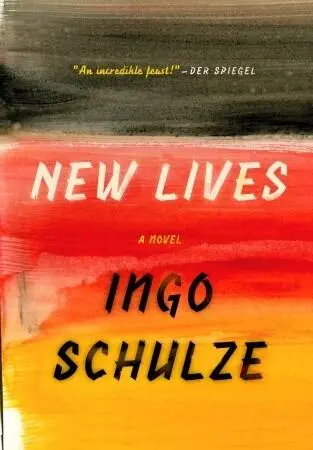
- Название:New Lives
- Автор:
- Издательство:Knopf
- Жанр:
- Год:2008
- ISBN:нет данных
- Рейтинг книги:4 / 5. Голосов: 1
-
Избранное:Добавить в избранное
- Отзывы:
-
Ваша оценка:
New Lives: краткое содержание, описание и аннотация
Предлагаем к чтению аннотацию, описание, краткое содержание или предисловие (зависит от того, что написал сам автор книги «New Lives»). Если вы не нашли необходимую информацию о книге — напишите в комментариях, мы постараемся отыскать её.
This upheaval in our hero’s life, mirrored in the vaster upheaval gripping Germany itself after the fall of the Berlin Wall and the birth pangs of a reunified nation, is captured in the letters Enrico writes to the three people he loves most: his sister, Vera; his childhood friend Johann; and Nicoletta, the unattainable woman of his dreams. As he discovers capitalism and reports on his adventures as a businessman, he peels away the layers of his previous existence, in the process creating the thing he has dreamed of for so long — the novel of his own life, in whose facets contemporary history is captured. Thus Enrico comes to embody all the questionable aspects not only of life in the old Germany, but of life in the Germany just taking form.
Once again Ingo Schulze proves himself a master storyteller, with an inimitable power to reconjure the complete insanity of this wildest time in postwar German history. As its comic chronicler, he unfurls a panorama of a world in transformation — and the birth of a new era.
New Lives — читать онлайн бесплатно полную книгу (весь текст) целиком
Ниже представлен текст книги, разбитый по страницам. Система сохранения места последней прочитанной страницы, позволяет с удобством читать онлайн бесплатно книгу «New Lives», без необходимости каждый раз заново искать на чём Вы остановились. Поставьте закладку, и сможете в любой момент перейти на страницу, на которой закончили чтение.
Интервал:
Закладка:
Instead of laughing in his face as Claudia Marcks had done, I thought of Nadja. And now I heard myself saying, “Why should I do that?”
Everyone joined in the laughter. Even Claudia Marcks and Antonio. Antonio said he admired the people who were pure intellect, people like me. It was hell.
Sometime long after midnight the assistant director asked if she and Antonio could spend the night in my quarters, the bed in the guest room was nice and wide, after all, and they had missed their train. Neither of the two slept a single minute.
Lying at the edge of a bed and having to listen to those two beside me seemed to me the perfect metaphor of my life as an outsider. Jonas had humiliated me before everyone, and tomorrow Antonio would tell him about this night. Wasn’t the reason I hadn’t defended myself that I was afraid of losing my position, my job as dramaturge? How life takes its revenge on you, I thought, when you want something else from it. My life was that of a storyteller. And for telling stories a man needs distance and a cold eye. How could I have forgotten that. 245

In the middle of June, a few days after Vera’s departure, I was back again in Altenburg. One more unpleasant experience — and what else was I supposed to expect from the theater? — and my desire to follow Vera would have been all the stronger.
The chief dramaturge handed me a small bright orange book, for which I had to give her a receipt. From bottom to top I read: Bibliothek Suhrkamp/Fräulein Julie/August Strindberg. I wouldn’t be staying in the guest room this time, but in the Wenzel. Flieder, the director, had not yet arrived.
That evening in the hotel I opened Vera’s imitation-leather silverware pouch, sorted the bills, laying them out in separate rows on the floor. At three thousand marks, more than my stipend for a whole year, I stopped counting.
From the bed I watched as the bills were caught up in a draft from the open window and began overlapping as if trying to couple, and finally I just closed my eyes and listened to their rustling. When I woke up the bills were strewn about the room, in one corner they had formed a little pile of leaves.
I showered, sat down at a breakfast setting in the restaurant, and, as the clock struck ten, headed off for the Lindenau Museum. After that I took a walk through town, circled the Great Pond, looked for the house of Gerhard Altenbourg, and had my noonday meal at the Ratskeller. Then I lay down in the park and read. In the evening I went to the movies. That was more or less how I spent the whole week.
My favorite pastime was to sit in the garden café beside the Great Pond and imagine I was with Vera somewhere on the Landwehr Canal in West Berlin, recovering from the interviews I had had to deal with all day.
That Friday I traveled to Dresden to see my mother. Despite my having announced my arrival, she wasn’t waiting for me at the station, nor was she at home. Nothing in the apartment indicated a welcome — no note, no stew in the refrigerator, my bed hadn’t even been made up.
When Mother arrived — after all, I ought to know she worked late sometimes — we spoke only about Vera. Vera should have left a lot sooner, Mother said, her path had been blocked from the start, she had been robbed of valuable years. I said that Vera had enjoyed her life and had learned more about the theater and read more books than I had at the university. How could I say that! That had all just been makeshift. Vera belonged in a drama school, they should have accepted her at the Deutsches Theater in Berlin. I hadn’t any idea of just how desperate Vera had been at times.
For supper Mother placed an unwrapped camembert on the table, I opened a tin of fish, the bread was stale. I felt miserable. This shabbiness toward both herself and me was something new.
I arrived late for Monday’s rehearsal discussion. It was a bad omen that Flieder likewise had a ponytail, even if it was just bound-up remnants of his wreath of hair and hung gray and scraggly over his collar. As was to be expected he didn’t turn to look at me when, after first knocking, I opened the door and took a seat at the table. As was also to be expected he had me repeat my name. Imagine my terror when I saw Claudia Marcks sitting at the table. She hadn’t been listed as a cast member.
“So this is our Enrico,” Flieder said, “Enrico will be helping us with everything here. At least I hope so. Good thing you’re here, Enrico.” No one laughed.
The only others at the table besides Claudia Marcks were Petrescu (Kristin, cook, thirty-five years old) and Max (Jean, servant, thirty years old). I also got a wave from Flieder’s young female assistant, a long drink of water with short hair, who was also the set designer and was perched on the arm of a chair off to one side, sipping at her Karo.
What followed was more like a seminar than a rehearsal. And I wasn’t prepared. It was just for me, or so it seemed, that Flieder went on at length about the book that he had left at the front gate for me, along with a note inside. As he paced back and forth, giggling every now and then, he began to look more and more like a faun or a satyr. His assistant repeated and augmented his comments, talked about behavioral research, squinting each time she took a drag on her cigarette.
At the noon break, Claudia Marcks took a seat beside me. “Do you know each other?” Flieder asked.
“Yes,” I said. Claudia Marcks looked at me. “Where from?”
“ Undine, the premier, the cast party, at this very same table.”
“Oh, please, no,” she cried. “I was so sloshed, so sloshed, oh please, I’m sorry.” And as if by way of apology she laid a hand on my forearm and asked almost anxiously if we had drunk to our friendship that night.
“Sad to say, no,” I replied, “but I would have been happy to.”
“Just call me Michaela,” she whispered. “Okay?”
“Happy to, Michaela,” I said, repeated my first name for her, and gazed at her gorgeous hand, still lying on my forearm.
Your Enrico T.
Thursday, May 17, ’90
Dear Nicoletta,
Before I tell you any more about Michaela, I need to insert something that happened in the summer of 1987, but that I didn’t mention to anyone, since it didn’t seem worth mentioning. And how was I supposed to understand it anyway?
Maybe in fact there is something in us beyond our conscious and unconscious mind, something akin to the sixth sense animals have that lets them register an earthquake or storm, long before we do. Should I call it instinct, or the power of premonition? Or simply a heightened sensitivity?
In August I had gone to Waldau for two weeks so that I could finally do some more work on my novella. One night I awoke and thought I heard a shot reverberating through the house, through the whole woods.
If it hadn’t been for the creaking of the bed I would have thought I was deaf. I snapped my fingers. Not a rustle, not a breeze, not a bird. I had broken into a sweat and knew that I wouldn’t go back to sleep.
Naked as a jaybird, I stepped out the door. Everything seemed frozen in place. With each little noise I made, silence closed in all the tighter. The more intensely I listened, the more impenetrable the hush, until finally I thought I could feel it above my head like some giant black block of stone.
I tried several times to take a deep breath, but my lungs felt only half full of the air I sucked down into them, as if I were several thousand meters above sea level. It didn’t help to sit down either. I felt a rippling, swirling sensation around my heart. I was amazed I didn’t panic. At least I could distinguish between the deep black of the trunks of the firs and the grayish darkness between them. I was on the verge of saying a prayer or humming a tune just to escape the silence, the hush. Suddenly it seemed incredible that I should be sitting all alone at night in a stock-still woods — the only restive thing in a mute world. I thought I might be dreaming or losing my mind. My own laughter gave me a fright.
Читать дальшеИнтервал:
Закладка:
Похожие книги на «New Lives»
Представляем Вашему вниманию похожие книги на «New Lives» списком для выбора. Мы отобрали схожую по названию и смыслу литературу в надежде предоставить читателям больше вариантов отыскать новые, интересные, ещё непрочитанные произведения.








Обсуждение, отзывы о книге «New Lives» и просто собственные мнения читателей. Оставьте ваши комментарии, напишите, что Вы думаете о произведении, его смысле или главных героях. Укажите что конкретно понравилось, а что нет, и почему Вы так считаете.