Ingo Schulze - New Lives
Здесь есть возможность читать онлайн «Ingo Schulze - New Lives» весь текст электронной книги совершенно бесплатно (целиком полную версию без сокращений). В некоторых случаях можно слушать аудио, скачать через торрент в формате fb2 и присутствует краткое содержание. Год выпуска: 2008, Издательство: Knopf, Жанр: Современная проза, на английском языке. Описание произведения, (предисловие) а так же отзывы посетителей доступны на портале библиотеки ЛибКат.
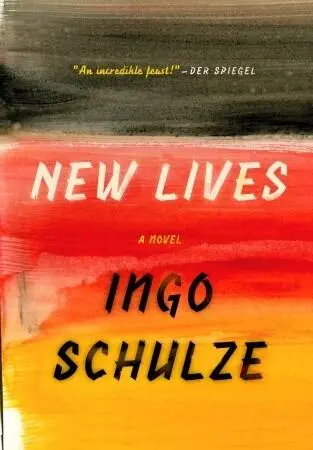
- Название:New Lives
- Автор:
- Издательство:Knopf
- Жанр:
- Год:2008
- ISBN:нет данных
- Рейтинг книги:4 / 5. Голосов: 1
-
Избранное:Добавить в избранное
- Отзывы:
-
Ваша оценка:
New Lives: краткое содержание, описание и аннотация
Предлагаем к чтению аннотацию, описание, краткое содержание или предисловие (зависит от того, что написал сам автор книги «New Lives»). Если вы не нашли необходимую информацию о книге — напишите в комментариях, мы постараемся отыскать её.
This upheaval in our hero’s life, mirrored in the vaster upheaval gripping Germany itself after the fall of the Berlin Wall and the birth pangs of a reunified nation, is captured in the letters Enrico writes to the three people he loves most: his sister, Vera; his childhood friend Johann; and Nicoletta, the unattainable woman of his dreams. As he discovers capitalism and reports on his adventures as a businessman, he peels away the layers of his previous existence, in the process creating the thing he has dreamed of for so long — the novel of his own life, in whose facets contemporary history is captured. Thus Enrico comes to embody all the questionable aspects not only of life in the old Germany, but of life in the Germany just taking form.
Once again Ingo Schulze proves himself a master storyteller, with an inimitable power to reconjure the complete insanity of this wildest time in postwar German history. As its comic chronicler, he unfurls a panorama of a world in transformation — and the birth of a new era.
New Lives — читать онлайн бесплатно полную книгу (весь текст) целиком
Ниже представлен текст книги, разбитый по страницам. Система сохранения места последней прочитанной страницы, позволяет с удобством читать онлайн бесплатно книгу «New Lives», без необходимости каждый раз заново искать на чём Вы остановились. Поставьте закладку, и сможете в любой момент перейти на страницу, на которой закончили чтение.
Интервал:
Закладка:
Freckles was staring at his notebook. The table was raked, no one had won — except me! Only me! I silently made fun of Freckles — go ahead and analyze, while I play. And when I’ve won yet again, you can mull it over and analyze what I’ve done some more. And on and on, to the end of our days!
My blue tower fell apart between the croupier’s fingers, all six jetons, I counted along with him — and received at last, along with two more blues, my Lipizzaner!
I would never have dared to dream of that white rectangle. If there is anything I regret it is only that I possessed my Lipizzaner for no more than two minutes. That’s all the time I needed to scrape up my little pile and head for the cashier without so much as a farewell.
I was too weak to wipe the sweat from my brow. Out in the lobby, somebody shouted something at me, a whole group of people burst into laughter. I was pale, my feet moved me with exaggerated precision toward my goal — I was seen as the epitome of the loser.
When I entered our room, Vera was holding her hand to her eyes, from the TV came screams. I disappeared into the bathroom, gagged and retched and fought for air — nothing.
I don’t know how I’ll survive the flight back. My third cup of tea is on its way. I’m still tortured by the idea that I could have failed at the crucial moment and not have bet all my winnings. 238If I had lost my nerve, I’d no longer be able to look at myself in the mirror. As you can see, I have stopped asking questions and have begun to understand.
Vera asked me to say hello for her. She’s insisting we be on our way.
Your Enrico
PS: As we walked out to get our taxi, John was sitting at the front desk again. He bowed, I extended my hand and slipped him a hundred in farewell. I saw immediately that I had not committed a faux pas.
Vera and I went our separate ways in Frankfurt am Main. She boarded a train for Berlin, I took the one for Leipzig. As soon as Vera has broken up her apartment in Berlin she’s coming to Altenburg for a few weeks. I gave her my winnings, and that was a great relief in the end.
Wednesday, May 16, ’90
Dear Nicoletta,
It really is strange. Now that I’m coming to the point in my narrative where I first met Michaela, we’re about to separate. Not one angry word has been spoken, that’s all well behind us. Robert says that he and I will still be together, that of course we’re a family — him, me, Michaela, and my mother — no matter what happens. “We are and always will be a family,” I promised.
Unlucky in love, lucky at cards. I did in fact win a few thousand, so there’s nothing standing in the way anymore of an excursion to Bamberg or Italy. 239So much for my present life.
If it hadn’t been for Anton I would never have ended up in the theater or in Altenburg, would never have met Michaela and Robert, would never have become a newspaper man — and we two would probably have just walked on past each other.
Anton wanted to become a dramaturge and move to Berlin. He pursued both goals with such unqualified zeal that he was willing to sacrifice everything else. Anton explained to me what all a “dramaturge” has to do. He wasn’t really looking for work as such, but for a comfortable position that would leave him plenty of time for his escapades.
In January ’87, six months before Vera’s departure, I sent applications to every theater in the country; there were circa forty (and if you didn’t find a job yourself, you ran the risk of the university assigning you to some library, museum, or publishing house). 240Four theaters invited me for an interview: Potsdam, Stendhal, Zeitz, and Altenburg. Not long thereafter I found a letter from Anton in my cubbyhole, which began very formally — so I took it for a joke. A few lines later, however, and I couldn’t believe my eyes. Since he, Anton, was leaving the entire country to me, he hoped I would in turn have the good grace to waive any claims to Berlin and Potsdam.
Vera raved about Altenburg’s Lindenau Museum and about how Gerhard Altenbourg lived there — and furze-faced Hilbig 241likewise came from Meuselwitz, a town just a few miles away. Besides which, the town had survived the war practically unscathed.
And so I traveled to Altenburg, and after only ten minutes the general manager (a long-haired man in his late thirties, who wore his shirt open halfway to his navel) informed me that I would be hired — providing I passed my internship — turning my first walk through town into a tour of the arena where my real life was to begin.
It was snowing. The approach to the castle lay in spotless white before me. I had a headache from all the excitement and because of my spare pair of glasses, which had a different prescription from my regular pair (Vera had them on her conscience). Snowflakes big as postage stamps were falling faster and faster with every step I took. When I turned around and looked down as if through a veil to the theater below me and to the town rising off to the west, I could scarcely see my own footprints.
After a circuit of the castle courtyard (this was before the fire), I walked to the park, whose paths were now discernable only because they lay between rows of benches. At the foot of the hill, but removed into the distance by the drifting snow, stood the Lindenau Museum. All I knew about it were illustrations of its vases from antiquity. I don’t need to describe to you what happens when, having climbed the stairs and stridden across the octagon, you enter that suite of rooms hung with Italian paintings. I knew almost nothing about the Sienese, and very little about the Florentines, 242and yet I felt I had arrived. Perhaps you’re thinking that I’m just mouthing your words. 243But just as some people suffer when they must do without the Elbe or the sea, I would never be able to move to a place if I knew there wasn’t such a treasure somewhere nearby.
The great collections in Dresden, Prague, Lódź, Budapest, or Leningrad lack a certain serenity. Here, however, you are alone with each painting. Even the guards remain hidden and you are reminded of them at most by a distant creaking of floorboards. I was already in Italy here. It was here that I understood that the best of the Renaissance comes from the pre-Renaissance. Here I could let pass in review the two hundred years so decisive not only for Italian art, but also for the intellectual spirit of all of Europe. 244
To this day the same paintings that I took into my heart that afternoon have remained my favorites. Of course the three Guido da Sienas, Man of Sorrow by Lorenzetti, the Madonna by Lippo Memmi, the Adoration by Taddeo di Bartolo, the crucifixions by Giovanni di Paoli, everything by him really and by Lorenzo Monaco, and of course Masaccio; but I’m almost even fonder of Fra Angelico’s St. Francis’ Trial by Fire, with its skeptical sultan on his throne, but also his saints, plus the St. Jerome by Lippi, Botticelli’s stern St. Katherine, Signorelli’s artistic torturers, the Madonnas in his Internment, the Annunciation by Barnaba da Moden, Puccinelli’s Madonna with its angels and saints, and the joy of the one to whom the baby Jesus has turned his face.
As I left the museum a bluish red patch of late-afternoon sky shone bright above me.
Three weeks later I passed through the theater’s portals with a nod of my head, managed to catch the grated door before it closed behind a dancer in her warm-up outfit — and froze at the sound of a shrill “Halt!” The gatekeeper had jumped up and was pressing her forehead to the pane of her booth. Called to account as to who I was and where I was headed, I finally answered with “Hoffmann! Undine !”
“Step back! All the way back!” My shoulder bag and I were blocking the way for others. I was told to explain why I had tried to “break into” the theater. When I asked her to call the general manager, she laughed, grabbed the telephone receiver, and took her eye off me only long enough to jab a finger into the dial. With each new arrival she again asked me to give my name. I was forced to shout “Enrico Türmer” several times, and to repeat it a little louder, “if you please,” to spell the two words — so that every newcomer had learned the name of this stupid young fellow at the gate before I even got inside the theater. “Do you know a Türmer, Enrico maybe?”—or in her dialect: Dürmer, Ähnreegoh. That indefinite article before my name obliterated me.
Читать дальшеИнтервал:
Закладка:
Похожие книги на «New Lives»
Представляем Вашему вниманию похожие книги на «New Lives» списком для выбора. Мы отобрали схожую по названию и смыслу литературу в надежде предоставить читателям больше вариантов отыскать новые, интересные, ещё непрочитанные произведения.







Обсуждение, отзывы о книге «New Lives» и просто собственные мнения читателей. Оставьте ваши комментарии, напишите, что Вы думаете о произведении, его смысле или главных героях. Укажите что конкретно понравилось, а что нет, и почему Вы так считаете.