Wolfgang Hilbig - 'I'
Здесь есть возможность читать онлайн «Wolfgang Hilbig - 'I'» весь текст электронной книги совершенно бесплатно (целиком полную версию без сокращений). В некоторых случаях можно слушать аудио, скачать через торрент в формате fb2 и присутствует краткое содержание. Год выпуска: 2015, Издательство: Seagull Books, Жанр: Современная проза, на английском языке. Описание произведения, (предисловие) а так же отзывы посетителей доступны на портале библиотеки ЛибКат.
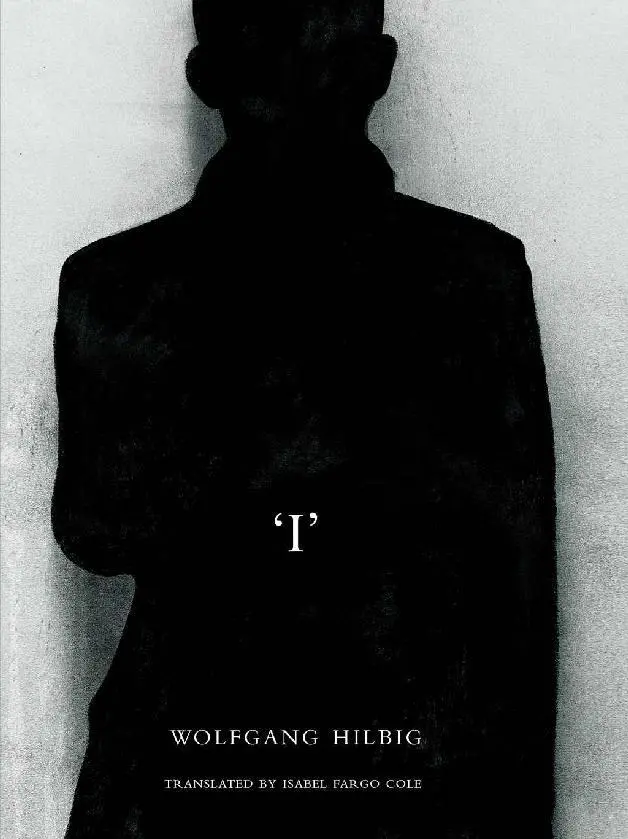
- Название:'I'
- Автор:
- Издательство:Seagull Books
- Жанр:
- Год:2015
- ISBN:нет данных
- Рейтинг книги:4 / 5. Голосов: 1
-
Избранное:Добавить в избранное
- Отзывы:
-
Ваша оценка:
'I': краткое содержание, описание и аннотация
Предлагаем к чтению аннотацию, описание, краткое содержание или предисловие (зависит от того, что написал сам автор книги «'I'»). Если вы не нашли необходимую информацию о книге — напишите в комментариях, мы постараемся отыскать её.
introduces us to W, a mere hanger-on in East Berlin’s postmodern underground literary scene. All is not as it appears, though, as W is actually a Stasi informant who reports to the mercurial David Bowie lookalike, Major Feuerbach. But are political secrets all that W is seeking in the underground labyrinth of Berlin? In fact, what W really desires are his own lost memories, the self undone by surveillance: his ‘I.’
First published in Germany in 1993 and hailed as an instant classic,
is a black comedy about state power and the seductions of surveillance. Its penetrating vision seems especially relevant today in our world of cameras on every train, bus, and corner. This is an engrossing read, available now for the first time in English.
“[Hilbig writes as] Edgar Allan Poe could have written if he had been born in Communist East Germany.”—
'I' — читать онлайн бесплатно полную книгу (весь текст) целиком
Ниже представлен текст книги, разбитый по страницам. Система сохранения места последней прочитанной страницы, позволяет с удобством читать онлайн бесплатно книгу «'I'», без необходимости каждый раз заново искать на чём Вы остановились. Поставьте закладку, и сможете в любой момент перейти на страницу, на которой закончили чтение.
Интервал:
Закладка:
He stepped into the room; it had been cleaned, the cloying smell of floor polish stung his nostrils, at the foot of the cot was a stack of folded bedclothes, seeming to shine faintly in the darkness. He recognized them, the legacy of negligent REWATEX laundry customers. Suddenly it seemed too much to expect him to wander down Frankfurter Allee, to stop at a stinking cafe there, to head for the flat that was not his own, since Feuerbach could come in at any moment, in most cases without ringing. . he decided to spend the next few days here in Frau Falbe’s room. He sat in the red armchair, staring into the darkness of the tiny, still quite cold room. . over the coming weeks it could only get warmer.
On one of the following days he woke up late in the afternoon, which hadn’t happened to him for a long time. . the previous evening had almost completely vanished from his memory; it was a long time, too, since he’d treated himself to a pub session as protracted as yesterday’s. . the eternal sitting around in the cafe on Frankfurter couldn’t be described as such. — Frau Falbe was in the room, and embarrassed about it, as he thought he could tell when he peered through lids he opened with an effort. He had been woken by the rattle of the blind as she raised it; outside was bright daylight, though at this time of day his window was on the dark side of the house. Yet the street was filled with the reflection of a powerful glare blindingly intensified by the windows of the houses across the way. For a moment he thought he’d overslept his shift at the laundry. . with Frau Falbe’s help this had practically never happened. He turned towards her under the blanket, she pointed to the pot of coffee on the desk. . You must have had an awful lot to drink last night, she said. — He stood up, walked past her to the toilet without a word, when he came back the coffee was already poured. . it was just as always.
All this conspired to make him forget the whole last stretch of time. . the last weeks, months, the last year, the last two years — if it was that many already. Here every last detail was unchanged, all at once it cost him a vast effort to think of the past year and a half (or the past two and a half years?), it was as though this time had passed in his imagination only, as though all his memories of it could be extracted only from a fairly bizarre, not to say perverted realm of his imagination. . and it seemed to him that he’d come here to immediately tackle this task. Nothing in the past two or three years admitted the conclusion that he’d lived his own life. . he had done nothing on his own initiative! And all the possible explanations for what he’d done with the time of his last two or three years came not from his reason. . they were not products of any reasoning by W. — they had been devised by experts.
Only gradually did he feel a certain amazement that it had all turned out as it had; he didn’t know how he could have articulated it. . Frau Falbe seemed to waste no thoughts on the time that had passed, not at the moment, anyway; she seamlessly resumed the days spent with her lodger, and poured coffee. As always, as though it had been this way only yesterday, he sat across from her in his pyjamas — she didn’t seem to notice — audibly slurping the scalding beverage, as always with slightly trembling hands, not producing a word until he’d taken a few drags on his first cigarette. This detail seemed as habitual to her as the gesture with which she took herself a cigarette from his pack, lying open on the table, and lit it. — Just to keep you company! was her formulaic excuse, recycled daily. She smoked two or three a day, only with W., who a year and a half ago had told her to help herself whenever she liked from the opened packs he had lying around everywhere. After finishing her cup of coffee she asked if she should go. . all one summer and all one autumn she had asked him that almost every day, in the same tone of voice, when she finished her cigarette at three-thirty in the morning, and every day the question had startled him, as it did now, and there was regret in his eyes, which she took as confirmation, though he remained mute.
At the door she turned around again: You know, that really spooked me recently when you showed up here again. Because Harry told me you sometimes go around with that guy who was here and questioned me. And now that he’s seen you with this guy he never stays in Berlin for long. You know the one I mean, the slick one who’s always acting so polite, Wasserstein’s his name. . You know him pretty darn well! — And now you’re not suspicious any more? asked W. — He’s a snitch, you can tell that a mile away. . she said, shaking her head. But now I saw right off how tired you are. I saw the way you were sleeping, I thought you’d never wake up again. He must be totally done for, I thought, what on earth have they done to him, I asked myself.—W. gave a startled nod, and Frau Falbe went on: First off, you’ve really got to get a good night’s sleep. And then come and see me. Or I’ll come down to you, I have to tell you something about that guy. Just so you know who you’re dealing with. .
He had plenty of time, and he was rested, he’d replied; if she liked, he’d come up and see her that evening. — Then, avid and urgent, he downed the entire pot of coffee to finally wake himself up, and left the house to shop for the bare necessities. It was quite a warm April day; suddenly his nervousness was shed, he walked through the provincial-seeming neighbourhood, which had no hint of the cramped big city, and had no trouble whatsoever recognizing the whole environment in which two years ago he had still moved as though on call — pestered by Feuerbach to move away again. . and clearly, in his heart of hearts, eagerly awaiting the Firm’s commands — only now, it seemed, had he truly arrived here, the next winter was still far off, and he couldn’t let himself think about it. — He’d meant to buy a bottle of wine for the evening at Frau Falbe’s, but hadn’t found anything drinkable, only some insultingly sweet purplish stuff. Back in his room he’d begun reading his manuscripts, and lost himself in them. . starting up now and then because he thought he heard the doorbell. The manuscripts struck him as incoherent, and yet unpleasantly transparent. In each text, amid the elusive, sometimes cryptic strings of words, he seemed to detect extremely telltale formulae — precisely because they were exquisitely encrypted: for a reader with even the slightest clue about his double life, it would have been virtually impossible to misinterpret these passages. And then, it seemed to him, these constructions had to immediately become the centre of gravity for all his poems. . yes, you could have pulled out these phrases and listed them one after the other, and suddenly they would have become intelligible of themselves: they were a jumble of accusations against an anonymous, secret power, and, that was the worst of it, they were supposed to arouse pity. . yes, these were pitiful testimonies to a profound resignation . . whoever had written them was too gutless to express himself openly, and had already reconciled himself to his gutlessness. — He’d have to start rewriting this very minute, expunging the telltale words! he thought, pale and streaming with a sudden sweat; at that moment a knock came at his window from outside. He looked up, the room blurring in the nausea that overcame him. . he recalled his old quirk of never opening the door right away when it rang, but waiting first instead: reading his old work — some of it written two years ago, here in this very room — had immediately reactivated this mechanism. — Frau Falbe waved at him from the window; he was sitting in the light, the blind still raised.
You’ve got the key, you can come in, he said as he admitted her. He didn’t like going to the door when the bell rang, he said, since the room was supposed to be a hideout. — I can imagine who you’re hiding out from, she said. I’d like to hide from him myself. But can’t he find out where you are? — I hope not, said W., you’re the only person who knows about my hideout! — Good! she said, and that’s how it’ll stay, no one’ll learn anything from me, that’s for sure. It’s a good thing I know. . and you’re not registered here any more either. I was going to tell you a few things about Harry, but I can tell it’s not a good time for you. .
Читать дальшеИнтервал:
Закладка:
Похожие книги на «'I'»
Представляем Вашему вниманию похожие книги на «'I'» списком для выбора. Мы отобрали схожую по названию и смыслу литературу в надежде предоставить читателям больше вариантов отыскать новые, интересные, ещё непрочитанные произведения.










Обсуждение, отзывы о книге «'I'» и просто собственные мнения читателей. Оставьте ваши комментарии, напишите, что Вы думаете о произведении, его смысле или главных героях. Укажите что конкретно понравилось, а что нет, и почему Вы так считаете.