Wolfgang Hilbig - 'I'
Здесь есть возможность читать онлайн «Wolfgang Hilbig - 'I'» весь текст электронной книги совершенно бесплатно (целиком полную версию без сокращений). В некоторых случаях можно слушать аудио, скачать через торрент в формате fb2 и присутствует краткое содержание. Год выпуска: 2015, Издательство: Seagull Books, Жанр: Современная проза, на английском языке. Описание произведения, (предисловие) а так же отзывы посетителей доступны на портале библиотеки ЛибКат.
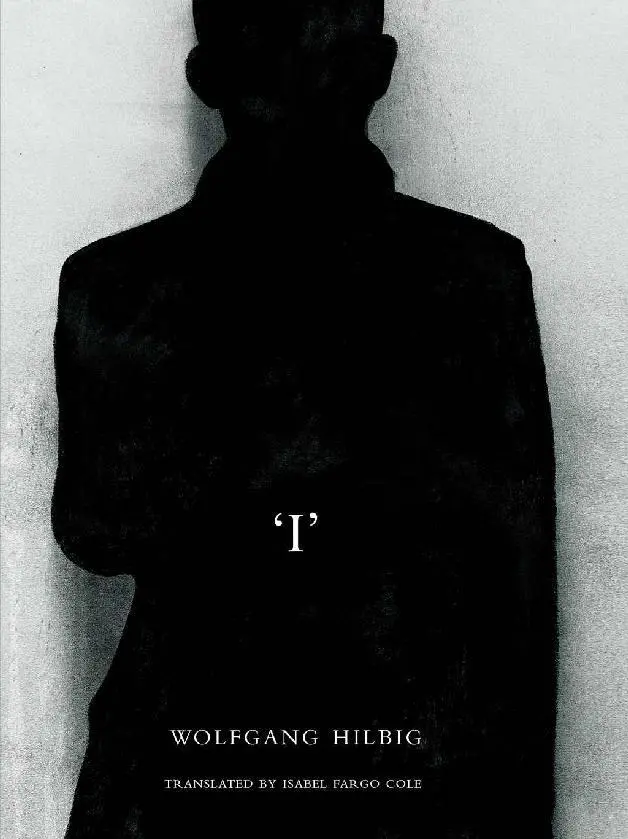
- Название:'I'
- Автор:
- Издательство:Seagull Books
- Жанр:
- Год:2015
- ISBN:нет данных
- Рейтинг книги:4 / 5. Голосов: 1
-
Избранное:Добавить в избранное
- Отзывы:
-
Ваша оценка:
'I': краткое содержание, описание и аннотация
Предлагаем к чтению аннотацию, описание, краткое содержание или предисловие (зависит от того, что написал сам автор книги «'I'»). Если вы не нашли необходимую информацию о книге — напишите в комментариях, мы постараемся отыскать её.
introduces us to W, a mere hanger-on in East Berlin’s postmodern underground literary scene. All is not as it appears, though, as W is actually a Stasi informant who reports to the mercurial David Bowie lookalike, Major Feuerbach. But are political secrets all that W is seeking in the underground labyrinth of Berlin? In fact, what W really desires are his own lost memories, the self undone by surveillance: his ‘I.’
First published in Germany in 1993 and hailed as an instant classic,
is a black comedy about state power and the seductions of surveillance. Its penetrating vision seems especially relevant today in our world of cameras on every train, bus, and corner. This is an engrossing read, available now for the first time in English.
“[Hilbig writes as] Edgar Allan Poe could have written if he had been born in Communist East Germany.”—
'I' — читать онлайн бесплатно полную книгу (весь текст) целиком
Ниже представлен текст книги, разбитый по страницам. Система сохранения места последней прочитанной страницы, позволяет с удобством читать онлайн бесплатно книгу «'I'», без необходимости каждый раз заново искать на чём Вы остановились. Поставьте закладку, и сможете в любой момент перейти на страницу, на которой закончили чтение.
Интервал:
Закладка:
But one time W. did open the door, and a different person stood outside in the stairwell, rather lost, hovering indecisively near the switch for the timed light. — Sorry , the person said, using the English word, I don’t think you’re the person I wanted. . or are you? — The last part of the question was spoken into the darkness, since the light in the corridor had just gone out; there was no way the visitor could have had another look at him, W. thought, and behind him was nothing but the weak glow of his desk lamp. . Who are you looking for? he asked. — At short intervals a cigarette could be seen flaring up in the darkness, pulled at hastily and audibly; he smelt the smoke, it had to be a very odd, foul-smelling brand, or a cheap cigar exuding acrid, almost sulphurous fumes. . the embers fell to the ground and were trodden out with a crunching sound. — Maybe you have some idea, the other said, whether a certain Harry Falbe lives here?
The visitor made no move to press the button for the light, remaining instead in the dark. — No, said W., he doesn’t live here. And I’m certainly not him. — Do you know him? the person said. — I said no, W. returned, I don’t know him. And who are you, are you from the registration office? — At that he finally turned on the stairwell light; the other man squinted, seemed surprised by the brightness. . From the registration office? He gave a short laugh. No, not that, but maybe we’re something along those lines. Why do you ask, do you need a new flat?
Of course W. knew the man meant his old friend Harry from A., but the last name had thrown him off; the woman who’d rented the room to him had the same name. . and it wasn’t the first time he’d seen the man standing in front of him; once before. . or even several times he’d run into him in the stairwell; he had looked just as helpless, as though he’d mixed up the address (a behaviour that struck him as familiar); and W. thought he’d even seen him coming down the stairs one time. — No, said W., Harry Falbe. . is that what you said? I’ve never heard the name before. — That’s right, you don’t hear it very often! the person said — by now he’d lost his hesitancy, taking two or three long strides forward and glancing at the spot on W.’s front door where a name plate is usually mounted; there was no plate on W.’s door; then he peered — just as coolly and brazenly, W. felt — past the doorframe into the room. . How can anyone stand living in a dump like that! he said.
W. hadn’t even thought of disclosing to the gentleman that a few steps up, on the first floor, there lived a woman who also answered to the name of Falbe . . of course that was completely immaterial, because he knew it anyway. Soon he was running into this person more frequently, repeatedly in the stairwell (and soon he’d introduced himself: Sorry . . Feuerbach!), and more and more often the man dragged him into conversations about flat-related issues; he regarded W.’s room as absolutely uninhabitable, which he kept saying until W. asked: Do you have something else to offer, and what’s the price?
It seemed there was an accommodation in reserve for him, much closer to the city centre, which he could move into immediately. . that place wasn’t anything special either, but still (and it was much closer to the city’s real centre). Two and a half rooms, and at least there was an indoor toilet, he wouldn’t have to go piss between the ashcans in the yard. And if necessary he could even have the rooms rent-free. .
A company flat, then. . it irked W. that he hadn’t asked this question. This exquisitely casual civilian (only later did W. learn the military title in front of his name) had given a barely noticeable shudder as he glanced about W.’s four walls, tarred with the sticky residue of countless cigarettes. . And if you accept my proposal, we’ll have to find a solution for the renovation costs here, he’d added. — He goes around acting like a landlord, thought W.; and then he recalled the small-town boss: he’d also tended to regard his entire surroundings with the appraising gaze of a property owner.
So far W. had dodged the question of a possible move. . in his own mind he postponed it to the following winter, but he didn’t tell that to the gentleman yet. Also, his relationship with the landlady, previously rather tense, had sorted itself out — when he’d handed over the second rent payment (again for a quarter of a year, plus the cleaning costs for the stairwell), she complained that he still hadn’t gone to the registration office. He kept putting off his registration, and avoided her. . one day, when he failed to react to her ring, she unlocked the door (of course she had the spare key), stuck her head in and called: Are you still alive in there? You don’t need to hide from me any more now that the registration is taken care of! And you’ve absolutely got to ventilate more!
W. seemed subjected now to a certain solicitude, especially when shortly thereafter he found pots of leftovers by his threshold; something, he didn’t know what, had aroused the nurturing instinct in this woman. . who couldn’t be all that old, incidentally!—W. waited till night, then dumped the food into the garbage bin and tossed news-papers over it; he washed the pots and set them back out on the stairs. The very next day he found them filled again. . it occurred to W. that she was competing with this Feuerbach, but how could she have learnt that he’d offered W. a flat? — You don’t need to wash the dishes, she called to him through the door. Just put them back out! — And a little later she caught him as he was coming in from the street and held out a frying pan with a breaded cutlet sizzling in butter. . Feel free to tell me what to cook. . Harry, the guy who lived here first, he always ate with me. . aren’t you from that same town down south? Go ahead, take it, you always pay me much too much rent. — Very kind of you, Frau Falbe, said W., and took the opportunity to tell her that unfortunately he’d have to move out soon. — Yeah, yeah, she replied, I know, you’re just like Harry, he was always moving out again too. Besides, it’s really no room for a grown man!
Hardly had he taken the cutlet into the flat when she rang and brought a plate brimful of fried potatoes; W. thanked her and asked whether Harry, his predecessor, was perhaps a relative of hers. — A relative, no, said the woman. Didn’t you know Harry doesn’t have any relatives? He’s an orphan. . from a home. He doesn’t even know his real last name, and he put my name on the registration.—W. was astonished at how lax the formalities were at Berlin’s registration offices, if the woman wasn’t misinformed. . but the whole thing was neither here nor there. — After consuming the cutlet and the fried potatoes he felt the scarcely unpleasant, swiftly subsiding nausea with which his atrophied stomach reacted to the shock of an unaccustomed, copious warm meal; then a sense of long-lacking well-being set in — from that day on he devoured Frau Falbe’s rations; delighted, she began cooking with redoubled zeal. — One day she stuck her head in again and announced that she’d set aside money for him. . You’ve always paid me too much rent. Just let me know when you need it, I always gave Harry a bit of money too. — I’d rather buy your armchair, he said. I’d like to take it with me when I move, I’ve gotten used to it. But at that she shook her head: I don’t think I can do that, actually that’s my husband’s armchair.
Why shouldn’t he stay as long as possible, why shouldn’t he keep letting his landlady feed him? For over a month, for nearly two months he’d eaten nothing but cold, rancidly shimmering tinned goods, the contents of cans, brownish jelly and stale, ivory-coloured fat hiding an over-salted kernel of meat, minced to the point of greatest possible undefinability. . fearing he’d end up completely emaciated, propped in the armchair like a toothpick (like his old friend Harry), he’d made up for it with huge quantities of beer. Suddenly he’d won Frau Falbe’s increasingly forthright affections, he was being fed, almost overfed, he was even being offered financial assistance. . so why shouldn’t he wait until winter expelled him from the room the natural way, as it were? Wasn’t this the sort of life people pictured as a quasi-artistic existence. . the ineradicable common wisdom being naive enough to regard this as disreputable, but at the same time indulge it in the literati?
Читать дальшеИнтервал:
Закладка:
Похожие книги на «'I'»
Представляем Вашему вниманию похожие книги на «'I'» списком для выбора. Мы отобрали схожую по названию и смыслу литературу в надежде предоставить читателям больше вариантов отыскать новые, интересные, ещё непрочитанные произведения.












Обсуждение, отзывы о книге «'I'» и просто собственные мнения читателей. Оставьте ваши комментарии, напишите, что Вы думаете о произведении, его смысле или главных героях. Укажите что конкретно понравилось, а что нет, и почему Вы так считаете.