Wolfgang Hilbig - 'I'
Здесь есть возможность читать онлайн «Wolfgang Hilbig - 'I'» весь текст электронной книги совершенно бесплатно (целиком полную версию без сокращений). В некоторых случаях можно слушать аудио, скачать через торрент в формате fb2 и присутствует краткое содержание. Год выпуска: 2015, Издательство: Seagull Books, Жанр: Современная проза, на английском языке. Описание произведения, (предисловие) а так же отзывы посетителей доступны на портале библиотеки ЛибКат.
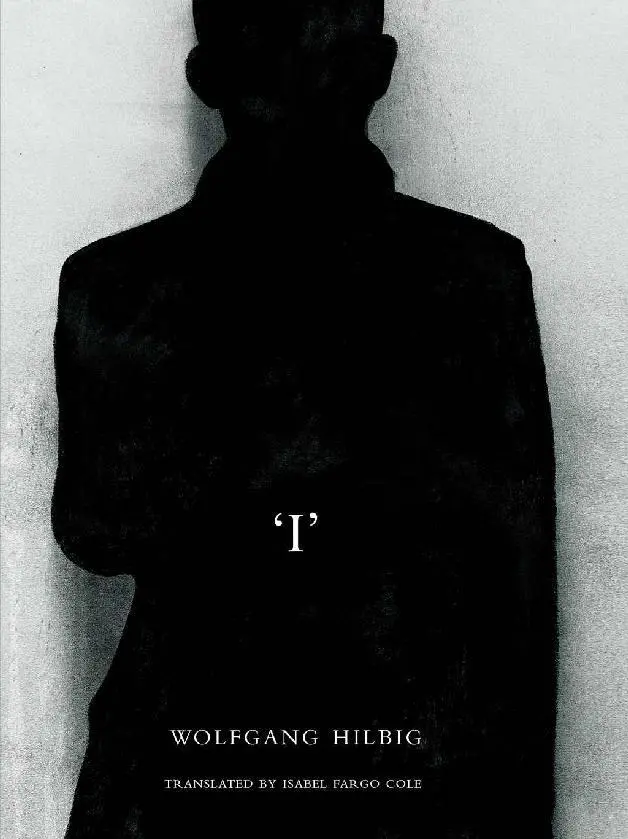
- Название:'I'
- Автор:
- Издательство:Seagull Books
- Жанр:
- Год:2015
- ISBN:нет данных
- Рейтинг книги:4 / 5. Голосов: 1
-
Избранное:Добавить в избранное
- Отзывы:
-
Ваша оценка:
'I': краткое содержание, описание и аннотация
Предлагаем к чтению аннотацию, описание, краткое содержание или предисловие (зависит от того, что написал сам автор книги «'I'»). Если вы не нашли необходимую информацию о книге — напишите в комментариях, мы постараемся отыскать её.
introduces us to W, a mere hanger-on in East Berlin’s postmodern underground literary scene. All is not as it appears, though, as W is actually a Stasi informant who reports to the mercurial David Bowie lookalike, Major Feuerbach. But are political secrets all that W is seeking in the underground labyrinth of Berlin? In fact, what W really desires are his own lost memories, the self undone by surveillance: his ‘I.’
First published in Germany in 1993 and hailed as an instant classic,
is a black comedy about state power and the seductions of surveillance. Its penetrating vision seems especially relevant today in our world of cameras on every train, bus, and corner. This is an engrossing read, available now for the first time in English.
“[Hilbig writes as] Edgar Allan Poe could have written if he had been born in Communist East Germany.”—
'I' — читать онлайн бесплатно полную книгу (весь текст) целиком
Ниже представлен текст книги, разбитый по страницам. Система сохранения места последней прочитанной страницы, позволяет с удобством читать онлайн бесплатно книгу «'I'», без необходимости каждый раз заново искать на чём Вы остановились. Поставьте закладку, и сможете в любой момент перейти на страницу, на которой закончили чтение.
Интервал:
Закладка:
Perhaps that was the moment when his sleep phase began; he didn’t know, and probably it was irrelevant, being the moment from which all notions of time became blurred. The beginning had come some time that winter; perhaps it was that the summons ceased to contain anything by way of a date, and that he met the breezy gentleman in the buff suede jacket — he knew by now that this gentleman was the boss — only on the streets of town now, apparently by accident. — In this time W. wrote with an intensity he’d never known before, poems and short, one- to two-page prose miniatures, particles that sprang from his pen when he was in a sort of half-sleep, or in moments of resistance, when some unknown thing within rebelled against the torpor that otherwise gripped him. It really was a thing unknown to him, he no longer had a word for it, the rebellion within him was a relic from the time when he’d lived without this sleep. And indeed all day long he barely sensed himself, his mother nearly always found him in a state of collapse, in a sitting position at the kitchen table, his forehead resting on his lower arms, before his closed eyes the scribbled pages on which the words were little more than runaway horizontal lines. She slipped past behind him, wringing her hands; sometimes he started up and scared her off with an alien, barking voice, with cries he himself no longer understood.
At work he was a pale, bleary-eyed figure, unpunctual, unreliable, not to be trusted with the simplest of tasks; and yet fractious, stand-offish, full of a strained, hypersensitive aggression which called to mind a perpetually angered insect. The foreman avoided saying a single unnecessary word to him; a worker like this was clearly one the old man would rather be rid of, and he soon banished him to the boiler room for good.
The sleep phase — as W. had decided to call these weeks and months; he recalled them with horror — was a time in which he didn’t seem to sleep at all. All he remembered about that winter was the sense that his brain was being sucked empty, down to the last stale dregs, down to the most necessary functions which just barely enabled his survival; and it was a time in which a great coldness grew within him. . and perhaps this had hardened him up for his nocturnal paths through Berlin’s frost.
The winter that year — his last year in the town — was long, icy and dry, almost entirely snowless. Permanent, dense, piercingly cold fog filled the streets, saturated with the sulphurous fumes of poorly burning coal; this oppressive, inert atmosphere had the entire town in its stranglehold. The streets came to life for just a few hours late in the afternoon, after the factories shut down. Then, around the marketplace, the eerily lit town centre filled with bundled-up pedestrians hastily running the most vital shopping errands, and with a multitude of crawling, smoke-spewing cars whose criss-crossing headlights tore to pieces the hurried melee in which all were in solitary, senseless flight. At any rate the quantities of food in town seemed sufficient, albeit with no variety whatsoever in the offerings, so that at least there were no shopping queues. When W. returned from his errands, he had the town’s taste upon his mucous membranes and its bitterness in his lungs; it was as though the air and the fog between the houses were filling irreversibly with toxins. . but perhaps, he thought, it was partly due to the quality of the coal he was forced to burn at work. It more resembled an earthen sludge, once wet, now frozen hard, mingled with sand and clumps of grass, barely describable as fuel any more. No doubt the excavator claws were scraping the very last remnants from the deposits, coal that didn’t burn, but stewed and smouldered. And the smell it emitted sank down into the streets, ochre and leaden, and even the daylight could barely penetrate this haze. Once the grocery stores closed at 6 p.m., the town went dead; in the space of half an hour silence fell amid the houses, which seemed all at once, all at the same time, to be bolted and barred, as though the town had been warned of a hostile invasion. For budgetary reasons, street lighting in the town centre had been reduced to a minimum; mute, huddled together, the buildings seemed to await a gigantic blow that would smash everything to pieces. . and indeed it was a state of siege that kept it in suspense, winter’s siege; some time in December the mercury columns had plummeted and remained alarmingly low, as though frozen in place. — When the town came to life again early in the morning, when the light blazed up behind the factory windows, W. saw the workers hurrying towards the factory, bundled up, arms wrapped around their bodies, heads ducked, . it was one of those moments he’d always found poetic . — He himself had stopped going to the factory, one day he’d just let it be. . one morning he’d woken up at the kitchen table, already an hour late; his mother hadn’t been able to wake him, or she’d thought he had a different shift. . he’d gone to the window and gazed out at the crippled town; it was dark still, and suddenly the town had seemed subterranean, buried and choked. He’d had to jot that down, and as he did time passed imperceptibly. . at the factory they’d been at work a long time now without him. . he could see the workers coming into the barely heated production halls early in the morning and making their cynical remarks: Just five inches of snow, and we can put the country up for sale! — Sure, they said, but there won’t be any takers. — And so they carried on. . and the snow didn’t come; it looked as though the country would last out the winter. .
W. was happy not to meet anyone in town who wanted to talk to him. He had the impression that people had begun avoiding him in public as well; an industrial plant as large as the one that had employed him held a certain sway over the public, and the opinions that formed among the workers soon found their way into town as well. If someone did talk to him, he hastened to assert that he was planning to move to Leipzig. . and immediately afterwards he generally forgot whom he had just met: it was time to be careful what he said! — In the town’s half-light he met the breezy gentleman in the suede jacket, the boss, who stopped and greeted him. — How can you go walking around in this toxic stuff? said W., pointing upward. . It’s not much better in Leipzig, either! the retort came after him. Or he’d simply walk past as though he hadn’t noticed him, the boss opened his mouth, but it was as though the frost wouldn’t let his voice out. . all the same, soon afterwards W. was no longer sure whether they hadn’t had a brief conversation. — At a grocery store, buying the last kilo of potatoes, he met the boss’ assistant in the green anorak, leaning on the counter and drinking a bottle of beer. Impulsively W. asked for a bottle of beer too (perhaps hoping to learn from the green guy what they thought about his moving to Leipzig). . Sorry, takeaway only! the green guy replied in the store clerk’s stead. It’s closing time already! — So he was pretending not to know W. at all; but W. recognized the same uncertain flicker of the eyes with which the lanky guy, it must have been months ago, had once leant on his doorjamb. It was, in fact, three before six; W. left without the beer and wandered with the bag of potatoes in his gloved fist through streets that were emptying of pedestrians, an exodus, it seemed to him. — That was it, then, the sleep phase, he walked around town like a ghost, people looked straight through him. . there was one incident, as though not all forms of reality had yet faded from the life of this town: he ran into Cindy, stopped her and said that he wanted to give her the watch back. — The watch? Why give it back. .? she said. No, he should go ahead and keep it, he’d be sure to need it. And if not, then for old time’s sake. — Harry had given him the watch as a pledge when he couldn’t pay up after a game of dice at the pub. . It’s Cindy’s watch, he’d said, it’s yours until I’ve got money again. — He last saw Cindy in the coldest, most unendurable phase of that winter, in the fuzzy, ferrous daylight, pushing an old-fashioned pram on softly squeaking wheels. She tried to hurry past him but he asked her how the baby was doing. — And you don’t care how I’m doing? she retorted. — Their brief talk was almost a talk between strangers, but it seemed to him that her voice throbbed with suppressed hatred. . How should he be doing, she said, maybe bad, . maybe he doesn’t even notice any more! — And she nodded in the direction of the pram; beneath the plastic tarp, patched and stuck together with filthy bits of sticking plaster, it was eerily silent. W. had taken her words for one of the coarse jokes one had to reckon with in Cindy’s circles. — Is your son sick? asked W., looking at the tiny bundle in the carriage, completely motionless beneath the recklessly thin blankets. — Sick or dead, as if it was yours, Cindy said spitefully. And after a while: It’s a crying shame to make a baby for a country like this! Making a baby in this country. . that’s something you can never, ever put right. — She said it in a strangely clear voice; W. was relieved that her anger had found another target: Why don’t you apply to emigrate?3—We have a chance at getting a flat in Berlin. Then maybe we’ll be a bit better off. .—W. announced that he was also planning to move away. . I’d rather go to Leipzig, though!
Читать дальшеИнтервал:
Закладка:
Похожие книги на «'I'»
Представляем Вашему вниманию похожие книги на «'I'» списком для выбора. Мы отобрали схожую по названию и смыслу литературу в надежде предоставить читателям больше вариантов отыскать новые, интересные, ещё непрочитанные произведения.




Обсуждение, отзывы о книге «'I'» и просто собственные мнения читателей. Оставьте ваши комментарии, напишите, что Вы думаете о произведении, его смысле или главных героях. Укажите что конкретно понравилось, а что нет, и почему Вы так считаете.