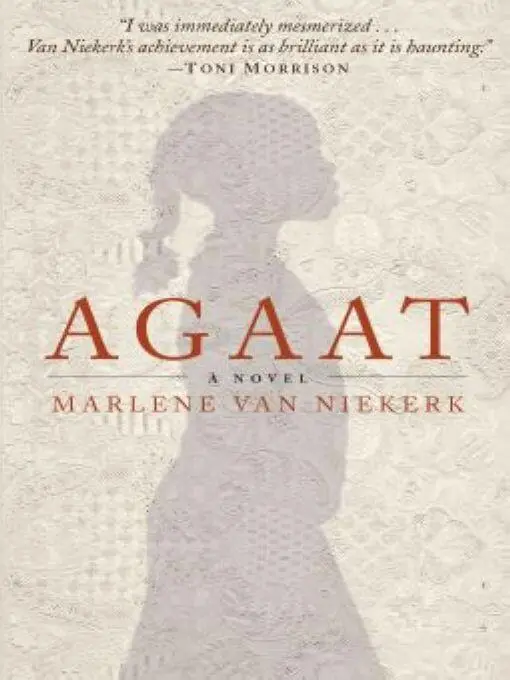
Marlene van Niekerk - Agaat
Здесь есть возможность читать онлайн «Marlene van Niekerk - Agaat» весь текст электронной книги совершенно бесплатно (целиком полную версию без сокращений). В некоторых случаях можно слушать аудио, скачать через торрент в формате fb2 и присутствует краткое содержание. Год выпуска: 2010, Издательство: Tin House Books, Жанр: Современная проза, на английском языке. Описание произведения, (предисловие) а так же отзывы посетителей доступны на портале библиотеки ЛибКат.
- Название:Agaat
- Автор:
- Издательство:Tin House Books
- Жанр:
- Год:2010
- ISBN:нет данных
- Рейтинг книги:4 / 5. Голосов: 1
-
Избранное:Добавить в избранное
- Отзывы:
-
Ваша оценка:
Agaat: краткое содержание, описание и аннотация
Предлагаем к чтению аннотацию, описание, краткое содержание или предисловие (зависит от того, что написал сам автор книги «Agaat»). Если вы не нашли необходимую информацию о книге — напишите в комментариях, мы постараемся отыскать её.
portrays the unique relationship between Milla, a 67-year-old white woman, and her black maidservant turned caretaker, Agaat. Through flashbacks and diary entries, the reader learns about Milla's past. Life for white farmers in 1950s South Africa was full of promise — young and newly married, Milla raised a son and created her own farm out of a swathe of Cape mountainside. Forty years later her family has fallen apart, the country she knew is on the brink of huge change, and all she has left are memories and her proud, contrary, yet affectionate guardian. With haunting, lyrical prose, Marlene Van Niekerk creates a story of love and family loyalty. Winner of the South African Sunday Times Fiction Prize in 2007,
was translated as
by Michiel Heyns, who received the Sol Plaatje Award for his translation.
Agaat — читать онлайн бесплатно полную книгу (весь текст) целиком
Ниже представлен текст книги, разбитый по страницам. Система сохранения места последней прочитанной страницы, позволяет с удобством читать онлайн бесплатно книгу «Agaat», без необходимости каждый раз заново искать на чём Вы остановились. Поставьте закладку, и сможете в любой момент перейти на страницу, на которой закончили чтение.
Интервал:
Закладка:
Slowly she retreats from me. She places the teaspoon on the saucer’s edge. She slides off her high perch next to my bed.
Lower the girl, she says softly on a held-in breath through her teeth.
To and fro she looks, as I looked, I flicker my eyes all the time. She looks at me, she looks where I’m looking, she nods slowly.
Mirror, mirror, she says, is it bothering you? Seen too much? On the wall? Seen it all?
That’s a start! I signal. You’re warm! That’s excellent progress! Yes, I signal, yes Agaat, you’re on the right track! Now just think further! Now just think: map on the wall, think flat earth, think pictured palm of hand, think life-line, think fingerprint!
Agaat gives me her eyes. I look deep into them, I take hold of her eyes with mine, I bend them to the door, down the passage, all the way to the front room, to the sideboard next to the wall, to the quivers lying there, behind the photo albums. I close my eyes slowly and keep them closed. I gather a sheaf, from behind her apron, from out of her chest. I see a great sailing ship tacking against the wind with billowing sails. Keel-deep in the waving wheat she comes towards me, hill crest after hill crest, disappearing in the troughs, every time bigger as she reappears till I can hear her apron creaking in the swells and can make out her figurehead, the profile of a Fate, the jaw set to brave without retort the storms that she has predestined.

Only when it really dawned on him that he was going to be a father, did Jak start treating you slightly better. You didn’t altogether trust it. It was the eighth month of your pregnancy and all of a sudden you were being showered with all kinds of gifts, an LP with saxophone music which, it must be said, didn’t do much for you, Wonderland by Night , perfume by Elizabeth Arden, a new tea set. He even took you into Swellendam for Die Heks by Leipoldt which an amateur dramatic company was staging. Not that he’d given it much thought, but you appreciated the effort.
You had to listen to his fantasies of how the child would look just like him, what sterling blood flowed in the de Wet veins and how he was going to bring him up to be strong and fit just like his father, a gentleman farmer. In the evenings he drew plans of toys that he wanted to build for the child. Kites from which one could hang, aeroplanes, rockets that could really take off.
You asked, what if it’s a little girl? In his family, Jak said, the firstborn was always a boy.
You watched this husband of yours in the evenings as he washed his face and brushed his teeth, standing stooped over in his underclothes. Sometimes as he removed the towel from his face, it seemed to you as if he was going to cry. Sometimes you found him paging through one of your books on the night-table and shutting it quickly when he saw you looking. At night he left the stoep room and came and lay behind your back like a little boy. In the mornings when you woke up he was gone.
As meek as he was with you, so volatile was he with the labourers. He would berate them for the slightest infraction. You’d always chosen to overlook those things, the sugar and the coffee disappearing from the house, the dogs’ bones vanishing from the meat cooler outside, but Jak took up arms against them. He lay in wait for the kids who stole pumpkins from the roof of the shed at night, and shot at them with the air gun. You knew about it because their mothers brought them to you mewling with the pellets that had become infected in their buttocks. You had to remove them with needles burnt clean and provide ointment and plasters until the wound had cleared up. They never said what had happened, and some of them didn’t even know, because Jak of course didn’t let himself be seen. When you dug out the pellet with the mother holding down the screaming child on the kitchen table, you said, don’t look, and spirited away the evidence between your breasts.
One evening you put the pellets in Jak’s plate. There were five of them.
Jake, these are children, you said, they can take as many pumpkins as they like, it’s not as if you eat them. And you don’t plant them either and you don’t water them and you don’t stack them on the roof, they’re my pumpkins with which I earn a little extra at the market to pay the servants, I might as well just regard it as part of their wages.
He said nothing, put the pellets in his shirt pocket.
The children grow up here on the farm, you said, when they’re grown men they’ll remember it, aren’t you ashamed of yourself?
The creatures just breed here, Jak said, I’ve a good mind to fire the whole lot, they can’t do as they like on my yard, they’re just loafing about and getting up to mischief.
You can’t do as you like on the yard either, you said. They’re human beings, remember, not cattle.
You stopped talking when the food was brought in. You put your finger on your lips to warn Jak not to talk further.
But he’d already said it.
You get the creatures accustomed to everything, Milla, he said, you’re the one who creates expectations, not me. Remember, give them the little finger and they’ll take the whole hand, don’t come and complain to me one day if they come to confront you with all kinds of demands. Mark my words, the Romans knew it long before us, give a hotnot a hard master and he’ll long for a soft master, give him a soft master and he’ll start dreaming of being his own master. Is that what you want? And then where do you think we’ll bloody well end up in this country?
It was the old pattern. The political justification of downright meanness.
Shooting at children as if they were baboons, you said, has nothing to do with politics, Jak.
And you teaching them the alphabet as if they were parrots? What does that have to do with? And then you think you can contain it afterwards? You may think you know all about farming, Milla, but you mustn’t come and tell me about politics.
What could you do? You couldn’t even stop him ranting for all the world to hear.
Let them hear who have ears to hear, Milla, he said when you tried to silence him, I won’t be shunted around in my own home. Not by a long shot.
That last while before Jakkie’s birth you couldn’t inform yourself at first hand, your legs were swollen and you no longer went out into the yard so often. But you knew in a matter of minutes if anything happened.
Who came to tell you about the fighting? That Jak first shoved Koos Makkelwyn because he gave him lip?
Initially it wasn’t clear to you what had happened. And you could get nothing from Jak himself. Bedraggled, his riding clothes full of dust and horse manure and his riding-helmet dented, he arrived at home in the middle of the afternoon to take a bath and then he left again in the bakkie without a word.
Makkelwyn was a sturdy, neat man in his fifties whom Jak had hired specially to look after his stable horses. He was a farrier and breaker-in of wild horses and in the mornings arrived, quite the dandy, on a dapple-grey ambler from The Glen, where he was stable-master. His people, the McCalvins, had since time immemorial been the farriers in the region.
You had Dawid called in when Jak had left. So then he brought along his father.
You can still see them standing there in the kitchen, the old man in his seventies, and his son, both with the Okkenel crooked mouths and light-green eyes, and with their oily khaki hats in their hands. In Dawid’s other hand the gleaming riding crop, incongruous against the dirty pants, the scuffed shoes.
What happened in the stable, Dawid? Spit it out!
You were irritated. Why had the old man come along? When OuKarel put in an appearance in the kitchen, you knew from childhood, then there was trouble. You were tired. You weren’t in a mood for trouble.
Читать дальшеИнтервал:
Закладка:
Похожие книги на «Agaat»
Представляем Вашему вниманию похожие книги на «Agaat» списком для выбора. Мы отобрали схожую по названию и смыслу литературу в надежде предоставить читателям больше вариантов отыскать новые, интересные, ещё непрочитанные произведения.









Обсуждение, отзывы о книге «Agaat» и просто собственные мнения читателей. Оставьте ваши комментарии, напишите, что Вы думаете о произведении, его смысле или главных героях. Укажите что конкретно понравилось, а что нет, и почему Вы так считаете.