Alan Moore - Jerusalem
Здесь есть возможность читать онлайн «Alan Moore - Jerusalem» весь текст электронной книги совершенно бесплатно (целиком полную версию без сокращений). В некоторых случаях можно слушать аудио, скачать через торрент в формате fb2 и присутствует краткое содержание. Год выпуска: 2016, Издательство: Liveright Publishing Corporation, Жанр: Современная проза, на английском языке. Описание произведения, (предисловие) а так же отзывы посетителей доступны на портале библиотеки ЛибКат.
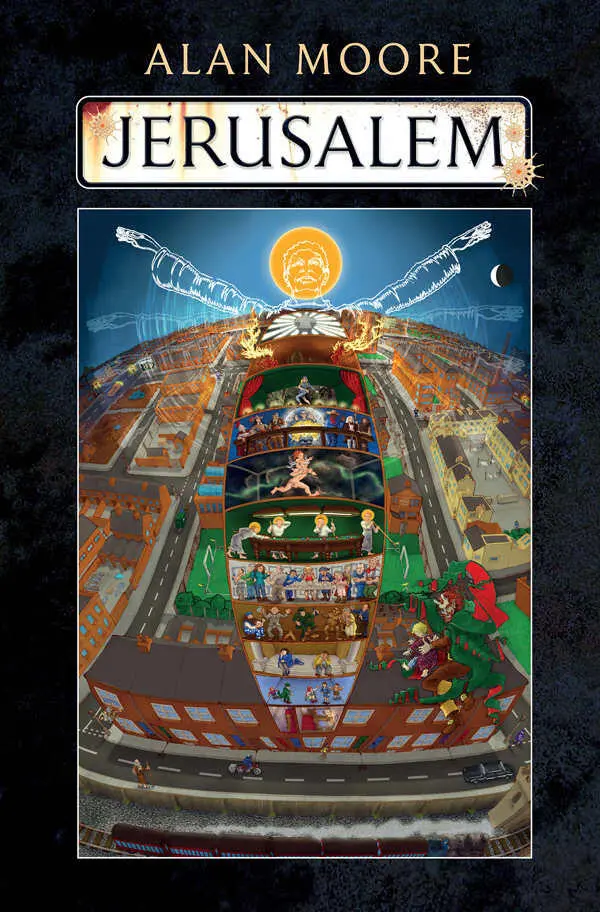
- Название:Jerusalem
- Автор:
- Издательство:Liveright Publishing Corporation
- Жанр:
- Год:2016
- ISBN:нет данных
- Рейтинг книги:4 / 5. Голосов: 1
-
Избранное:Добавить в избранное
- Отзывы:
-
Ваша оценка:
Jerusalem: краткое содержание, описание и аннотация
Предлагаем к чтению аннотацию, описание, краткое содержание или предисловие (зависит от того, что написал сам автор книги «Jerusalem»). Если вы не нашли необходимую информацию о книге — напишите в комментариях, мы постараемся отыскать её.
Disappeared lanes yield their own voices, built from lost words and forgotten dialect, to speak their broken legends and recount their startling genealogies, family histories of shame and madness and the marvellous. There is a conversation in the thunderstruck dome of St. Paul’s cathedral, childbirth on the cobblestones of Lambeth Walk, an estranged couple sitting all night on the cold steps of a Gothic church-front, and an infant choking on a cough drop for eleven chapters. An art exhibition is in preparation, and above the world a naked old man and a beautiful dead baby race along the Attics of the Breath towards the heat death of the universe.
An opulent mythology for those without a pot to piss in, through the labyrinthine streets and pages of Jerusalem tread ghosts that sing of wealth and poverty; of Africa, and hymns, and our threadbare millennium. They discuss English as a visionary language from John Bunyan to James Joyce, hold forth on the illusion of mortality post-Einstein, and insist upon the meanest slum as Blake’s eternal holy city. Fierce in its imagining and stupefying in its scope, this is the tale of everything, told from a vanished gutter.
Jerusalem — читать онлайн бесплатно полную книгу (весь текст) целиком
Ниже представлен текст книги, разбитый по страницам. Система сохранения места последней прочитанной страницы, позволяет с удобством читать онлайн бесплатно книгу «Jerusalem», без необходимости каждый раз заново искать на чём Вы остановились. Поставьте закладку, и сможете в любой момент перейти на страницу, на которой закончили чтение.
Интервал:
Закладка:
Behind her chair there is an arching stained-glass panel where gold stars mark the positions of the kabbalistic spheres against a deep royal blue grading into aquamarine. The low sun through the room’s rear window falls through this and drenches Alma in cobalt and yellow radiance as she lights up the cigarette. The painted stars break eggs onto the cyan glaze of her wet hair. She holds the smoke in for a moment and then sits back and exhales into the gathering indigo, luxuriating in her own identity, in the incessant fun and mostly-pleasant strain of simply being her.
As the cloud-chamber of her consciousness begins to warm up, turbines whirring into life as it approaches normal operating speed, she reaches for the nearest page of print to give her rapidly engaging mental processes a point of focus. This turns out to be the latest issue of New Scientist , dated May 4th, open at an intriguing article concerning Alma’s favourite science philosopher, the beautifully-named Gerard ’t Hooft, whose criticisms of string theory she’d been so impressed by. It seems that ’t Hooft has formulated a hypothesis which would, if proven, finally resolve the quandaries of quantum indeterminacy; would resolve them right out of existence, if Alma is reading it correctly. The philosopher apparently suggests that there’s a deeper and more fundamental level, as yet undiscovered, underlying the mysterious quantum world. ’T Hooft predicts that once we have developed tunnelling microscopes that can reveal this previously unsuspected layer of reality we’ll find that Heisenberg’s idea of particles existing in a wide variety of states until observed is an illusion based upon misunderstanding.
Reading all this between alternating sips of tea and smoke, Alma allows herself the guttural chortle of an ogre who’s just realised where the schoolchildren are hiding. She can spot a well-constructed dangerous idea when she sees one, and ’t Hooft’s proposal strikes her as one of the most ingenious conceptual land mines that she’s ever heard of. The idea’s attractions are immediately apparent. Quantum indeterminacy is the stumbling block preventing any easy resolution of the vast discrepancies between the quantum world-view and the classically-constructed universe of Einstein, Newton and the rest. If tiny subatomic particles behave according to the Lewis Carroll laws that govern quantum physics, then why do entirely different laws govern the stars and planets? The attempts thus far to reconcile the quantum microcosm with the classic macrocosm have led to such mind-wrenching extravagances as string theory, notions that require extra dimensions, ranging between ten and twenty-six, before the mathematics will make sense.
That’s not to say that the string theorists might not be correct, Alma observes, but simply to suggest that to her ear it all sounds rather messy and unnecessary. If ’t Hooft is right, however, and there is no quantum indeterminacy, then the problem vanishes to leave a unified field theory which accounts for everything without resorting to exotic explanations that can often raise more questions than they answer. She can see how many scientists would find ’t Hooft’s hypothesis hard to resist, but then there is that other shoe to fall: if there’s no quantum indeterminacy, then there’s no free will. That, right there, is the problem, and in Alma’s estimation it has the potential to make all the other current disputes between Christianity and science pale by comparison.
That’s why she’s laughing as she reads. It’s all this free will business and the way that everybody gets so jittery about it, even thinkers that she has the greatest of respect for. Alma, having worked all year upon her brother Warry’s near-death vision, has grown very comfortable with predetermination, with the idea of life as a great recurrence that we re-experience, unvaryingly and eternally. During this time, though, she’s learned that both Nietzsche and one of her idols, the Brixton-based artist and magician Austin Osman Spare, have previously formulated almost the same concept but then shied away from it because of the implied negation of free will.
Alma can’t see what all the fuss is over. She’s convinced that no one really needs free will as long as there is a sustainable illusion of the same to stop everyone going mad. It also seems to her that our perception of free will depends upon the scale at which we view the issue. Looking at a single individual, it’s obviously impossible to accurately forecast what will happen to that person during, say, the next five years. This would seem to support the argument for free will and a future that is not yet written. On the other hand, if we consider a large group of people, such as the few thousand souls inhabiting the Boroughs or an average modern sink estate, then our predictions become frighteningly easy and precise. We can state, near enough exactly, just how many people will get sick, get stabbed, get pregnant, lose their jobs, their homes, have minor triumphs on the Lottery, will beat their partners or their kids, will die from cancer or heart failure or sheer blind accident. It strikes her, sitting in the rich blue light and finishing her smoke, that this is the same quandary faced by the physicists, translated into a context of sociology. Why is free will, like quantum indeterminacy, only evident when we look at the microcosm, at a single person? Where does free will disappear to when we turn our gaze upon the larger social masses, on the populations that are the equivalent of stars and planets?
Stubbing out the joint she puts the magazine aside and starts to roll another one. The mug of iron-black tea, only three-quarters finished, has grown cold with small tan platelets formed upon its surface like a skin. She’ll make a fresh cup before she gets down to work in a few minutes, now her hair’s not dripping anymore.
Still musing on the subject of Gerard ’t Hooft she drifts through the next slice of time to find herself stood at her easel by the window, with a newly-filled and steaming mug upon the high table beside her, near the ashtray and the as-yet-unlit second joint propped on its lip. She holds a double-zero brush in her right hand, dead still and horizontal like the raised spear of a patient jungle hunter, unblinking and confident her prey will make a movement before she does. It will give itself away, the image or the line that she is looking for, and then her short dart will stab forward, tipped with poison colour.
On the easel is the final piece to be completed before Alma’s exhibition opens up its playschool doors tomorrow morning. The last-minute nature of the painting is due to the fact that Alma didn’t make her mind up to include it until fairly recently. Entitled Chain of Office , it’s an afterthought, a kind of visual epilogue to the preceding works. It shows a single figure, standing posed as though for an official mayoral portrait, on an indistinct and drifting field of almost drinkable green pointillism, a deep emerald smoulder. The imposing subject, features still unfinished, stands draped in a strange and ornate ceremonial robe that hides the contours of its body, which could just as easily be male or female. Lacking a completed face to rest upon, the eye is drawn to the exotic and cascading fabric of the gown, which, upon close examination, seems to be what the whole picture is about. The intricate design of detailed scenes set in irregularly contoured panels, linked by a gold filigree of branching lines, turns out to be a lavishly illuminated map of Alma’s former neighbourhood, from Sheep Street to Saint Andrew’s Road, from Grafton Street to Marefair. On the decorated hem is a motif of paving stones, each individually cracked and weathered, fringed with seams of bright viridian moss. The cuff-buttons are glued-on snail-shells. Isomorphic images of Doddridge Church, bulging with ranting puritans, seem to be painted or embroidered on the garment’s folds, with Spring Lane School and Scarletwell Street sliding from a hanging pleat into the crease’s umber.
Читать дальшеИнтервал:
Закладка:
Похожие книги на «Jerusalem»
Представляем Вашему вниманию похожие книги на «Jerusalem» списком для выбора. Мы отобрали схожую по названию и смыслу литературу в надежде предоставить читателям больше вариантов отыскать новые, интересные, ещё непрочитанные произведения.









Обсуждение, отзывы о книге «Jerusalem» и просто собственные мнения читателей. Оставьте ваши комментарии, напишите, что Вы думаете о произведении, его смысле или главных героях. Укажите что конкретно понравилось, а что нет, и почему Вы так считаете.