Alan Moore - Jerusalem
Здесь есть возможность читать онлайн «Alan Moore - Jerusalem» весь текст электронной книги совершенно бесплатно (целиком полную версию без сокращений). В некоторых случаях можно слушать аудио, скачать через торрент в формате fb2 и присутствует краткое содержание. Год выпуска: 2016, Издательство: Liveright Publishing Corporation, Жанр: Современная проза, на английском языке. Описание произведения, (предисловие) а так же отзывы посетителей доступны на портале библиотеки ЛибКат.
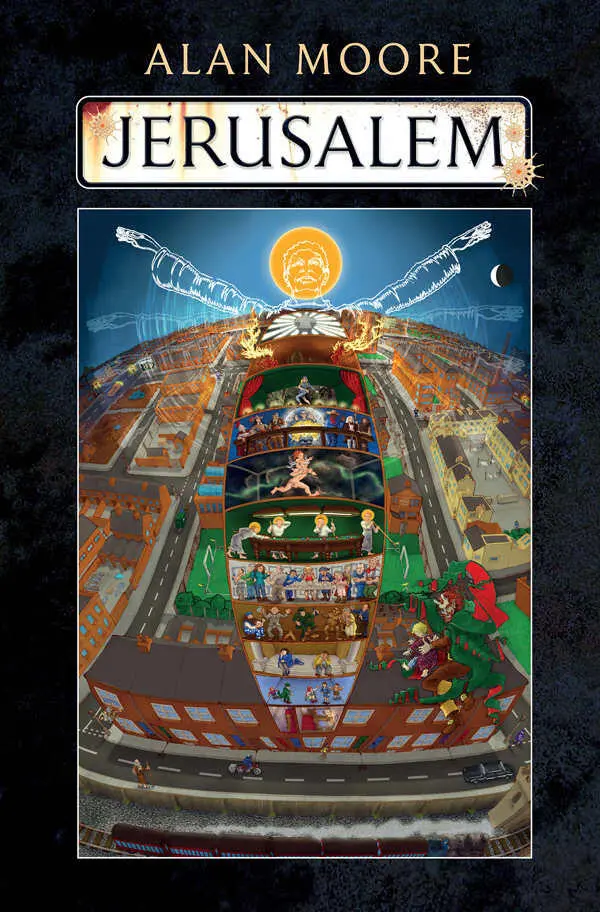
- Название:Jerusalem
- Автор:
- Издательство:Liveright Publishing Corporation
- Жанр:
- Год:2016
- ISBN:нет данных
- Рейтинг книги:4 / 5. Голосов: 1
-
Избранное:Добавить в избранное
- Отзывы:
-
Ваша оценка:
Jerusalem: краткое содержание, описание и аннотация
Предлагаем к чтению аннотацию, описание, краткое содержание или предисловие (зависит от того, что написал сам автор книги «Jerusalem»). Если вы не нашли необходимую информацию о книге — напишите в комментариях, мы постараемся отыскать её.
Disappeared lanes yield their own voices, built from lost words and forgotten dialect, to speak their broken legends and recount their startling genealogies, family histories of shame and madness and the marvellous. There is a conversation in the thunderstruck dome of St. Paul’s cathedral, childbirth on the cobblestones of Lambeth Walk, an estranged couple sitting all night on the cold steps of a Gothic church-front, and an infant choking on a cough drop for eleven chapters. An art exhibition is in preparation, and above the world a naked old man and a beautiful dead baby race along the Attics of the Breath towards the heat death of the universe.
An opulent mythology for those without a pot to piss in, through the labyrinthine streets and pages of Jerusalem tread ghosts that sing of wealth and poverty; of Africa, and hymns, and our threadbare millennium. They discuss English as a visionary language from John Bunyan to James Joyce, hold forth on the illusion of mortality post-Einstein, and insist upon the meanest slum as Blake’s eternal holy city. Fierce in its imagining and stupefying in its scope, this is the tale of everything, told from a vanished gutter.
Jerusalem — читать онлайн бесплатно полную книгу (весь текст) целиком
Ниже представлен текст книги, разбитый по страницам. Система сохранения места последней прочитанной страницы, позволяет с удобством читать онлайн бесплатно книгу «Jerusalem», без необходимости каждый раз заново искать на чём Вы остановились. Поставьте закладку, и сможете в любой момент перейти на страницу, на которой закончили чтение.
Интервал:
Закладка:
The imposing figure stands with both hands raised in welcome or in benediction, draped in its astounding coat of maps. Hung round the neck, in a dull grey that stands out strikingly against the riotous surrounding colour of the vestments, is the dented gong of an old saucepan lid attached to what appears to be a length of lavatory chain.
Alma’s one problem with the piece is that she can’t decide whose face this splendid Boroughs totem should be wearing. Philip Doddridge’s, perhaps? Black Charley’s? What about the sweet owl roundness of Alma’s beloved and deceased Aunt Lou, lost in a lightning storm? No. No, that will look wrong, perched on an already-completed body that is differently proportioned. She puts down her hovering brush and picks the joint up, lighting the touch-paper twist. After a pull or two, she sets the fuming column back down in the ashtray and retrieves her brush, having arrived at a decision.
For the next two hours she works upon the face until she’s satisfied, then spends a further half hour gazing love-struck at the finished painting, basking in her own magnificence. Finally, her vanity starts to exhaust her. Alma feels she’s earned a break.
She stands, with a theatrical sciatic groan, and slouches out into the kitchen where she fries up sliced halloumi while a brace of pitta pockets puff and fatten in the oven. When the thick-cut steaks of cheese have taken on a leathery autumnal mottle she retrieves them from the pan; slips them inside the pouches of warm bread with an accompanying spill of mixed leaf salad and some guillotined tomatoes. She can never eat halloumi without feeling a misguided sense of vegetarian guilt. This is because her first taste of the fibrous and salt Greek delicacy, decades earlier, had led her to assume that the halloumi was a possibly-endangered species of Cypriot fish. Even though she knows better now, she still can’t shake the frisson of forbidden and delicious flesh that comes with every carefully-chewed mouthful, and in fact she rather likes it that way.
After she’s devoured whichever meal her hasty fry-up was supposed to represent — elevenses or brunch or lunkfast (her own coinage) — Alma gets rid of the plate and rolls another smoke. Having completed Chain of Office an hour earlier than she’d anticipated she has time to pick over a couple of her other projects, maybe make laborious, autistic-looking jottings in block capitals across whatever unmarked pages she can find in one of several workbooks. She has never mastered joined-up handwriting. Along with tying shoelaces the ordinary way, it is a skill that she experienced initial problems with and instantly gave up on, stubbornly resolving that she’d come up with her own approach to things and stick with it, even if it was obviously wrong. This is the formative decision, made when she was seven, that has shaped her entire subsequent existence. In a recent interview, when asked if the political upheaval of the 1960s had caused Alma’s fiercely individual approach to life, her puzzling response of, “No, it was those fucking shoelaces” apparently became the subject of much speculation on the message boards she never saw but only heard about.
Settling back into her chair, her nest of curling vapour ribbons, she picks up the nearest blank-paged and hard-covered exercise book from the cluttered coffee table on her left, scooping up a blue ballpoint pen that still looks viable while doing so. She makes a few notes on the possible autobiography that she’s considered writing, which at present isn’t much more than a paragraph or two about her nan, May, and a working title, We Was Poor But We Was Cannibals . Alma composes a few dozen chapter headings, phrases that seem funny, resonant or smugly clever to her, and makes tiny notes beside each one suggesting what ideas or episodes that chapter might include. The details and the actual meat of things can all be worked out later, on the hoof, on wings and prayers.
Conveniently satisfied with her half-hour’s work just as she is starting to get bored with it, she puts the workbook down and reaches for whichever paperback or magazine or comic is closest to hand. As it transpires, this is a polythene-bagged copy of Forbidden Worlds , seemingly issue 110, dated March-April 1963 and published by the long-since vanished ACG, or American Comics Group. Being both sick and tired of the protracted adolescence typifying the contemporary comic business, publications of this vintage are almost the only ones that Alma will allow into the house.
Removing the frail pamphlet gently from the elderly and wilting plastic of its envelope, Alma examines the admittedly completely crappy covers, front and back. The rear is an advertisement, in black and white, for an impressive catalogue of novelties from Honor House Productions, boldly labelled as a “TREASURE CHEST OF FUN”. The fun seems to involve confusing adults with ventriloquism, frightening them with a cigarette-dispensing lighter that “looks like a Browning automatic”, or increasing their nuclear anxiety with an Atomic Smoke Bomb: “Just light one and watch the column of white smoke rise to the ceiling, mushrooming into a dense cloud like an A-Bomb.” These cost twenty cents. Also available are silent dog-whistles, Ju-Jitsu lessons promising that YOU, TOO, CAN BE TOUGH, a deck of marked cards and the snappily-described SEE BEHIND GLASSES that “enable you to see behind you without anyone knowing you’re watching. Really comes in handy at times.” Struggling to imagine on precisely which occasions these wing-mirrored spectacles would “really come in handy”, other than if she should be compelled to back her massive head out of a cul-de-sac, she turns instead to the front cover, all in citrus colour with its oversized seal of approval from the once-important Comics Code Authority and the black “9d” imprint of a British newsagent stamped on the planet-decorated logo.
The front image, by an artist Alma doesn’t recognise, is clearly a generic piece of cover artwork pulled from the inventory. It shows a thuggish-looking monk clad in green robe and hood grimacing from within a fortune-teller’s crystal ball. A blue-tinged cover blurb appended to the illustration tries to justify it by pretending that the sulky-looking figure in the snow-globe is “just ONE” of various menaces that the anthology’s single continuing character, Herbie, would meet inside. Flicking through two or three nondescript tales of strange adventure to the Herbie story at the back, the only reason that she’s kept the tattered comic-book, Alma discovers that this is the ruse she had suspected. The green monk is nowhere to be seen throughout the ten-page yarn, a favourite of Alma’s called “Herbie and the Sneddiger’s Salad Oil”.
Herbie had been created several issues previously in what may have been intended as a one-off tale. Readers, however, were intrigued by its protagonist, a spherical and solemn schoolboy with a bowl-cut hairdo, horn-rimmed glasses, unexpected supernatural powers and an unusual obsession with fruit-flavoured lollipops. Due to this favourable response the character appeared more frequently from then on, clad in his trademark attire of weirdly scaled-down adult clothing with blue pants, white shirt and a black tie. While obviously not a look that everyone could get away with, Herbie would have bailed out of Forbidden Worlds within a year of issue 110 and be established as the title character in his own comic, of which Alma owns a very-near complete collection.
The main reason for this singular compulsion is Alma’s infatuation with the strip’s distinctively obsessive artist, Ogden Whitney. Whitney, working in the business since the 1940s, had a drawing style that somehow managed to take smothering suburban blandness to extremes which should have been the envy of the avant-garde. His tidily-coiffured cast of generic middle-class Americans might have stepped from a magazine ad for soap-powder, cars or coffee were it not for a conspicuous lack of grinning toothy confidence. Instead, his characters wear tight expressions of barely-suppressed anxiety as they stand hesitating in the kitchens of their uniform white-painted homes or loiter upon bright green lawns so neatly-shorn as to be utterly devoid of texture, mere outlines left for the colourist to fill. And then, amidst this twitchy Cold War landscape with its populace of clenched neurotics, there is the still, planetary mass of Herbie Popnecker.
Читать дальшеИнтервал:
Закладка:
Похожие книги на «Jerusalem»
Представляем Вашему вниманию похожие книги на «Jerusalem» списком для выбора. Мы отобрали схожую по названию и смыслу литературу в надежде предоставить читателям больше вариантов отыскать новые, интересные, ещё непрочитанные произведения.








Обсуждение, отзывы о книге «Jerusalem» и просто собственные мнения читателей. Оставьте ваши комментарии, напишите, что Вы думаете о произведении, его смысле или главных героях. Укажите что конкретно понравилось, а что нет, и почему Вы так считаете.