Alan Moore - Jerusalem
Здесь есть возможность читать онлайн «Alan Moore - Jerusalem» весь текст электронной книги совершенно бесплатно (целиком полную версию без сокращений). В некоторых случаях можно слушать аудио, скачать через торрент в формате fb2 и присутствует краткое содержание. Год выпуска: 2016, Издательство: Liveright Publishing Corporation, Жанр: Современная проза, на английском языке. Описание произведения, (предисловие) а так же отзывы посетителей доступны на портале библиотеки ЛибКат.
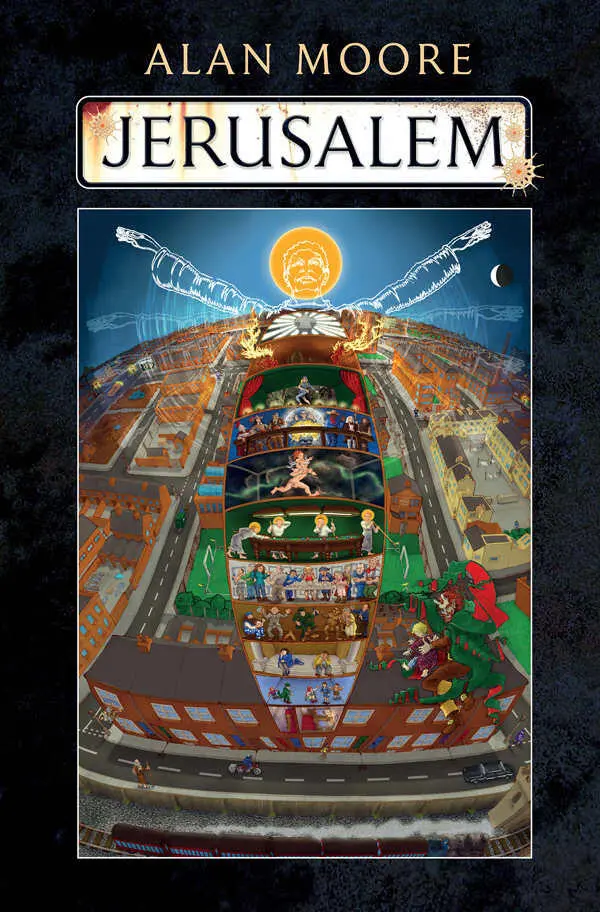
- Название:Jerusalem
- Автор:
- Издательство:Liveright Publishing Corporation
- Жанр:
- Год:2016
- ISBN:нет данных
- Рейтинг книги:4 / 5. Голосов: 1
-
Избранное:Добавить в избранное
- Отзывы:
-
Ваша оценка:
Jerusalem: краткое содержание, описание и аннотация
Предлагаем к чтению аннотацию, описание, краткое содержание или предисловие (зависит от того, что написал сам автор книги «Jerusalem»). Если вы не нашли необходимую информацию о книге — напишите в комментариях, мы постараемся отыскать её.
Disappeared lanes yield their own voices, built from lost words and forgotten dialect, to speak their broken legends and recount their startling genealogies, family histories of shame and madness and the marvellous. There is a conversation in the thunderstruck dome of St. Paul’s cathedral, childbirth on the cobblestones of Lambeth Walk, an estranged couple sitting all night on the cold steps of a Gothic church-front, and an infant choking on a cough drop for eleven chapters. An art exhibition is in preparation, and above the world a naked old man and a beautiful dead baby race along the Attics of the Breath towards the heat death of the universe.
An opulent mythology for those without a pot to piss in, through the labyrinthine streets and pages of Jerusalem tread ghosts that sing of wealth and poverty; of Africa, and hymns, and our threadbare millennium. They discuss English as a visionary language from John Bunyan to James Joyce, hold forth on the illusion of mortality post-Einstein, and insist upon the meanest slum as Blake’s eternal holy city. Fierce in its imagining and stupefying in its scope, this is the tale of everything, told from a vanished gutter.
Jerusalem — читать онлайн бесплатно полную книгу (весь текст) целиком
Ниже представлен текст книги, разбитый по страницам. Система сохранения места последней прочитанной страницы, позволяет с удобством читать онлайн бесплатно книгу «Jerusalem», без необходимости каждый раз заново искать на чём Вы остановились. Поставьте закладку, и сможете в любой момент перейти на страницу, на которой закончили чтение.
Интервал:
Закладка:
A rush of sparks erupted from the well-mouth of the Mayorhold, scurrying up into the dark behind the silhouetted builder. Timber was collapsing somewhere lower down. Michael was still attempting to look anywhere but at the view beyond the railings. The old people in their underpants still huddled in a wailing, weeping mass of wrinkled pink and scrubby grey. The baby-faced man was still singing the same hymn, eyes streaming as with mad determination he stared fixedly into the heat-haze. The exploding person further down the balcony seemed to have paused in order to appreciate the view, one spectacle looking admiringly upon another. Somewhere nearby, perhaps on the landing overhead, a team of fire-fighting demons were discussing the logistics of those devils who had wings flying reconnaissance above the fire-pit of the former town square. Michael played for time.
“Gut eye don’t blunderstand! How clang one chillery-pot claws all dis turble?”
John sighed.
“Because of where it wiz and what it meant, that’s how. It wizn’t just Northampton’s waste that the Destructor wiz intended to destroy, it wiz the whole community that it wiz built right in the middle of. Destroying people’s dreams and hopes about a better future for their kids, that takes a special sort of fire, a fire that people in the living world can’t even see, not even when its turning all their houses, schools and clinics into rubble. The thing wiz, a fire like that, you can’t just put it out by knocking down the waste incinerator that it started from. By the time the Destructor wiz pulled down, back in the ’Thirties, its effects had spread into the way that people thought about the Boroughs and about themselves. Its special sort of fire had spread right to the heart of things. Down in the half-world all our ghosts and memories were smouldering, until Mansoul itself wiz set alight. It’s burning, nipper. Heaven’s burning. Come and have a look yourself, then we can all get out of here.”
Still unconvinced but prompted by the promise of an early exit from this dreadful situation, Michael took a slippered step towards the landing’s edge. He didn’t know if it was fear that made his throat so sore and tight or if it was the Guy Fawkes tang the air had, but he almost felt like he was choking.
“Doug, that policeman blew ’is whistle at us.”
“I don’t care. It’s only down York Road now. You just ’ang on.”
Almost at the gap-toothed railings, Michael thought he heard his mum’s voice over all the clamour of the devils and the high-voiced man who still sang the same hymn, but realised that he must have just imagined it. With John and Phyllis standing to each side of him, he stepped up to the short stretch of remaining balustrade and gazed down, between its pitch-painted bars, into the roaring, swirling mouth of the Destructor.
It was all the dogs, the drain, the smoke that everything was either going to, or down, or up in. It was rack, and it was ruin, and the destination of the handcarts. It was other people. It was where you led apes. It was what you rode for leather and what came in absence of high water.
Pink light broke on Michael’s cheeks, his forehead, and below the Mayorhold was a mile-wide maelstrom, all ablaze. Worse, as John had explained, this was not common fire that lit a cigarette or charred a house. This was instead a pure and awful poetry of fire, that set morality and trust and human happiness alight, that turned the fragile threads connecting people into ashes. This was fire enough to burn down decency, or self-respect, or love. Michael looked down into the spitting, crackling chasm. From the flaming debris turning in its magma stir he realised that it was consuming nothing physical, but only a more precious fuel of wishes, images, ideas and recollections. It was as if something had collected up a thousand different family albums full of corner-mounted photographs, remembered moments that had been important to somebody once, and in a fit or misery or rage had thrown them all into a furnace. Blistered incidents and scorching pictures circled sluggishly in the volcanic eddy, in the churning black and red.
He saw terraced houses fall against each other in a run of demolition dominoes, complex spider-webs of jitties and rear-entries simplified to blocks of flats like giant filing cabinets. Hundreds of heirloom prams rolled rattling and squeaking down a smoky gradient into the abyss. Everybody’s pets died, countless budgie-cages empty save for shit and sandpaper that tumbled endlessly through ruddy darkness. Everybody’s favourite toys were lost. Small girls who wanted to be nurses, show-jumpers or film stars played a skipping game, ageing with each turn of the rope to drudges, inadvertent mothers or hairnets and pairs of hands on a conveyor belt. Small boys who wanted to be football heroes kicked and kicked and kicked and never realised that their goal was unattainable, was only drawn in chalk onto the shabby brickwork. Envelopes fell with a sigh on bristly doormats bringing bad news from the front line, bank or hospital. A desperate landlord murdered a streetwalker with a hammer in the back yard of his pub, and at the head of Scarletwell Street men in black shirts with moustaches and their skulls shaved halfway up the back held rallies, shouted slogans and folded their arms like gods. Everything burned and didn’t know it burned. These were the pictures in that frightful, final hearth.
Sheep Street seemed to have broken in the middle, its near end a steep slope that was almost vertical, and toppling down it there were fifty years of Bicycle Parades. Girls dressed as fairies rattling their collection tins, deliberately wonky bikes with oval wheels and men whose papier-mâché heads with leprous, peeling paintwork were much bigger than their bodies — all of these poured down the chute into the gaping conflagration of the Mayorhold and were lost. A marching band assembled by the Boy’s Brigade went tumbling after them in a percussion-heavy clattering of drums and cymbals, a lone glockenspiel attempting to perform “It’s a Long Way to Tipperary” before it was swallowed in the light, the thunder, the collapse. Eleven-year-old boys with plastered hair that smelled of chlorine and with damp Swiss rolls of towel and swimming trunks inside their shouldered kitbags skittered on the tilting cobbles, trying to arrest their slide. Nothing was safe, the district’s sense of safety having been the first thing to catch fire.
A line of butcher’s, barber’s, greengrocer’s and sweetshops all went in, and then a whole church that he thought might be St. Andrew’s. Michael watched it as it ground and slithered inexorably towards the glaring edge and then tipped over, limestone buttresses crumbling away from the main structure, falling to the firestorm in a shower of smashed stained glass and smoking hymnals. Pews that still had tiny people kneeling in them spilled out of the plunging buildings through its broken doors and windows, dropped into the all-consuming mortal bonfire like unwanted dollhouse furniture. Eyes stinging, Michael saw his own home on St. Andrew’s Road, its windows covered up with corrugated tin, as it sank helplessly into a quicksand of rough grass, its chimney at length disappearing underneath the patch of turf that was itself creeping towards fiery oblivion down an upended Scarletwell Street. Horses pulling tinkling milk floats shied and snorted in distress, dropped steaming fibrous pancakes, good for roses, which were quickly shovelled up into tin buckets by the grubby children who were plummeting behind them on the sudden incline. Everything went on the pyre, went down the flaming pan.
Michael understood that it was meaning that was being turned to ash here, and was not really surprised that many of the burning, blackening scenarios were only meaningful to him. He saw his stick-thin grandma, Clara, fall abruptly to a shiny kitchen floor that wasn’t red and blue tiles like the one they had down on St. Andrew’s Road. He saw his nan, May, clutching at her drooping bosom as she stumbled down the passage of a little modern flat somewhere that wasn’t Green Street, trying to reach the front door and fresh air, collapsing on her face and lying still instead. He saw a hundred other old men and old women moved from the condemned homes where they’d raised their families, dumped in distant districts with nobody that they knew and failing to survive the transplant. By the dozen they keeled over on the well-lit stairs of their new houses; in the unfamiliar indoor toilets; onto their unprecedented fitted carpets; on the pillows of magnolia-painted bedrooms that they failed to wake to. Countless funerals fell into the Mayorhold’s fires, and furtive teenage love-affairs, and friendships between relocated children sent to different schools. Infants began to understand that they would probably now never marry the classmate that they had been expecting to. All the connecting tissue, the affections and associations, became cinders. He became aware that he was weeping, had presumably been weeping for some time.
Читать дальшеИнтервал:
Закладка:
Похожие книги на «Jerusalem»
Представляем Вашему вниманию похожие книги на «Jerusalem» списком для выбора. Мы отобрали схожую по названию и смыслу литературу в надежде предоставить читателям больше вариантов отыскать новые, интересные, ещё непрочитанные произведения.






Обсуждение, отзывы о книге «Jerusalem» и просто собственные мнения читателей. Оставьте ваши комментарии, напишите, что Вы думаете о произведении, его смысле или главных героях. Укажите что конкретно понравилось, а что нет, и почему Вы так считаете.