Elin Hilderbrand - The Island
Здесь есть возможность читать онлайн «Elin Hilderbrand - The Island» весь текст электронной книги совершенно бесплатно (целиком полную версию без сокращений). В некоторых случаях можно слушать аудио, скачать через торрент в формате fb2 и присутствует краткое содержание. Жанр: Современная проза, на английском языке. Описание произведения, (предисловие) а так же отзывы посетителей доступны на портале библиотеки ЛибКат.
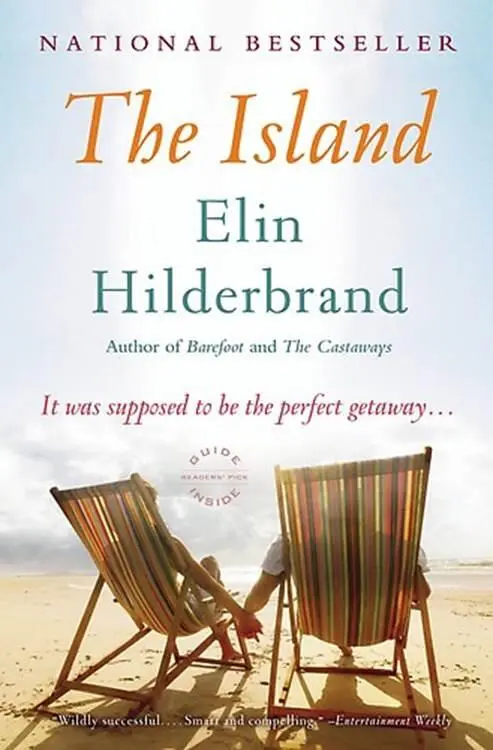
- Название:The Island
- Автор:
- Жанр:
- Год:неизвестен
- ISBN:нет данных
- Рейтинг книги:3 / 5. Голосов: 1
-
Избранное:Добавить в избранное
- Отзывы:
-
Ваша оценка:
The Island: краткое содержание, описание и аннотация
Предлагаем к чтению аннотацию, описание, краткое содержание или предисловие (зависит от того, что написал сам автор книги «The Island»). Если вы не нашли необходимую информацию о книге — напишите в комментариях, мы постараемся отыскать её.
It's only the first hint of what will be a summer of upheavals and revelations. Before the dust has even begun to settle, far worse news arrives, sending Chess into a tailspin of despair. Reluctantly taking a break from the first new romance she's embarked on since the recent end of her 30-year marriage, Birdie circles the wagons and enlists the help of her younger daughter Tate and her own sister India. Soon all four are headed for beautiful, rustic Tuckernuck Island, off the coast of Nantucket, where their family has summered for generations. No phones, no television, no grocery store – a place without distractions where they can escape their troubles.
But throw sisters, daughters, ex-lovers, and long-kept secrets onto a remote island, and what might sound like a peaceful getaway becomes much more. Before summer has ended, dramatic truths are uncovered, old loves are rekindled, and new loves make themselves known. It's a summertime story only Elin Hilderbrand can tell, filled with the heartache, laughter, and surprises that have made her page-turning, bestselling novels as much a part of summer as a long afternoon on a sunny beach.
The Island — читать онлайн бесплатно полную книгу (весь текст) целиком
Ниже представлен текст книги, разбитый по страницам. Система сохранения места последней прочитанной страницы, позволяет с удобством читать онлайн бесплатно книгу «The Island», без необходимости каждый раз заново искать на чём Вы остановились. Поставьте закладку, и сможете в любой момент перейти на страницу, на которой закончили чтение.
Интервал:
Закладка:
And now, India was distracted. The letter! As soon as Barrett disappeared down the beach steps, she put on Bill’s reading glasses and slit the letter open with a butter knife.
A piece of white copy paper, folded in thirds. At the top, in red felt-tip pen, it said: Was I wrong about you?
India read the line twice, then a third time. Then she sighed, folded the letter up, and slid it back into the envelope. She let Bill’s reading glasses fall to her chest.
The letter was from Lula.
On the one hand, India felt relieved. A letter from her sons would only have contained tragic news. On the other hand, India felt oddly exposed. Lula had found her, here on Tuckernuck, with an envelope that had been addressed for the pony express.
Lula might have called Ainslie to figure out where India was; perhaps Ainslie had given up the name of the island (but not the caretaker’s address). Or Lula remembered India mentioning that her ancestral summer home was on this sandbar called Tuckernuck. India felt relieved that the letter wasn’t harsher; if Lula was angry enough to leave PAFA, then she was angry enough to write more than that one little line. Lula had censored herself; she had shown restraint. She had, almost, accepted the blame.
India didn’t know how to answer the question.
She lit a cigarette, then she repaired to the kitchen to pour herself a glass of wine. It was only three o’clock, but what the hell, Barrett had delivered a new case of Sancerre. It was chilled, and India had suffered a shock. She would have a drink.
She sat back down at the picnic table and ran her hand through her spiky, salt-stiffened hair, feeling newly self-conscious, as if someone were watching her. She smoked her cigarette down to the filter, sipped her wine, raised her face to the sun, wrinkles be damned, regarded the envelope, and shook her head. Jesus.
Was Lula wrong about her?
Yes, Lula, you were probably wrong, you took the things I said and did the wrong way, you invested them with too much meaning. Was that the answer? I misled you, I vacillated, I didn’t know what I wanted or what I was feeling. I was out of my comfort zone.
India finished her glass of wine and poured another. It was cold and it was good-Birdie knew her Sancerres-and India thought, Goddamn it! She had made it through an entire week without thinking about PAFA in general and Lula in particular, and now this.
Tallulah Simpson. Lula had come to PAFA late in life, which is to say, at the age of twenty-six. She already had a degree in Romance languages from McGill University. She spoke French, Italian, Spanish, Portuguese, Arabic, and Hindi. The languages were a gift, more of a gift, perhaps, than her art; ever since Lula was a little girl, she had wanted to be an interpreter for an important organization-Unicef, the World Bank, the Red Cross. She had worked for a few years as a translator for big tobacco; she traveled between Montreal, Paris, and India. She hadn’t painted anything in her life until she contracted dengue fever in India and was hotel-bound on big tobacco’s dime. She recovered from the fever in three weeks and took another three weeks to regain her strength. This was when she started to paint-out of boredom, she said, and weakness. She had wanted to write a novel, but thinking hurt her brain. Painting was easier; she started with watercolors and tempera on heavy, expensive paper from the hotel’s business center. She already knew what she wanted to paint; the images had been with her since birth.
Lula had told India this much during their first meeting over lattes at the White Dog Cafe, on the first October day that it was chilly enough to enjoy an afternoon coffee. The meeting was official. India was Lula’s second-year adviser. India’s position at the academy was such that she handpicked all of her advisees; it was a condition of her serving as an adviser at all. (She was such a bitch.) India chose the second-year students who had proved during their first year to be the most interesting, the most talented, the most attractive-and Tallulah Simpson was at the top of each category. She was stunning-with long, straight black hair, clear green eyes, and golden skin. Her mouth was wide; there was a gap between her front teeth. She had an unplaceable accent. She smoked and drank and used foreign phrases; she wore expensive, stylish clothes-flaring tops, tight jeans, impossibly high heels. (India ended up emulating her fashion sense; she had, with certain purchases, downright plagiarized it.) Lula’s father, now dead, had been an Iranian businessman who had immigrated to Canada in the late seventies, and Lula’s mother was from a prominent family in Bangalore. Lula’s life had been one of privilege, though she had been marginalized, even among the tolerant Canadians, because of her race. She understood the pain of being an outsider, and from this pain came the inspiration for her paintings.
What India had thought was, Oh, come on.
The story sounded worn out and typical; India had hoped for more. But most of PAFA’s students-aspiring artists in their late teens and early twenties-held an overly romanticized vision of themselves. They liked to talk about their pain, their inspiration. They didn’t realize yet that their currency would be hard work and ambition.
Lula had been a little moony at that first coffee, but she was a fiercely talented painter. She was always in the studio, always experimenting with different canvases and paints and techniques. She brought gesso back into fashion, then gouache. She did studies of color and texture, underpainting and overpainting. She studied her history-Matisse, Modigliani, O’Keeffe, Pollock, Rothko. She loved Rothko; she single-handedly started a Rothko renaissance. Suddenly, references to Rothko’s paintings were appearing in everyone’s work, and the faculty were shaking their heads. It was because of Tallulah. She set trends.
Lula never slept; that was the rumor. Her insomnia had been inherited from her Iranian father, who had also never slept. Lula mentioned her insomnia to India when they met again for coffee at the White Dog. India admitted to Lula that she didn’t sleep either, though her insomnia was situational and not inherited. It had been caused by her husband’s suicide.
India spent her insomniac hours drinking chamomile tea and paging through fashion magazines. She listened to John Coltrane; she watched Love Story on TNT. Lula went to Tattooed Mom and 105 Social; she drank champagne bought for her by men with expense accounts; she did recreational drugs. At dawn, she went home, washed her hair, ate a hard-boiled egg, and was in her studio by 7 A.M.
During that second year, Lula discovered the female nude. She spent long hours in Cast Hall, sketching the plaster forms of the human body; she would spend an hour on an ear, an entire day on a hand. She wanted to be technically perfect. The most famous of PAFA’s instructors, Thomas Eakins, had encouraged his students to dissect dead bodies. In this tradition, Lula hounded someone at UPenn’s medical school, and she spent a week sketching cadavers. News of this over-the-top effort in the name of authenticity traveled through the halls of the school; Lula quickly became the It Girl with the untouchable talent, the sick work ethic. India and the other professors knew that a burnished reputation in only her second year could be a good thing or a bad thing. But the work spoke for itself: One entire wall of Lula’s studio was dedicated to a study done in pink, of a woman dancing. The woman was six feet tall and had her arms extended over her head; Lula had rendered her sixteen times in succession, so that to look at the wall from left to right was to sense the woman twirling.
At the end of the year, Lula won the cash award for the Most Promising Student. This was the subject of much controversy and conversation because she was the only student who hadn’t completed a single canvas. Her entire oeuvre, at that point, was studies. But the studies showed brilliance, and as India-who held the most influential vote where this award was concerned-pointed out, not one of the other students’ finished canvases held the promise of Tallulah’s studies.
Читать дальшеИнтервал:
Закладка:
Похожие книги на «The Island»
Представляем Вашему вниманию похожие книги на «The Island» списком для выбора. Мы отобрали схожую по названию и смыслу литературу в надежде предоставить читателям больше вариантов отыскать новые, интересные, ещё непрочитанные произведения.



Обсуждение, отзывы о книге «The Island» и просто собственные мнения читателей. Оставьте ваши комментарии, напишите, что Вы думаете о произведении, его смысле или главных героях. Укажите что конкретно понравилось, а что нет, и почему Вы так считаете.