Харуки Мураками - Killing Commendatore
Здесь есть возможность читать онлайн «Харуки Мураками - Killing Commendatore» весь текст электронной книги совершенно бесплатно (целиком полную версию без сокращений). В некоторых случаях можно слушать аудио, скачать через торрент в формате fb2 и присутствует краткое содержание. Город: New York, Год выпуска: 2018, ISBN: 2018, Издательство: Alfred A. Knopf, Жанр: Современная проза, на английском языке. Описание произведения, (предисловие) а так же отзывы посетителей доступны на портале библиотеки ЛибКат.
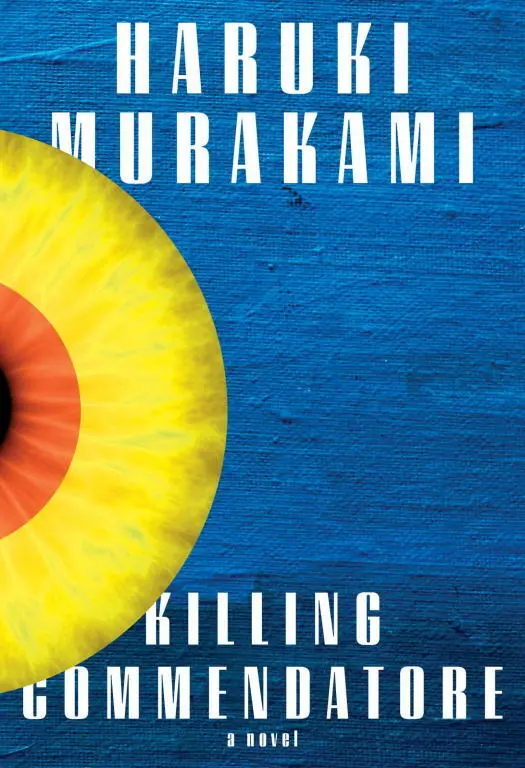
- Название:Killing Commendatore
- Автор:
- Издательство:Alfred A. Knopf
- Жанр:
- Год:2018
- Город:New York
- ISBN:978-0-5255-2005-4
- Рейтинг книги:5 / 5. Голосов: 1
-
Избранное:Добавить в избранное
- Отзывы:
-
Ваша оценка:
Killing Commendatore: краткое содержание, описание и аннотация
Предлагаем к чтению аннотацию, описание, краткое содержание или предисловие (зависит от того, что написал сам автор книги «Killing Commendatore»). Если вы не нашли необходимую информацию о книге — напишите в комментариях, мы постараемся отыскать её.
In Killing Commendatore, a thirty-something portrait painter in Tokyo is abandoned by his wife and finds himself holed up in the mountain home of a famous artist, Tomohiko Amada. When he discovers a previously unseen painting in the attic, he unintentionally opens a circle of mysterious circumstances. To close it, he must complete a journey that involves a mysterious ringing bell, a two-foot-high physical manifestation of an Idea, a dapper businessman who lives across the valley, a precocious thirteen-year-old girl, a Nazi assassination attempt during World War II in Vienna, a pit in the woods behind the artist’s home, and an underworld haunted by Double Metaphors.
A tour de force of love and loneliness, war and art—as well as a loving homage to The Great Gatsby—Killing Commendatore is a stunning work of imagination from one of our greatest writers.
Killing Commendatore — читать онлайн бесплатно полную книгу (весь текст) целиком
Ниже представлен текст книги, разбитый по страницам. Система сохранения места последней прочитанной страницы, позволяет с удобством читать онлайн бесплатно книгу «Killing Commendatore», без необходимости каждый раз заново искать на чём Вы остановились. Поставьте закладку, и сможете в любой момент перейти на страницу, на которой закончили чтение.
Интервал:
Закладка:
I walked around the parking lot, keeping an eye out for someone who resembled him. I checked the observation deck. But the man with the white Subaru Forester was nowhere to be seen. A man of middle age, deeply tanned, with a salt-and-pepper crew cut. On the tall side. When last seen, wearing a battered black leather jacket and a Yonex golf cap. I had whipped off a quick sketch on my memo pad and shown it to the young woman sitting across from me. “You’re really good at drawing!” she had enthused.
Once I was sure no one matching his description was outside, I looked inside the restaurant. I circled the place, but he was nowhere to be seen. The seats were almost full. Masahiko was back at our table, drinking his coffee. The sandwiches hadn’t shown up yet.
“Where’d you disappear to?” he asked me.
“I thought I saw someone I knew. So I went outside to check.”
“Did you find them?”
“No. Probably a case of mistaken identity,” I said.
After that, I kept a close eye on the white Subaru Forester outside. Yet if the man in question did come back, what should I do? Go out and talk to him? Tell him I was sure I had bumped into him twice this past spring in a small coastal town in Miyagi? Is that so? Well, I don’t remember you , he’d probably shoot back.
Well then, why are you following me? I would ask. What are you talking about? he would reply. Why the hell would I be tailing someone I don’t even know? End of conversation.
In any event, the driver of the white Subaru Forester never went back to his car. It just sat there in the lot, short and squat, silently awaiting its owner’s return. We finished our sandwiches and coffee, but he still hadn’t shown.
“We’d better be going,” Masahiko said, glancing at his watch. “We don’t have a whole lot of time.” He picked up his Ray-Bans from the table.
We stood, paid the bill, and walked out. Then we climbed into the Volvo and drove out of the jammed parking lot. I wanted to wait for the man with the white Subaru Forester to return, but meeting Masahiko’s father had to be my top priority. The Commendatore had driven home that message with absolute clarity: My friends will be invited somewhere. You must not decline that invitation.
I was left with the fact that the man with the white Subaru Forester had shown up once again. He had known where to find me and had made it clear that he was there . His intent was obvious. His appearance could be no accident. Nor, of course, was the tour bus that had hidden him from view.
To reach the facility where Tomohiko Amada was being cared for, we had to leave the Izu Skyline and drive down a long, winding road. The area had recently been turned into a summer retreat for city folk: we passed stylish coffee shops, fancy inns built to resemble log cabins, stands selling local produce, and small museums aimed at passing tourists. Each time we went around a curve, I gripped the door handle and thought of the man with the white Subaru Forester. Something was blocking me from finishing his portrait. A key element, something that made him who he was, had escaped me. A missing piece of the puzzle, as it were. This was new for me. I always gathered together everything I knew I would need before I started a portrait. In the case of the man with the white Subaru Forester, though, I had not been able to do that. Probably the man himself was standing in my way. He didn’t like having his portrait painted, for whatever reason. In fact, he seemed dead set against it.
At a certain point, the Volvo turned off the road and passed through a big, open steel gate. The gate was marked only by a very small sign. Someone could easily drive right by if they weren’t paying attention. It appeared to be an institution that didn’t feel compelled to announce its presence to the world. Masahiko stopped at the small guardhouse beside the gate and gave his name and the name of the resident he was visiting to the uniformed security guard on duty. The guard made a phone call to confirm the resident’s identity. Once through the gate, we entered a dense grove of trees. Most were tall evergreens, which cast a chilly shadow. We drove up the freshly paved road to the circle set atop the rise, where cars could be parked. A bed of ornamental cabbages surrounding a circle of bright red flowers sat at the center. The flowers were being tended with care.
Masahiko drove to the far end of the circle and parked his car in one of the visitor spots. Two other cars had preceded us. A white Honda minivan and a dark blue Audi sedan. Both were sparkling new—between them his Volvo looked like an aged workhorse. Masahiko, however, didn’t seem to mind a bit (his Bananarama cassette tape took clear precedence). Below, the Pacific Ocean gleamed dully in the early-winter sun. A few midsized fishing vessels were plying its waters. A small humped island sat just offshore, and beyond it the Manazuru Peninsula. The hands of my watch pointed to 1:45.
We got out of the car and walked toward the entrance. The building looked quite new. It was a clean and stylish concrete structure, yet nothing was distinctive about it. Perhaps the architect who designed it lacked imaginative oomph. Or else the client, considering its function, had demanded that the building be as simple and conservative as possible. It was three stories high, and quite square—a structure made up entirely of straight lines. The blueprints could have been drawn up with a single ruler. The ground floor was mainly glass, to create as bright an impression as possible. Jutting out from the front of the building was a large wooden balcony with about a dozen deck chairs, but it was winter, so no one would be sunbathing, however bright and pleasant the day. The cafeteria had glass walls that soared from floor to ceiling. I could see five or six people inside, all well along in years, from the look of them. Two were in wheelchairs. I couldn’t tell what they were doing. Perhaps watching television on the big screen on the wall. They weren’t playing leapfrog, that’s for sure.
Masahiko walked through the entranceway and up to a young woman stationed at the front desk. She was round-cheeked and friendly, with beautiful long black hair. A name tag was affixed to her dark blue blazer. She seemed to know Masahiko by sight, for the two of them chatted for a few minutes. I stood a short distance away and waited for them to finish. A large vase sat in the entranceway, overflowing with a lavish assortment of fresh flowers, arranged, I assumed, by an ikebana expert. At a certain point, Masahiko signed the guest register with a pen and, consulting his watch, added the precise time. He left the desk and walked over to me, hands in pockets.
“My father’s condition seems to have stabilized,” he said. “Apparently, he was coughing all morning and very short of breath, so they worried that he was developing pneumonia. But they got his cough under control a short while ago, and now he’s fast asleep.”
“Is it really okay for me to go in with you?”
“Of course,” Masahiko said. “You came all this way to see him, didn’t you?”
He and I took the elevator to the third floor. The corridor there was also simple and conservative. Decoration kept to a bare minimum. The one exception, as if by way of concession, was a row of oil paintings hanging on the long, white wall. All were coastal landscapes. They seemed to be a series by a single artist, who had painted spots along the same stretch of coast from a number of angles. They weren’t especially well done, but at least the artist had been generous in his use of paint, and I could applaud the way his paintings disrupted the strict minimalism of the architecture. The rubber soles of my shoes squeaked ostentatiously on the smooth linoleum floor. A little old white-haired lady in a wheelchair pushed by a male attendant passed us in the corridor. She stared straight ahead, her gaze so fixed and rigid it did not even flicker when we went by. As if she was determined not to lose sight of a crucial sign suspended in the air before her.
Читать дальшеИнтервал:
Закладка:
Похожие книги на «Killing Commendatore»
Представляем Вашему вниманию похожие книги на «Killing Commendatore» списком для выбора. Мы отобрали схожую по названию и смыслу литературу в надежде предоставить читателям больше вариантов отыскать новые, интересные, ещё непрочитанные произведения.









Обсуждение, отзывы о книге «Killing Commendatore» и просто собственные мнения читателей. Оставьте ваши комментарии, напишите, что Вы думаете о произведении, его смысле или главных героях. Укажите что конкретно понравилось, а что нет, и почему Вы так считаете.