Харуки Мураками - Killing Commendatore
Здесь есть возможность читать онлайн «Харуки Мураками - Killing Commendatore» весь текст электронной книги совершенно бесплатно (целиком полную версию без сокращений). В некоторых случаях можно слушать аудио, скачать через торрент в формате fb2 и присутствует краткое содержание. Город: New York, Год выпуска: 2018, ISBN: 2018, Издательство: Alfred A. Knopf, Жанр: Современная проза, на английском языке. Описание произведения, (предисловие) а так же отзывы посетителей доступны на портале библиотеки ЛибКат.
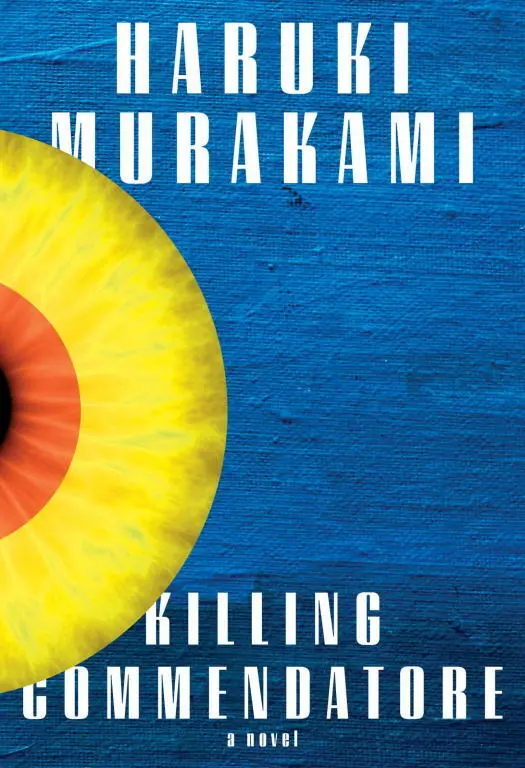
- Название:Killing Commendatore
- Автор:
- Издательство:Alfred A. Knopf
- Жанр:
- Год:2018
- Город:New York
- ISBN:978-0-5255-2005-4
- Рейтинг книги:5 / 5. Голосов: 1
-
Избранное:Добавить в избранное
- Отзывы:
-
Ваша оценка:
Killing Commendatore: краткое содержание, описание и аннотация
Предлагаем к чтению аннотацию, описание, краткое содержание или предисловие (зависит от того, что написал сам автор книги «Killing Commendatore»). Если вы не нашли необходимую информацию о книге — напишите в комментариях, мы постараемся отыскать её.
In Killing Commendatore, a thirty-something portrait painter in Tokyo is abandoned by his wife and finds himself holed up in the mountain home of a famous artist, Tomohiko Amada. When he discovers a previously unseen painting in the attic, he unintentionally opens a circle of mysterious circumstances. To close it, he must complete a journey that involves a mysterious ringing bell, a two-foot-high physical manifestation of an Idea, a dapper businessman who lives across the valley, a precocious thirteen-year-old girl, a Nazi assassination attempt during World War II in Vienna, a pit in the woods behind the artist’s home, and an underworld haunted by Double Metaphors.
A tour de force of love and loneliness, war and art—as well as a loving homage to The Great Gatsby—Killing Commendatore is a stunning work of imagination from one of our greatest writers.
Killing Commendatore — читать онлайн бесплатно полную книгу (весь текст) целиком
Ниже представлен текст книги, разбитый по страницам. Система сохранения места последней прочитанной страницы, позволяет с удобством читать онлайн бесплатно книгу «Killing Commendatore», без необходимости каждый раз заново искать на чём Вы остановились. Поставьте закладку, и сможете в любой момент перейти на страницу, на которой закончили чтение.
Интервал:
Закладка:
“So I guess you have to be prepared for the worst.”
“That’s about right.”
“It must be rough.”
“Hey, it’s a big deal when someone dies. I can hardly complain.”
The old Volvo was equipped with a tape deck, and the glove compartment was stuffed with cassettes. Masahiko stuck his hand in, grabbed one, and inserted it without checking to see what it was. It turned out to be a collection of hits from the 1980s. Duran Duran, Huey Lewis, and so on. When ABC’s “The Look of Love” came on, I turned to him.
“Sure feels like time has stopped in this car,” I said.
“I don’t like CDs. They’re too shiny—they’d scare crows away if I hung them outside my house, but they’re hardly something to listen to music on. The sound is tinny and the mixing is unnatural. Having no A and B sides is a drag too. That’s why I still drive this car—so I can listen to my cassettes. Newer models don’t have tape decks, right? Everyone thinks I’m nuts. But I’m stuck. I have a huge collection of songs I recorded off the radio and I don’t want them to go to waste.”
“Man, I never thought I’d hear ABC’s ‘Look of Love’ again in this lifetime.”
“Don’t you think it’s amazing?” Masahiko said, casting me a quizzical glance.
We went on talking about the music of the eighties, songs we’d heard on the radio, as we tooled through the mountains of Hakone. The blue slopes of Mt. Fuji loomed around each curve.
“You and your dad are quite a pair,” I said. “The father listens only to records, and the son is stuck on cassettes.”
“You should talk. You’re just as behind the times. Worse than us, maybe. I mean, you don’t even have a cell phone. And you hardly ever go online, right? I’ve always got my cell phone with me, and anything I need to know, I Google. I design stuff on my Mac at work. Socially, I’m light-years ahead of you.”
Bertie Higgins’s rendition of “Key Largo” came on. An interesting selection indeed for a guy claiming to be socially evolved.
“Are you seeing anyone these days?” I asked, changing the subject.
“You mean, like a woman?”
“Yeah.”
Masahiko gave a small shrug. “I can’t say it’s going all that well. As usual. And things have gotten even rockier since I made this weird breakthrough.”
“What kind of breakthrough?”
“That the right and left sides of a woman’s face don’t match up. Did you know that?”
“People aren’t perfectly symmetrical,” I said. “Whether it’s breasts or balls, the size and shape of the two sides are always going to be different. Every artist knows that much. That lack of symmetry is one of the things that makes the human form so interesting.”
Masahiko shook his head several times without taking his eyes off the road. “Of course I know that. But what I’m saying is a little different. I’m talking about personality, not form.”
I waited for him to go on.
“About two months ago, I took a photo of this woman I was seeing with a digital camera. A close-up of her face from the front. I put it on the big office computer. Then I managed to divide the screen down the middle and look at the two halves of her face separately. Removing the right half to look at the left, and vice versa… You get the idea, right?”
“Yeah, I get it.”
“That’s when I realized that her left side and her right side looked like two separate people. Like Two-Face, the bad guy in Batman .”
“I missed that one.”
“You should watch it sometime. It’s pretty good. Anyway, it freaked me out a bit. I should have left things alone at that point, but I went ahead and tried reversing each side to make a composite face. That way, I could double the right side to create a complete face, and do the same with the left side. Computers make that sort of stuff easy. What I was left with was images of what could only be seen as two women with two totally distinct personalities. It shocked me. I mean, there were actually two women inside every woman I met. Have you ever looked at women that way?”
“Nope,” I said.
“I tested my idea on several other women. Took head shots and created left- and right-side composites on the computer. That made it even clearer. That women literally have two faces. Once I knew that, I found I couldn’t figure out women at all. For example, if I was with a woman and we were having sex, I didn’t know if it was her right side or her left that I was embracing. If it was the right side, then where had the left side gone—what was it doing, and what was it thinking?—and if it was the left side, then what was the right side thinking? Once I reached that point, things got really messy. Get what I’m saying?”
“Not completely, but I can see that it must be messy.”
“You bet. Really messy.”
“Did you try it on men’s faces?”
“Yeah, I did. But it didn’t work the same way. The only drastic changes were with women’s faces.”
“Maybe you should go see a psychologist or therapist about this,” I said.
Masahiko sighed. “You know, I’ve always believed myself to be a totally normal sort of guy.”
“That could be a dangerous belief.”
“To believe that I’m normal?”
“I think it was F. Scott Fitzgerald who wrote that one should never trust people who claim they’re normal. It’s in one of his novels.”
Masahiko thought about that for a moment. “So even a commonplace man is irreplaceable?”
“I guess that’s another way of putting it.”
Masahiko thought for a while, his hands on the steering wheel.
“At any rate,” he said, “could you try it just once and see?”
“You know I’ve been a portrait painter for a long time. So I think I’m more skilled than most when it comes to examining faces. You could even say I’m an expert at it. But I’ve never thought that the difference between the right and left sides reflected a disparity in personality. Not once.”
“But almost all the subjects you painted were men, correct?”
Masahiko had a point. I’d never been commissioned to paint a woman. For whatever reason, my portraits were all of men. The only exception was Mariye Akikawa, and she was more child than woman. And I hadn’t finished her portrait, either.
“Men and women are different,” Masahiko insisted. “Completely.”
“So then let me ask you,” I said. “Are you claiming this personality difference on the right and left sides applies to almost all women?”
“Yeah, that’s my conclusion.”
“So then do you find yourself attracted to one side or the other? Or do you find you like both sides less ?”
Masahiko pondered this question for a moment. “No,” he said at last. “That’s not how it works. It’s not that I prefer one side to the other. That I find one side cheerful and the other gloomy, or that one side is prettier. The problem is at another level: it’s simply that the two sides are different . It’s that sheer fact that shakes me up. Sometimes it scares me.”
“It sounds to me like a kind of obsessive-compulsive disorder,” I said.
“It sounds like that to me too,” Masahiko said. “Just listening to myself. But it’s the truth . I ask you, just check it out for yourself.”
I promised him I would. But I had no intention of following through. That could only add to my troubles. My life was messy enough as it was.
Then we talked about Tomohiko Amada. About Tomohiko Amada in Vienna.
“My father said he heard Richard Strauss conduct one of Beethoven’s symphonies,” Masahiko said. “With the Vienna Philharmonic, of course. He said it was out of this world. That’s one of the few stories he told me about his days in Vienna.”
Читать дальшеИнтервал:
Закладка:
Похожие книги на «Killing Commendatore»
Представляем Вашему вниманию похожие книги на «Killing Commendatore» списком для выбора. Мы отобрали схожую по названию и смыслу литературу в надежде предоставить читателям больше вариантов отыскать новые, интересные, ещё непрочитанные произведения.





Обсуждение, отзывы о книге «Killing Commendatore» и просто собственные мнения читателей. Оставьте ваши комментарии, напишите, что Вы думаете о произведении, его смысле или главных героях. Укажите что конкретно понравилось, а что нет, и почему Вы так считаете.