Харуки Мураками - Killing Commendatore
Здесь есть возможность читать онлайн «Харуки Мураками - Killing Commendatore» весь текст электронной книги совершенно бесплатно (целиком полную версию без сокращений). В некоторых случаях можно слушать аудио, скачать через торрент в формате fb2 и присутствует краткое содержание. Город: New York, Год выпуска: 2018, ISBN: 2018, Издательство: Alfred A. Knopf, Жанр: Современная проза, на английском языке. Описание произведения, (предисловие) а так же отзывы посетителей доступны на портале библиотеки ЛибКат.
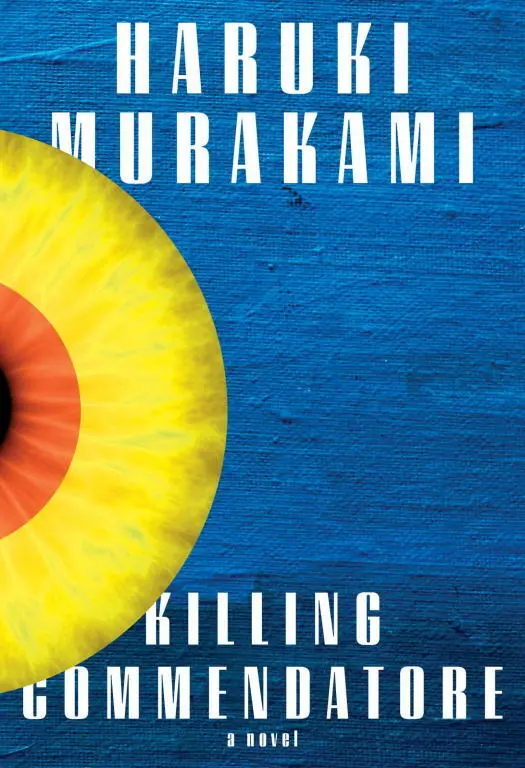
- Название:Killing Commendatore
- Автор:
- Издательство:Alfred A. Knopf
- Жанр:
- Год:2018
- Город:New York
- ISBN:978-0-5255-2005-4
- Рейтинг книги:5 / 5. Голосов: 1
-
Избранное:Добавить в избранное
- Отзывы:
-
Ваша оценка:
Killing Commendatore: краткое содержание, описание и аннотация
Предлагаем к чтению аннотацию, описание, краткое содержание или предисловие (зависит от того, что написал сам автор книги «Killing Commendatore»). Если вы не нашли необходимую информацию о книге — напишите в комментариях, мы постараемся отыскать её.
In Killing Commendatore, a thirty-something portrait painter in Tokyo is abandoned by his wife and finds himself holed up in the mountain home of a famous artist, Tomohiko Amada. When he discovers a previously unseen painting in the attic, he unintentionally opens a circle of mysterious circumstances. To close it, he must complete a journey that involves a mysterious ringing bell, a two-foot-high physical manifestation of an Idea, a dapper businessman who lives across the valley, a precocious thirteen-year-old girl, a Nazi assassination attempt during World War II in Vienna, a pit in the woods behind the artist’s home, and an underworld haunted by Double Metaphors.
A tour de force of love and loneliness, war and art—as well as a loving homage to The Great Gatsby—Killing Commendatore is a stunning work of imagination from one of our greatest writers.
Killing Commendatore — читать онлайн бесплатно полную книгу (весь текст) целиком
Ниже представлен текст книги, разбитый по страницам. Система сохранения места последней прочитанной страницы, позволяет с удобством читать онлайн бесплатно книгу «Killing Commendatore», без необходимости каждый раз заново искать на чём Вы остановились. Поставьте закладку, и сможете в любой момент перейти на страницу, на которой закончили чтение.
Интервал:
Закладка:
“Leaving Mariye out of the picture?”
“That’s hard to know. Mariye was the reason for our first meeting, after all. But had Mariye never existed, I think I still would have been attracted to her aunt.”
I wondered about that. Would a man whose mind was as complicated as Menshiki’s be so “powerfully attracted” to a woman as simple and easygoing as Shoko Akikawa? Still, I was in no position to judge. The workings of the human heart are impossible to predict. Especially when sex is involved.
“I understand,” I said. “At any rate, thank you for speaking so honestly. Honesty is always best, I think.”
“I hope you’re right.”
“To tell you the truth, Mariye already knew. That you and Shoko had begun that sort of relationship. In fact, she came to talk to me about it. A few days ago.”
The news seemed to catch Menshiki by surprise.
“She’s a perceptive child,” he said. “We tried our best not to let her find out.”
“Yes, a very perceptive child. But she didn’t find out from you. It was the things her aunt said and did that tipped her off.”
Shoko was a well-brought-up, intelligent woman, but while she could conceal her feelings to a degree, her mask was bound to slip sooner or later. Menshiki was aware of that, no question.
“If that’s the case… do you think Mariye’s disappearance is connected to her discovery of our relationship?”
I shook my head. “I can’t tell for sure. But I can tell you that you and Shoko ought to talk through everything together. She’s beside herself with worry, and she’s confused. She must be in need of your encouragement and support. Urgently in need.”
“You’re right. I’ll contact her the minute I get home.”
Menshiki wasn’t finished. Something else appeared to be on his mind.
He sighed. “To tell the truth, I don’t think I’ve fallen in love. I’m not cut out for that. Haven’t been from the beginning. I don’t know why I feel as I do. Would I have been so attracted to Shoko if not for Mariye? The connection between the two of them isn’t clear to me at all.”
I said nothing.
“But I swear I didn’t plan any of it in advance. Can you believe me?”
“Mr. Menshiki,” I said. “I can’t explain why, but I think you’re an honest man at heart.”
“Thank you,” he said. The corners of his mouth edged upward. It was a somewhat uncomfortable smile, but not an altogether unhappy one.
“Can I go on being honest?” he said.
“Of course.”
“Sometimes I think I’m empty,” he confessed. The smile still lingered on his lips.
“Empty?”
“Hollow inside. I know it sounds arrogant, but I’ve always operated on the assumption that I was a lot brighter and more capable than other people. More perceptive and discerning, with greater powers of judgment. Physically stronger, too. I figured I could succeed at whatever I turned my mind to. And I did. Put my hands on whatever I wanted to possess. Being locked up in Tokyo prison was a clear setback, of course, but I considered that an exception to the rule. When I was young, I saw no limits to what I could achieve. I thought I could attain a state close to perfection. Climb and climb until I reached a height where I could gaze down on everyone else. But when I passed fifty, I looked at myself in the mirror and discovered nothing but emptiness. A zero. What T. S. Eliot called a ‘straw man.’”
I couldn’t think of anything to say.
“My whole life may have been a mistake up till now,” Menshiki went on. “I feel that way sometimes. That I took a wrong turn somewhere. That nothing I’ve done has any real meaning. That’s why I told you I often find myself envying you.”
“Envying what, for example?”
“You have the strength to wish for what you cannot have. While I have only wished for those things I can possess.”
I assumed he was talking about Mariye. She was the one thing that had evaded his grasp. Yet there wasn’t much I could say about that.
Menshiki slowly got into his car. Then he rolled down the window, said goodbye, and drove off. When his car was out of sight I went back into the house. It was just past eight.
The telephone rang at shortly after ten. The call was from Masahiko.
“I know it’s sudden,” he said, “but I’m on my way to Izu to see my father. Would you like to come along? You mentioned the other day that you’d like to meet him.”
Someone will phone my friends tomorrow morning and invite you somewhere. You must not decline.
“That’s great. I’d love to go.”
“I just got on the Tokyo-Nagoya Expressway. I’m at the Kohoku parking area now. I think it’ll take me about an hour to reach you. I’ll pick you up and we can drive to Izu Kogen.”
“Did something happen to your father?”
“Yeah, the nursing home called. Seems he’s taken a turn for the worse. So I’m going to check on him. I’m more or less free today anyway.”
“Are you sure it’s all right if I go along? Aren’t times like this for family only?”
“Don’t worry. It’s perfectly okay. No other relatives will be there, so the more the merrier.” He hung up.
I put down the phone and scanned the room. Was the Commendatore around? But he was nowhere to be seen. Prophecy dispensed, he had disappeared. Probably to a realm where the dictates of time, space, and probability did not apply. Nevertheless, there had been a morning phone call, and I had been invited somewhere. So far, at least, that prophecy had been accurate. It bothered me to leave with Mariye still unaccounted for, but I couldn’t do much about that. The Commendatore had instructed me, “No matter the circumstances, my friends must not decline that invitation.” I could leave Shoko in Menshiki’s hands. After all, she was his responsibility, to some extent.
I sat back in the easy chair in the living room and resumed the story of the invincible Armada as I waited for Masahiko. Almost all the Spanish soldiers and seamen who had managed to escape their shipwrecked vessels and crawl onto the shores of Ireland more dead than alive were murdered by those who lived along the coast. The poverty-stricken locals had slaughtered them for their possessions. It had been the Spaniards’ hope that, as fellow Catholics, the Irish might show them mercy, but they were out of luck. Religious solidarity was no match for the fear of starvation. Sadly, the Spanish ship carrying the war chest holding the gold and silver intended to buy off England’s powerful nobility sank as well. No one knew where all that wealth had gone.
It was shortly before eleven in the morning when Masahiko’s old black Volvo pulled up in front of my house. I was still thinking about all those gold coins lying at the bottom of the sea as I threw on my leather jacket and headed out the door.
The route Masahiko chose took us from the Hakone Turnpike to the Izu Skyline highway and then down from the Amagi highlands to Izu. He explained that this way would be faster—that the weekend meant the coastal roads would be jammed—but nevertheless our route was crowded with people out on excursions. The leaf-viewing season had not yet ended, and many of those on the road were weekenders unfamiliar with mountain driving, so the trip took a lot longer than expected.
“Is your father really in bad shape?” I asked.
“He’s not long for this world, that’s for sure,” Masahiko said lightly. “A matter of days, to be more precise. Age has whittled him down to almost nothing. He has trouble eating, and pneumonia is a constant threat. But the patient’s orders are that under no circumstances are IV lines and feeding tubes to be used. In other words, he demands that he be allowed to go quietly once he can no longer eat. He arranged this with his lawyer when he was still mentally competent, signed the forms and everything. So there will be no interventions. That means he could go at any time.”
Читать дальшеИнтервал:
Закладка:
Похожие книги на «Killing Commendatore»
Представляем Вашему вниманию похожие книги на «Killing Commendatore» списком для выбора. Мы отобрали схожую по названию и смыслу литературу в надежде предоставить читателям больше вариантов отыскать новые, интересные, ещё непрочитанные произведения.






Обсуждение, отзывы о книге «Killing Commendatore» и просто собственные мнения читателей. Оставьте ваши комментарии, напишите, что Вы думаете о произведении, его смысле или главных героях. Укажите что конкретно понравилось, а что нет, и почему Вы так считаете.