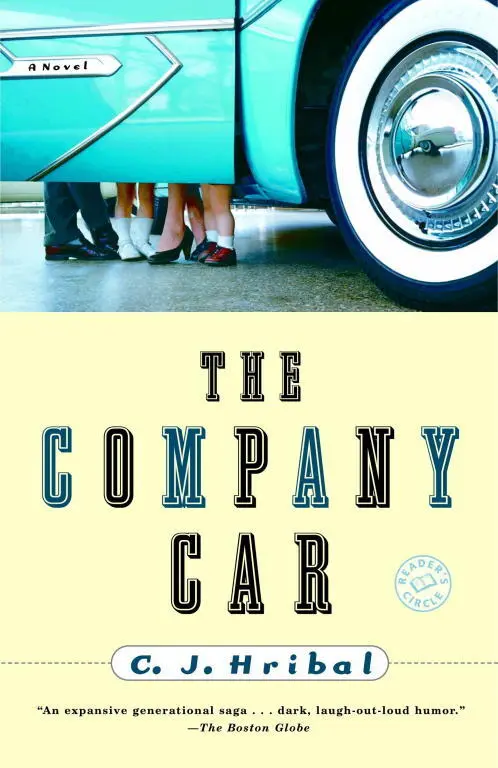
C Hribal - The Company Car
Здесь есть возможность читать онлайн «C Hribal - The Company Car» весь текст электронной книги совершенно бесплатно (целиком полную версию без сокращений). В некоторых случаях можно слушать аудио, скачать через торрент в формате fb2 и присутствует краткое содержание. Город: New York, Год выпуска: 2005, ISBN: 2005, Издательство: Random House, Жанр: Современная проза, на английском языке. Описание произведения, (предисловие) а так же отзывы посетителей доступны на портале библиотеки ЛибКат.
- Название:The Company Car
- Автор:
- Издательство:Random House
- Жанр:
- Год:2005
- Город:New York
- ISBN:1-58836-468-2
- Рейтинг книги:3 / 5. Голосов: 1
-
Избранное:Добавить в избранное
- Отзывы:
-
Ваша оценка:
The Company Car: краткое содержание, описание и аннотация
Предлагаем к чтению аннотацию, описание, краткое содержание или предисловие (зависит от того, что написал сам автор книги «The Company Car»). Если вы не нашли необходимую информацию о книге — напишите в комментариях, мы постараемся отыскать её.
“Are we there yet?” It’s the time-honored question of kids on a long family car trip—and Emil Czabek’s children are no exception. Yet Em asks himself the same thing as the family travels to celebrate his parents’ fiftieth wedding anniversary, and he wonders if he has escaped their wonderfully bad example.
The midwestern drive is Em’s occasion to recall the Czabek clan’s amazing odyssey, one that sprawls through the second half of the twentieth century. It begins with his parents’ wedding on the TV show It’s Your Marriage, and careens from a suburban house built sideways by a drunken contractor to a farm meant to shelter the Czabeks from a country coming apart. It is the story of Em’s father, Wally—diligent, distant, hard-drinking—and his attempts to please, protect, or simply placate his nervous, restless, and sensual wife, Susan, all in plain sight of the children they can’t seem to stop having.
As the tumultuous decades merge in his mind like the cars on the highway, Em must decide whether he should take away his parents’ autonomy and place them in the Heartland Home for the Elders. Beside him, his wife, Dorie, a woman who has run both a triathlon and for public office, makes him question what he’s inherited and whether he himself has become the responsible spouse of a drifting partner—especially since she’s packing a diaphragm and he’s had a vasectomy.
Wildly comic and wrenchingly poignant, The Company Car is a special achievement, a book that drives through territory John Irving and Jonathan Franzen have made popular to arrive at a stunning destination all its own.
The Company Car — читать онлайн бесплатно полную книгу (весь текст) целиком
Ниже представлен текст книги, разбитый по страницам. Система сохранения места последней прочитанной страницы, позволяет с удобством читать онлайн бесплатно книгу «The Company Car», без необходимости каждый раз заново искать на чём Вы остановились. Поставьте закладку, и сможете в любой момент перейти на страницу, на которой закончили чтение.
Интервал:
Закладка:
“Are you sure Mom and Dad can’t hear us?” asks Meg.
“Our father,” says Robert Aaron, “is piloting a La-Z-Boy into oblivion, and Mom is in her room with all the windows closed. What’s to hear? Besides, we’re just doing the Five P’s now.”
“The Five P’s?” Except for Brian, Meg’s beau, a quiet guy who suffers our loudness well, Dorie’s the only nonsibling up here. Our conversation was interrupted when Robert Aaron asked us to join him on the roof. Dorie’s stretched out at the base of the chimney, eyes closed, hands folded over her belly. She’s only vaguely interested in this. Her thoughts are on the hills of Pennsylvania, the sandy roads around Lake Michigan.
“Prior Planning Prevents Poor Performance.”
“You get that from Dad or Dale Carnegie?”
“From me,” says Ernie. “And I got it from Tony Robbins. Or Pete Lowe, one of those motivational guys. My whole office had to go to one of those seminars. You know, where they have you hugging total strangers and shouting ‘I can do it! I can be happy! Today I can be better than yesterday and tomorrow I can be my best!’ ” Ernie does exaggerated cheerleading moves, his hands shaking imaginary pom-poms as he skitters across the roof.
“Careful,” says Robert Aaron. “I don’t want you throwing yourself off the roof.”
“Will you relax? It’s a party, goddamn it, a party!” Ernie drains his beer, slings the bottle into the alfalfa field.
“Hey, pisshead!” says Wally Jr., never exactly Ernie’s buddy. “Stop being an idiot.”
“Too late,” says Ernie. “I’m hap-hap-happy! Act happy, feel happy, be happy! Let me hear you say Amen! I said, Let me hear you say Amen!” He’s dancing, eyes closed, spinning first on one foot, then on two. The spirit’s within him. He spins again and dances right off the roof.
“Amen,” says Wally Jr.
In what was to be our last autumn in Elmhurst, our mother decided to throw a costume party for Halloween. Of course, we didn’t know it was to be our last autumn in Elmhurst. We—we kids, that is—still thought we were entrenched there. Cinderella was in eighth grade, already dreaming about life in high school. Robert Aaron was trying out for seventh-grade football. Horrible things were happening in the world, but our parents, at least in front of us, were pretending that everything was okay. “The static quo,” Nomi called it. “You can do worse in life than maintain the static quo.” A veteran of several bankruptcies and the Great Depression (“She doesn’t look sad anymore,” said Ike), she was allowed to pontificate in our household, even to our father, to whom her remark was directed.
Of course the static quo was not okay with our father. After months of silence on the subject and no visits to Uncle Louie, our mother took a different tack. Uncle Louie was to visit us. Our mother maintained the party was to cheer up Uncle Louie, but we guessed that it wasn’t only for him. Our mother was hoping that a real celebration, a party on a day usually reserved for the kiddies, and at our home, would make our father feel better, would make him forget about the sawn-in-half boat that was sitting now in our backyard. It also would bring Uncle Louie back into the fold, and reestablish our mother as hostess and peacemaker, not the distraught harridan who was forcing our father into his nightly pilgrimage to the Office. Our mother was no doubt aware that these were ambitions no party should bear, but she was also grimly determined that it be all these things. In the weeks before the party, our mother wore on her face an expression of aggressive niceness, as though her fierce good cheer would be contagious. Were it not for the fact that it was Halloween and we had our own desires, we’d have been creeped out by the alien, its smile fixed firmly in place, that had taken over our mother’s body.
The year of our parents’ costume party it was a warm Halloween. We were ecstatic. No winter coats covering up our costumes, and our hands wouldn’t freeze. Not quite ten, I was the Indian brave I had always thought I was. Down the outside seams of my jeans our mother had sewn strips of diamond-patterned cloth and had made a breechclout, vest, and headband out of the same material. Two pheasant tail feathers completed the headdress. My war paint was streaks of lipstick in three colors, and I was probably the only Indian brave east—or west—of the Mississippi who sported a blond crew cut.
I was looking forward to being out all evening. Out in the gloaming, as Artu would say. “The homer in the gloamer,” said our father, recalling a day when the Cubs still won pennants.
Oh, to be a ten-year-old at dusk in America!
Our mother had other plans. “Short night,” she said. “Patty Duckwa is going to babysit you.” Patty Duckwa? My heart did its lurchings. My brain twittered with an image of the bas relief Venus de Milo in Grandpa Cza-Cza’s basement, only she had Patty Duckwa’s arms and Patty Duckwa’s breasts. Flutterings in my stomach now, twitchings and tinglings in my groin. I barely heard our mother explaining that Cinderella, our usual babysitter, would need help later, and Nomi and Artu, who didn’t want to be in the house as the party got going, were going out for dinner and a movie. And our mother, who had a party to prepare for, wasn’t going to walk with the little ones. We had to. Patty would be over later. More tinglings.
We went outside. “Criminy,” said Robert Aaron. He had friends waiting for him. He and Cinderella and I were each assigned a sibling. Cinderella, a witch, had Peg Leg Meg, dressed as a princess. Robert Aaron, a pirate, had Ernie, a pumpkin. Ike and I (Ike was a sheikh, my costume from last year) had Wally Jr., whom Mom had dressed as an Indian brave, too. Great, I thought, just what I needed: a towheaded Indian in tow. How was I to maintain my ferocity and seriousness if a rotund, jolly, dimple-cheeked Indian was holding my hand? I could already hear the jokes: “Oh, are you blood brothers?” “Abner, come take a look at this—one little, two little Indian boys.” And then they’d start singing that song.
Wally Jr., Ernie, and Peg Leg Meg had plastic buckets with jack-o’-lantern faces. Our plan was to get those buckets filled as quickly as possible, then get these kids the hell home. Once we got out of earshot of our mother, the soft night air would belong to us.
It didn’t play out that way. We walked our charges around our block once, and around the block behind us, but when we got back our mother wasn’t ready yet, Patty Duckwa hadn’t come over yet, our father wasn’t home yet, and we had to take them on another round of the neighborhood. They were tired. They were whiny. Their hands were hot. We circled another block and brought them home. “Oh, good, you’re here,” said our mother. “Dinner’s ready, then it’s off to bed with you.” To bed? This early? On Halloween night? But we were just getting started. “I can’t help it,” said our mother. “The party’s going to start soon, your father isn’t here, and I can’t have you wandering around the neighborhood. Of course I don’t mean to bed to bed. I mean you have to be in your rooms, where Sarah and Patty can keep an eye on you.”
We begged, we pleaded—Just one more block, Mommy, pleeeeeeeease! just one more block? She relented. She was wiping her hands on a dish towel—her most characteristic gesture. “You’ll be the death of me,” she said, but she had given us her blessing. We took off like a shot.
It was already dark. We had no intention of going only a single block. We’d already visited every house in a three-block radius. Robert Aaron suggested we split up. “We’ll cover more ground that way. It’s getting late.”
“It’s already late,” countered Cinderella. “You’re just hoping to run into your friends.”
Читать дальшеИнтервал:
Закладка:
Похожие книги на «The Company Car»
Представляем Вашему вниманию похожие книги на «The Company Car» списком для выбора. Мы отобрали схожую по названию и смыслу литературу в надежде предоставить читателям больше вариантов отыскать новые, интересные, ещё непрочитанные произведения.





Обсуждение, отзывы о книге «The Company Car» и просто собственные мнения читателей. Оставьте ваши комментарии, напишите, что Вы думаете о произведении, его смысле или главных героях. Укажите что конкретно понравилось, а что нет, и почему Вы так считаете.