C Hribal - The Company Car
Здесь есть возможность читать онлайн «C Hribal - The Company Car» весь текст электронной книги совершенно бесплатно (целиком полную версию без сокращений). В некоторых случаях можно слушать аудио, скачать через торрент в формате fb2 и присутствует краткое содержание. Город: New York, Год выпуска: 2005, ISBN: 2005, Издательство: Random House, Жанр: Современная проза, на английском языке. Описание произведения, (предисловие) а так же отзывы посетителей доступны на портале библиотеки ЛибКат.
- Название:The Company Car
- Автор:
- Издательство:Random House
- Жанр:
- Год:2005
- Город:New York
- ISBN:1-58836-468-2
- Рейтинг книги:3 / 5. Голосов: 1
-
Избранное:Добавить в избранное
- Отзывы:
-
Ваша оценка:
The Company Car: краткое содержание, описание и аннотация
Предлагаем к чтению аннотацию, описание, краткое содержание или предисловие (зависит от того, что написал сам автор книги «The Company Car»). Если вы не нашли необходимую информацию о книге — напишите в комментариях, мы постараемся отыскать её.
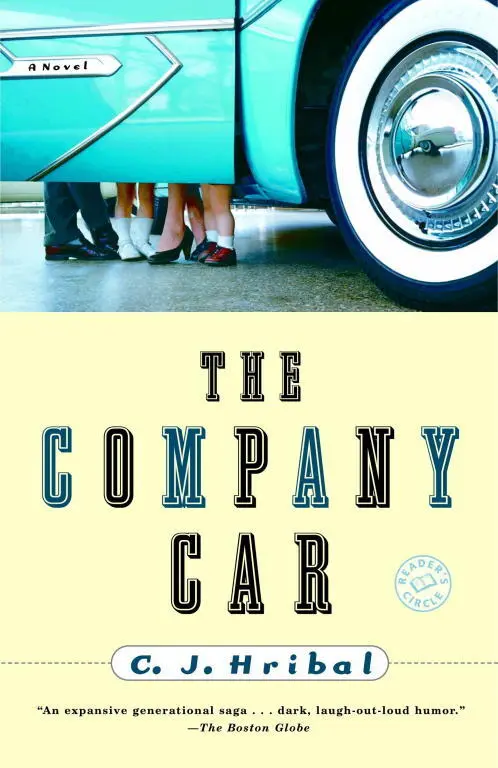
“Are we there yet?” It’s the time-honored question of kids on a long family car trip—and Emil Czabek’s children are no exception. Yet Em asks himself the same thing as the family travels to celebrate his parents’ fiftieth wedding anniversary, and he wonders if he has escaped their wonderfully bad example.
The midwestern drive is Em’s occasion to recall the Czabek clan’s amazing odyssey, one that sprawls through the second half of the twentieth century. It begins with his parents’ wedding on the TV show It’s Your Marriage, and careens from a suburban house built sideways by a drunken contractor to a farm meant to shelter the Czabeks from a country coming apart. It is the story of Em’s father, Wally—diligent, distant, hard-drinking—and his attempts to please, protect, or simply placate his nervous, restless, and sensual wife, Susan, all in plain sight of the children they can’t seem to stop having.
As the tumultuous decades merge in his mind like the cars on the highway, Em must decide whether he should take away his parents’ autonomy and place them in the Heartland Home for the Elders. Beside him, his wife, Dorie, a woman who has run both a triathlon and for public office, makes him question what he’s inherited and whether he himself has become the responsible spouse of a drifting partner—especially since she’s packing a diaphragm and he’s had a vasectomy.
Wildly comic and wrenchingly poignant, The Company Car is a special achievement, a book that drives through territory John Irving and Jonathan Franzen have made popular to arrive at a stunning destination all its own.
The Company Car — читать онлайн бесплатно полную книгу (весь текст) целиком
Ниже представлен текст книги, разбитый по страницам. Система сохранения места последней прочитанной страницы, позволяет с удобством читать онлайн бесплатно книгу «The Company Car», без необходимости каждый раз заново искать на чём Вы остановились. Поставьте закладку, и сможете в любой момент перейти на страницу, на которой закончили чтение.
Интервал:
Закладка:
By the fall our mother had gotten over our father’s reproach. She was, she said, “only trying to help.” To which our father replied, “He don’t need that kind of help.” Said our mother, “I was talking about you, Wally.” She had a point. The two boats, the trips to Uncle Louie’s—it was not working. Our father remained a frustrated man, not able to breathe—whatever that meant—and his trips to the Office only seemed to exacerbate matters, not help them, as he claimed they did.
Adding to his frustration was his miscalculation regarding the size of his boat. Or rather, the size of the door the boat had to get through if our father ever wanted it to see water. Artu and Uncles Benny and Louie had come over to help our father lift the boat off the sawhorses and out the door, but the boat was too wide, even when they turned it sideways. This was unfortunate, not only because they could not get it outside but because, except in the case of Artu, who had a sense of propriety and decorum, they had started in on a case of Miller High Life and had drunk two of the three champagne bottles they’d planned to christen our father’s boat with. Men deep in the midst of mirth-making should not, I believe, be confronted by logistical problems, or by anything that requires the figuring out of angles. In this case, the solution was clear. They had to take apart the doorframe, which they did amid much puffing, grunting, cursing, and what seemed to be genial joshing of our father, who’d constructed that classic of American shipbuilding, the boat too wide for its container.
And even then, when they got it sideways, the demolished doorframe a pile of broken lumber just inside the door, and they were nosing the boat out the door, scraping the keel as they went, they were again stymied. Our father—and his father—had forgotten the exterior basement stairs ran parallel to the back of the house, so they were nosing the boat into a narrow stairwell that immediately turned ninety degrees to the left. The boat’s nose bumped the concrete stairwell outside the door, and there they stood for a while, holding their burden, their muscles quaking—a plywood boat is pretty heavy, even if it’s a fourteen-footer—until Artu let his side go and started laughing and laughing. The other guys set their sides down, too, and laughed and wiped tears from their eyes and pointed, and shook their heads, and laughed again.
“Wally,” said Artu, “I do believe you’re going to have to saw this puppy in half if you want to get it up these stairs.”
Our father blinked, and his mouth fell open in an empty look of disbelief. All those calculations and he’d never opened the basement door, had never thought to see what lay outside. He was mortified, stupefied, chagrined. He emitted a low rumbling of curses that sounded like a motor started across a lake and opened to full throttle as it came near.
“Wally, the children,” said Artu, and our father answered him with something that I was reasonably sure was anatomically impossible. Our father was behind the boat, and I believe at that moment, had he the strength, he’d had shoved that boat into the stairwell wall until it was splinters. Instead he gritted his teeth and hissed, “The saw, get me the goddamn saw.”
“I see, said the blind man, as he picked up his hammer and saw,” said Robert Aaron, and for this he was rewarded with one of our father’s backhands across his teeth. Blood was dripping from his upper lip, but he just closed his mouth and said nothing. Nobody else said anything, either, not even Artu.
“I said,” hissed our father, “get me the goddamn saw.”
“Which one?” Louie asked.
Our father reflected a moment. He walked up and down the length of his boat, his fingers stroking the gunwales as the owner of a fine horse with a broken leg might stroke its withers prior to ordering that it be put down. Our father shook his head, and we could see he was near tears, bitter, bitter tears. “Well,” he bit out, “if I’m going to make a proper butchery of it, then I suppose I shall need the circular saw.”
Louie fetched it, plugged it in, ceremoniously held it out to our father. Had he been able to play “Taps,” I believe he would have. Then our father lowered his safety goggles, ordered his friends to hold the boat steady, and when the whine of the saw started to bite into the wood, we all had to turn away. It wasn’t only the sawdust being scattered in its wake that made us flinch. That whine, that whine, I will always remember that whine. The shriek of metal eating wood. It is the sound of dreams being sawn in two.

10. The Big Halloween: We Shall See What We Shall See
Roof summit. While Ike entertains our kids, we climb up the aerial tower abutting our parents’ house, setting up shop with a cooler of beer and soda. That triangular tower held together by Z-shaped rebar has been the sibling escape route, and the roof has been the sibling meeting place, of choice for over thirty years. How wonderful the farm seemed from up there. You were alone on the planet, on a different plane, and for a little while you could, in the words of our father, hear yourself think. Robert Aaron and I first used it as a place where we could get away from our siblings and talk about everything in the world that scared us—our changing bodies, girls, late periods and near-pregnancies, the future, our place in the world, what we wanted or feared to want. Eventually we were discovered, and soon everyone was climbing up on the roof. It was a place our parents weren’t supposed to know about, though, so even if the sib you hated most in the world right at that moment found you, you couldn’t order him or her off the roof. That was our one rule: “Nobody throws anybody else off the roof.” And we meant that literally. We’re talking a ranch house here, one and a half stories, a low pitch, so the worst you’re looking at is a sprained ankle or a broken leg, but still, it probably says something about us that we needed to have the rule in the first place. Expecting us to agree on anything is like expecting an amicable solution to the troubles in the Middle East. And for the same reason—too much history, too many pent-up animosities to untangle.
Robert Aaron, popping open a beer, is in charge. “Okay, the first order of business is nobody throws anybody else off the roof. And watch your step. I don’t want anybody taking an accidental header, either. Going splat on Mom and Dad’s anniversary—definite bummer.”
“Ha-ha,” says Wally Jr., who’s still down below. He has a hard time getting up on the roof anymore on account of his wheelchair. We offer to haul him up with ropes and block the wheels so he doesn’t pitch off, but he’d rather pull himself up, hand over hand. He’s fat now, though, so it’s slow going. “Now when I was a lean, mean fightin’ machine,” he says, “this would have been simple.” He says it cheerfully, without bile or bitterness, puffing a cigar as he pulls himself onto the roof. His wife, Claire, has gone back to their house. Can’t stand cigar smoke, she says. We’ve always suspected it was us she couldn’t stand, but that’s another story.
“So here we are,” says Ernie, popping his sixth or seventh beer of the evening.
“Ike’s not,” says Meg. “Cinderella neither.”
“But Ike’ll be up as soon as the kids in the tepee run out of gas—”
“Or he does.”
“—and what we decide isn’t going to affect Cinderella anyway. It’s not like Mom and Dad are expecting to move in with her.” Robert Aaron is reminding us that Cinderella, having helped mother us, gave up raising her own kids about halfway through and, given the additional burden of her own poor health, is not in the host-parents-in-their-old-age sweepstakes.
Читать дальшеИнтервал:
Закладка:
Похожие книги на «The Company Car»
Представляем Вашему вниманию похожие книги на «The Company Car» списком для выбора. Мы отобрали схожую по названию и смыслу литературу в надежде предоставить читателям больше вариантов отыскать новые, интересные, ещё непрочитанные произведения.





Обсуждение, отзывы о книге «The Company Car» и просто собственные мнения читателей. Оставьте ваши комментарии, напишите, что Вы думаете о произведении, его смысле или главных героях. Укажите что конкретно понравилось, а что нет, и почему Вы так считаете.