Barbara Vine - The Blood Doctor
Здесь есть возможность читать онлайн «Barbara Vine - The Blood Doctor» весь текст электронной книги совершенно бесплатно (целиком полную версию без сокращений). В некоторых случаях можно слушать аудио, скачать через торрент в формате fb2 и присутствует краткое содержание. Год выпуска: 2003, Издательство: Vintage, Жанр: Современная проза, на английском языке. Описание произведения, (предисловие) а так же отзывы посетителей доступны на портале библиотеки ЛибКат.
- Название:The Blood Doctor
- Автор:
- Издательство:Vintage
- Жанр:
- Год:2003
- ISBN:нет данных
- Рейтинг книги:4 / 5. Голосов: 1
-
Избранное:Добавить в избранное
- Отзывы:
-
Ваша оценка:
The Blood Doctor: краткое содержание, описание и аннотация
Предлагаем к чтению аннотацию, описание, краткое содержание или предисловие (зависит от того, что написал сам автор книги «The Blood Doctor»). Если вы не нашли необходимую информацию о книге — напишите в комментариях, мы постараемся отыскать её.
Barbara Vine (a.k.a. Ruth Rendell) deftly weaves this story of an eminent Victorian with a modern yarn about the embattled biographer, who is watching the House of Lords prepare to annul membership for hereditary peers and thus strip him of his position. Themes of fate and family snake throughout this teasing psychological suspense, a typically chilling tale from a master of the genre.
From Publishers Weekly
This rich, labyrinthine book by Vine (aka Ruth Rendell) concerns a "mystery in history," like her 1998 novel, The Chimney Sweeper's Boy. Martin Nanther-biographer and member of the House of Lords-discovers some blighted roots on his family tree while researching the life of his great-great-grandfather, Henry, an expert on hemophilia and physician to Queen Victoria. Martin contacts long-lost relatives who help him uncover some puzzling events in Henry's life. Was Henry a dour workaholic or something much more sinister? Vine can make century-old tragedy come alive. Still, the decades lapsed between Martin's and Henry's circles create added emotional distance, and, because they are all at least 50 years dead, we never meet Henry or his cohorts except through diaries and letters. Martin's own life-his wife's infertility and troubles with a son from his first marriage-is interesting yet sometimes intrudes on the more intriguing Victorian saga. Vine uses her own experience as a peer to give readers an insider's look into the House of Lords, at the dukes snoozing in the library between votes and eating strawberries on the terrace fronting the Thames. Some minor characters are especially vivid, like Martin's elderly cousin Veronica, who belts back gin while stonewalling about the family skeletons all but dancing through her living room. Readers may guess Henry's game before Vine is ready to reveal it, but this doesn't detract from this novel peopled by characters at once repellant and compelling.
From Library Journal
In her tenth novel writing as Barbara Vine, Ruth Rendell offers a novel of suspense based in 19th-century England and centering on deceit, murder, and various other family skeletons. Martin Nanther, the fourth Lord Nanther, has a comfortable life in present-day London as a Hereditary Peer in the House of Lords and as a historical biographer. He chooses as his most recent subject his own great-grandfather, the first Lord Nanther, physician to the royal family (Victoria and Albert) and an early noted researcher into the cause and transmission of hemophilia. The reader is taken through the family history as Martin painstakingly uncovers some not so savory bits of his own family's past. The story is dense with characters, and the author provides family trees of the two principal families, for which any reader will be eternally grateful. The story lacks the usual page-turner suspense of the Rendell/Vine novels but makes up for that with unusually detailed glimpses into Victorian life and the inner workings of the House of Parliament, which American readers will find particularly intriguing. Recommended for all public libraries. Caroline Mann, Univ. of Portland, OR
The Blood Doctor — читать онлайн бесплатно полную книгу (весь текст) целиком
Ниже представлен текст книги, разбитый по страницам. Система сохранения места последней прочитанной страницы, позволяет с удобством читать онлайн бесплатно книгу «The Blood Doctor», без необходимости каждый раз заново искать на чём Вы остановились. Поставьте закладку, и сможете в любой момент перейти на страницу, на которой закончили чтение.
Интервал:
Закладка:
The words ‘elevation’ and ‘noble’ lead me to think that Henry had his sights on a peerage. Perhaps the Queen had dropped hints, unlikely though this seems. His extraordinary notion about blood as against semen made me feel queasy the first time I read it and Jude, who was horrified by the idea of blood gushing from the penis at the moment of ejaculation, says it could put her off sex and she wishes I hadn’t told her. Henry seems to have picked up the habit from his mother-in-law of referring to Providence, but what does he mean about his being denied the opportunity he hoped for? And what is this bitter blow? The last line puzzles me too. If someone had written that today we’d think only that he was tired and age was telling on him. When Victorians wrote about ‘weakening of vitality’ they often meant something rather different. It sounds as if Henry is afraid of becoming impotent.
Next day Paul is at Alma Villa when I get home from the House. He’s staying the weekend with his friend in Ladbroke Grove and has phoned to ask one of us to post him a bunch of CDs he left here at Christmas. Jude, who’s powerless to be discreet about her pregnancy, said she’d something to tell him and if he wanted to hear it he’d better come up to St John’s Wood. Like most of his contemporaries, Paul conducts his life on the phone, talks into his mobile as he walks along the street and all the time he’s driving – which, thank God, happens seldom as he hasn’t a car and I won’t lend him mine – and wanted to know why she couldn’t tell him there and then. She said no, and curiosity drew him.
He’s in our living room, sitting opposite Jude, and instead of the sparkling water he lives on, he’s drinking whisky. When I come in he gets up, which is far from habitual with him, and says he thinks we’re mad. Jude has told him and he says he’s horrified. Well, what he actually says is that he thinks it’s ‘horrendous’.
‘I’m nearly nineteen,’ he says, ‘or hadn’t you noticed?’
That’s unfair because I’ve never forgotten his birthday and never would and he knows it. I fetch myself a whisky, though I never drink the stuff.
‘Jude wants children,’ I say, almost wincing at my own use of the plural. ‘Why not? She’s young enough. When she married me I don’t suppose she thought your existence disqualified me from having any more.’
‘ I want them,’ says Jude in a strained voice. She’s addressing me. ‘What you’ve said sounds as if you don’t.’
Paul ignores her. He’s staring at me. ‘And what about when your marriage breaks up?’ He takes no notice of Jude’s smothered gasp. ‘What’s the kid going to suffer? Have you thought of that?’
There are all sorts of things I could say, such as that I didn’t leave Sally, she left me, that any sufferings he had weren’t my fault, but I’m too angry to be coherent. I shout at him to get out of the house if he’s going to talk like that. I don’t want him, I didn’t invite him here, and God knows what Jude was thinking about even to tell her news to a little shit like him.
I’d forgotten, I always do forget, how he thrives on abuse. A smile of satisfaction spreads across his face. ‘I’ll help myself to some more of this,’ he says, ‘if you don’t mind,’ and he carries his whisky glass over to the cabinet, comes back with what you’d call a meagre amount if it was orange juice. ‘I just happen to feel that there ought to be a law against people who’ve been bad parents having any more kids.’
Jude counters this – bless her – with a calm and well-considered defence of me, telling him he can’t possibly call me a bad father when his mother took him away and did her best to deny me access. My anger has suddenly disappeared because I’ve realized something. Paul’s been rude and insulting and wildly slanderous, but what he hasn’t done is imply that things may go wrong and this baby never be born. I love him for that and ask him to stay to supper. He won’t, of course, but once he’s made a few of his essential phone calls and to my surprise heartily kissed Jude, he slopes off to a pub that does Thai food to meet one of the people he’s been talking to on his mobile.
Jude and I sit on the sofa, holding hands. She’s looking more like Olivia Batho than ever. Pregnancy has taken years off her, her skin glows with a pearly sheen and her eyes are clear and bright. She asks me if I’ve noticed she’s had no morning sickness and points out – this is her first reference to previous failures – that ‘last time’ she vomited every morning. This is a sign, she thinks, that everything is going to be all right.
‘You do want this baby, don’t you, Martin?’
I curse myself for my tactlessness half an hour ago and tell her that of course I do, I’m as excited about it as she is. And, though this is an exaggeration, I do have a feeling that considering the one I’ve got, another child might be different and might give me a chance to be a better father this time.
12
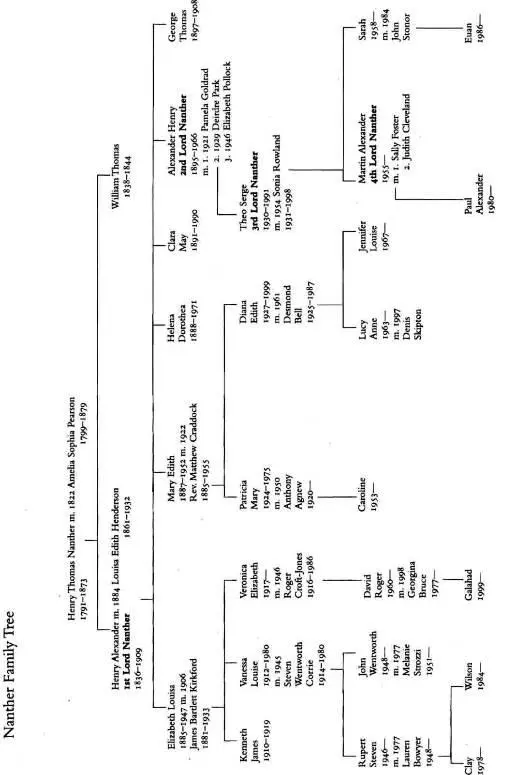
Last evening David Croft-Jones appeared on our doorstep, minus Georgie but bringing the latest version of the tree. Like most people, Jude and I don’t much like visitors turning up unannounced but we made the best of it. The tree is now several feet wide and growing by the week. I ask David about the letter from Patricia Agnew to his mother when he was three months old and he had another look at it. But he was as mystified as I am and a bit miffed too.
‘I obviously don’t have Down’s,’ he said rather stiffly.
‘No, but was that what Patricia thought you had?’
‘I really don’t have the faintest idea.’
I said that perhaps I could ask her. No, you can’t, he said, she’s dead. She’s been dead twenty years, and there’s a peevish note in his voice that implies I’d know that if I’d studied his tree properly. I suggested that her daughter, an only child, might know, but David poured scorn on that and said I’d have to employ a private detective because no one knows where Caroline is or what’s become of her. He didn’t explain what he meant by ‘no one’, though later on when he’d insisted on taking me relative by relative through the tree, he indicated he was sporadically in touch with Diana’s daughter Lucy.
He stayed so long that it was bedtime before he went. I fell asleep at once and some time during the night had a vivid dream. I was in a train – what else? – with Jude. We were on our way to some hospital in Scotland where she was going to undergo a test but I don’t know what kind of test because we seemed to be in the nineteenth century. At any rate, though I was in the sort of clothes I generally wear, Jude was in a crinoline and wearing a bonnet. She’s called Olivia but she looks more like Jimmy Ashworth than herself. In fact, she’s turning into Jimmy. It was evening. It was getting dark. A great gale rose, a storm of wind and rain. I suddenly realized what train we were in and where we were going. We were heading for the Tay Bridge and this was the night it’s going to collapse and take us with it.
I shall have to tell Olivia, I don’t want her to know, but I have to stop the train. A ticket collector comes in and I tell him my fears but I can’t tell him how I know. I don’t know how I know. Of course he doesn’t believe me, he thinks I’m mad. The bridge is new, he says, the bridge would stand a hurricane. I say, doesn’t he know who I am, I’m Lord Nanther. That makes it worse.
‘There’s no Lord Nanther,’ he says. ‘He’s lost his seat.’
After he’s gone I decide to pull the alarm handle, only it’s not a handle it’s a chain, a communication cord. Jude-Jimmy-Olivia has gone, disappeared, so there’s no one to stop me giving the alarm. I’m pulling on the cord when I wake up and find myself tugging on the bedlamp lead.
Читать дальшеИнтервал:
Закладка:
Похожие книги на «The Blood Doctor»
Представляем Вашему вниманию похожие книги на «The Blood Doctor» списком для выбора. Мы отобрали схожую по названию и смыслу литературу в надежде предоставить читателям больше вариантов отыскать новые, интересные, ещё непрочитанные произведения.





Обсуждение, отзывы о книге «The Blood Doctor» и просто собственные мнения читателей. Оставьте ваши комментарии, напишите, что Вы думаете о произведении, его смысле или главных героях. Укажите что конкретно понравилось, а что нет, и почему Вы так считаете.