Joanna Rakoff - A Fortunate Age
Здесь есть возможность читать онлайн «Joanna Rakoff - A Fortunate Age» весь текст электронной книги совершенно бесплатно (целиком полную версию без сокращений). В некоторых случаях можно слушать аудио, скачать через торрент в формате fb2 и присутствует краткое содержание. Город: London, Год выпуска: 2015, ISBN: 2015, Издательство: Bloomsbury, Жанр: Современная проза, на английском языке. Описание произведения, (предисловие) а так же отзывы посетителей доступны на портале библиотеки ЛибКат.
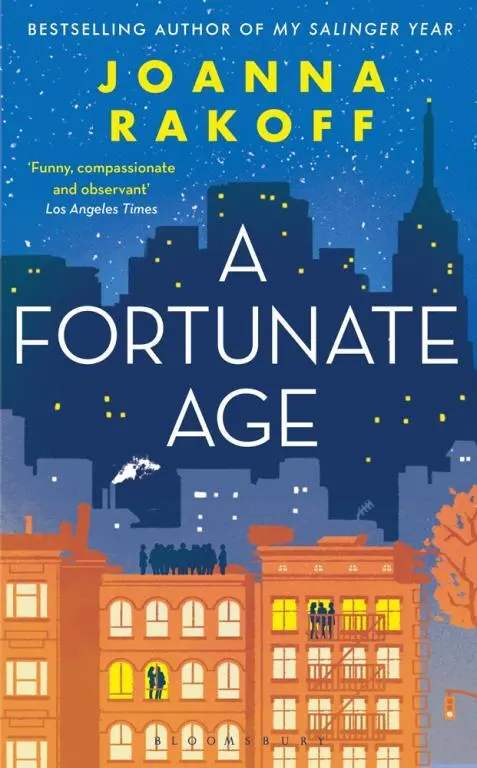
- Название:A Fortunate Age
- Автор:
- Издательство:Bloomsbury
- Жанр:
- Год:2015
- Город:London
- ISBN:978-1-4088-6239-1
- Рейтинг книги:4 / 5. Голосов: 1
-
Избранное:Добавить в избранное
- Отзывы:
-
Ваша оценка:
A Fortunate Age: краткое содержание, описание и аннотация
Предлагаем к чтению аннотацию, описание, краткое содержание или предисловие (зависит от того, что написал сам автор книги «A Fortunate Age»). Если вы не нашли необходимую информацию о книге — напишите в комментариях, мы постараемся отыскать её.
When the group come together to celebrate a marriage, anything seems possible. But soon the reality of rent, marriage and family will test them all. For this fortunate age can’t last for ever, and the group must face adulthood, whether they are ready for it or not.
Sprawling and richly drawn, A Fortunate Age traces the lives of the group during some of the most defining years of modern America—from the decadence of the dot com boom through to the sobering events of September 11 and the trailing years that followed—this brilliant, ambitious debut novel perfectly captures the hopes, anxieties and dreams of a generation.
A Fortunate Age — читать онлайн бесплатно полную книгу (весь текст) целиком
Ниже представлен текст книги, разбитый по страницам. Система сохранения места последней прочитанной страницы, позволяет с удобством читать онлайн бесплатно книгу «A Fortunate Age», без необходимости каждый раз заново искать на чём Вы остановились. Поставьте закладку, и сможете в любой момент перейти на страницу, на которой закончили чтение.
Интервал:
Закладка:
Mrs. Bernstein laughed. The summer after Beth’s graduation Dave had taken the train out—somewhat grudgingly—for the Bernsteins’ July Fourth barbecue. After sulking away most of the afternoon, he ended up deep in conversation with an older male cousin of Dr. Bernstein’s, a psychiatrist who had recently adopted Buddhism (after stints with Hinduism, Unitarianism, Confucianism, Scientology, and various strains of Socialism). Mrs. Bernstein tended to describe this cousin as a “condescending jerk” and on this particular day he was loudly yammering on about Buddhism. Somehow (it wasn’t hard to imagine how), he and Dave got into an argument, which began with the cousin suggesting that Dave didn’t really understand the “underlying principles” of Eastern religions and ended with Dave clutching a lawn chair in one hand, a steak knife in the other, saying, absurdly, “There’s an easy way to solve this. You want to go around the corner? Stand up, you pussy.” The cousin—a fattish sort, with a fey beard—cowered behind a potted ficus and told Beth that her boyfriend appeared to have sociopathic tendencies. Had he harmed animals as a child? Dave stormed out without saying good-bye, and presumably (he and Beth had never spoken of the incident) walked to the train station and skulked home to Brooklyn. Mrs. Bernstein had thought it all pretty funny. That cousin was just awful. He told everyone that they didn’t understand the “underlying principles” of this or that. But Beth was distraught afterward, feeling that she had failed Dave in some way. Now, however, she joined Mrs. Bernstein in a chortle.
“So you were afraid Dave had been arrested?” Mrs. Bernstein asked softly. “You were afraid for him?” Beth’s face went slack. “No, no. I wasn’t afraid. It was just… I try not to think about him. I can’t stand to think about him. He makes me so mad.” Mrs. Bernstein nodded sympathetically. “I know, I know. And you thought I was going to make you have some silly little chat about him. That I was acting like he was just another of your friends, like Lil or Sadie.” Beth furrowed her brow. “Something like that.” Mrs. Bernstein bobbed her blonde head. “But sweetie, what’s the trouble with him? Is he upset about your wedding? I mean, that you’re getting married? Is he making things difficult for you?” Beth shook her head. “No, no, he… he hasn’t said anything about it.” Before she could think about it, a little laugh escaped Mrs. Bernstein. “And I suppose that’s the problem.” Beth looked at her miserably and said nothing. “Do you see him? In the city?” Beth shrugged. “I see him sometimes. At parties.” “Your friends invite you two to the same parties?” Beth let out a guffaw. “Mom! He’s their friend, too. He’s known all of them as long as I have. What are they supposed to do? It’s not like they’re your friends, having little sit-down dinner parties. These are party-parties, with, like, a hundred people or something. It would be weird if they only invited one of us.” Mrs. Bernstein nodded. “I guess, it’s just now that you’re engaged , I thought—” “Mom, it’s not, like, 1950 . The world hasn’t changed because I’m engaged.”
Mrs. Bernstein struggled to stay calm. Beth rarely spoke to her this way, as though she were some sort of fossilized relic, incapable of understanding a young person’s mores or woes. But since she’d returned last fall, she’d been increasingly impatient and irritated with her parents, as though she was going through a delayed adolescence. Mrs. Bernstein had no idea why, unless, well, the Bernsteins had been in California when Beth arrived—visiting Jason at Stanford, over his fall break—and maybe Beth resented their not having been home to greet her and help her settle in to her new place. Perhaps she’d felt alone—abandoned—and fallen in with Will too quickly? But she’d insisted she would be fine. And she was twenty-seven years old, after all. At twenty-seven, Mrs. Bernstein had Beth, and a job, and a house, and Jason on the way.
No doubt, Lil’s wedding in and of itself had come as a bit of a blow. It’s always hard, Mrs. Bernstein thought, when the first of your friends marries. One of her friends had got married right out of school, to some man she’d met in the Village, and moved to a vegetarian commune in Maine. The rest of them thought it kind of a lark, as they were all going off on their single-girl adventures: Mrs. Bernstein to Morocco with the Peace Corps; her other friends to canvass for labor unions or environmental groups or to teach at public high schools in the Bronx or Brooklyn (where one, Marcy Goodman, had a gun pulled on her, long before they’d all started to worry about such things), or to internships at magazines or publishers. Now that friend—the first to marry—taught poetry at Colby and was married for the second time, to a doctor. The first husband moved back to New York and was never heard from again.
Why had she thought of that—Judy Horowitz and her communard? Yes, because of the difficulty when one’s first girlfriend marries. One feels betrayed. Was that why Beth had rushed into this engagement—and set the date for the wedding so soon? Because she felt abandoned by Lil? Until this point, Mrs. Bernstein had thought the exact opposite: that Lil’s happy marriage had made Beth see that Beth herself was also worthy of happiness in love. That Beth, too, might date a handsome, successful man—and even marry him—rather than the dissolute, self-important slackers (to use the kids’ lingo, which was quite apt in this case) she’d preferred since high school. Mrs. Bernstein also suspected that Lil and Tuck had made her see that marriage was not some archaic institution (as Beth had, no doubt, been taught at Oberlin, just as Mrs. Bernstein had before her), but a real and eventual part of life. Some of Mrs. Bernstein’s friends called it a “necessary evil,” but Mrs. Bernstein didn’t feel this way. She believed that some people were made for marriage. Beth, for example, had a nurturing personality and blossomed when she had someone to take care of; and yet, by the same token, she was also a fragile girl and needed someone to look out for her, to remind her to rest and take her vitamins. In May, when she and Will had come home to tell the Bernsteins about their engagement, she’d already seemed worlds happier and healthier, with a bloom in her cheeks and a sparkle in her eye. Remembering this, Mrs. Bernstein brightened. Until today, Beth had seemed over the moon about her wedding. She couldn’t really be thinking of Dave. She sighed again.
Beth, in some ways, resembled her father, a quiet, bookish man, prone to grand gestures (elaborate pieces of jewelry left on the toaster for Mrs. Bernstein to discover upon waking) and fits of melancholy (entire weeks spent in silence, reading and rereading Sophie’s Choice ). During Beth’s long illness in high school, Dr. Bernstein had spent every free minute sitting on the couch with the girl, watching old tearjerkers— Now, Voyager ; An Affair to Remember —and eating pumpkin seeds, his X-ray-filled briefcase open on his lap. It was during this same period, Mrs. Bernstein remembered, that Beth had read Sense and Sensibility —or, actually, all of Austen’s novels, in a two-volume set, brought home from the library—and favored the foolish and romantic Marianne over the wise and practical Elinor. At the time, Mrs. Bernstein had ascribed this bizarre proclivity— everyone preferred Elinor, that was the whole point of the novel, wasn’t it?—to illness: Marianne, like Beth, was prone to sickness. But had that early sympathy led to this exact moment? Perhaps. For Marianne was hung up on what were then called “first attachments,” believing a girl could never truly devote herself to anyone but her first love. Was this what was plaguing Beth? This girlish idea? That character learned, the hard way, that first loves didn’t work out so well, generally. Did Beth not remember the ending of the novel?
Читать дальшеИнтервал:
Закладка:
Похожие книги на «A Fortunate Age»
Представляем Вашему вниманию похожие книги на «A Fortunate Age» списком для выбора. Мы отобрали схожую по названию и смыслу литературу в надежде предоставить читателям больше вариантов отыскать новые, интересные, ещё непрочитанные произведения.











Обсуждение, отзывы о книге «A Fortunate Age» и просто собственные мнения читателей. Оставьте ваши комментарии, напишите, что Вы думаете о произведении, его смысле или главных героях. Укажите что конкретно понравилось, а что нет, и почему Вы так считаете.