Joanna Rakoff - A Fortunate Age
Здесь есть возможность читать онлайн «Joanna Rakoff - A Fortunate Age» весь текст электронной книги совершенно бесплатно (целиком полную версию без сокращений). В некоторых случаях можно слушать аудио, скачать через торрент в формате fb2 и присутствует краткое содержание. Город: London, Год выпуска: 2015, ISBN: 2015, Издательство: Bloomsbury, Жанр: Современная проза, на английском языке. Описание произведения, (предисловие) а так же отзывы посетителей доступны на портале библиотеки ЛибКат.
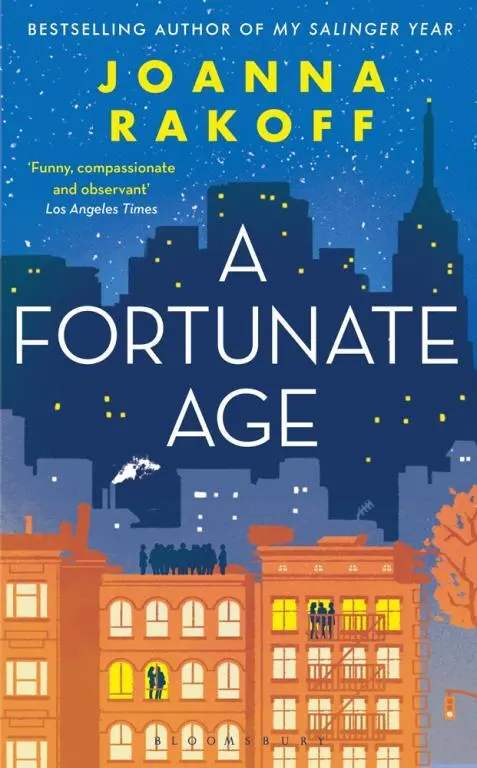
- Название:A Fortunate Age
- Автор:
- Издательство:Bloomsbury
- Жанр:
- Год:2015
- Город:London
- ISBN:978-1-4088-6239-1
- Рейтинг книги:4 / 5. Голосов: 1
-
Избранное:Добавить в избранное
- Отзывы:
-
Ваша оценка:
A Fortunate Age: краткое содержание, описание и аннотация
Предлагаем к чтению аннотацию, описание, краткое содержание или предисловие (зависит от того, что написал сам автор книги «A Fortunate Age»). Если вы не нашли необходимую информацию о книге — напишите в комментариях, мы постараемся отыскать её.
When the group come together to celebrate a marriage, anything seems possible. But soon the reality of rent, marriage and family will test them all. For this fortunate age can’t last for ever, and the group must face adulthood, whether they are ready for it or not.
Sprawling and richly drawn, A Fortunate Age traces the lives of the group during some of the most defining years of modern America—from the decadence of the dot com boom through to the sobering events of September 11 and the trailing years that followed—this brilliant, ambitious debut novel perfectly captures the hopes, anxieties and dreams of a generation.
A Fortunate Age — читать онлайн бесплатно полную книгу (весь текст) целиком
Ниже представлен текст книги, разбитый по страницам. Система сохранения места последней прочитанной страницы, позволяет с удобством читать онлайн бесплатно книгу «A Fortunate Age», без необходимости каждый раз заново искать на чём Вы остановились. Поставьте закладку, и сможете в любой момент перейти на страницу, на которой закончили чтение.
Интервал:
Закладка:
“Yes, yes, I saw Tuck,” said Rose, taking off her glasses and rubbing her eyes. “But where,” she asked, “is Lil?”
That same day, Beth took the train up to Scarsdale to spend the day with her mother. She and Will had set a date for their wedding (the third Saturday in September) and chosen a site (her family’s place in Maine), but she had yet to begin looking for a dress or to select invitations or to register for gifts. They’d only been engaged for two weeks, of course, but, according to her mother, September was just around the corner: the invites needed to go out within four weeks (“You have to give people eight weeks notice”), and if she didn’t pick a dress immediately , she wouldn’t have enough time to order the thing and have it fitted (“three months is the standard, Bethie”). And so Beth had agreed to come to Scarsdale for the day to look at card stock and gowns, even though she didn’t care much about either—she didn’t see why she needed an actual bridal gown, rather than simply a nice dress (and did it have to be white? She hated white), but her mother had simply, somehow (she tried to trace the thread back through their daily conversations but couldn’t), assumed that Beth would want a real wedding dress and everything that went along with it, and Beth was too tired—or too something —to correct this assumption, in part because she didn’t know exactly what she wanted.
Will was still in San Jose. She’d spoken to him in the early morning—five o’clock his time—and he’d said, “Choose whatever you like for the invites. Just no flowers or birds.” After she hung up she realized that she’d forgotten to ask him about the wording on the invitation, as she’d promised her mother she would. There were, Mrs. Bernstein had explained, two approaches to a wedding invitation: the traditional, in which the bride’s parents were named first (“Dr. and Mrs. Donald Bernstein request the honor of your presence as their daughter Elizabeth Anna is joined in matrimony with William Henry Chase), or the modern, in which both sets of parents are listed at the top (“Dr. and Mrs. Donald Bernstein and Mr. and Mrs. Harold Chase request the honor of your presence at the wedding of their children Elizabeth Anna and William Henry”). The latter was more egalitarian, but Beth thought it would seem weird, seeing as Will not only had been married before but also had a child —and presumably did not need his parents’ permission to marry. Beth herself favored simple things and wondered why they couldn’t just have a plain white (or cream?) card that said, in plain black (or brown?) letters, “Please join Beth Bernstein and Will Chase as they start their lives together.” Okay, well, maybe not “start their lives together.” But some simple, clear statement. Lil and Tuck’s invitations were very modern and elegant—a designer friend of Tuck’s had done them—but then Lil had planned her wedding in defiance of her mother, rather than with respect for her wishes.
Beth adored her mother—secretly, she considered her mother her best friend, though she knew how deeply uncool this was—and didn’t want to argue with her about small things, like invitations, which didn’t matter much to her, but seemed, like everything else about the wedding, very important to her mom, who was already asking questions like “Do you think you’ll wear your hair up or down?” and “Would you like to have those little disposable cameras on the tables?” Which was strange, since Beth’s mother wasn’t one of those mothers, the Scarsdale mothers, though in certain, superficial ways she resembled them: blonde pageboy, tailored slacks, Tod’s driving mocs. But the details betrayed her hippie past: embroidered Chinese jacket, “ethnic” jewelry, ancient Subaru (she refused to trade it in for a new model), and unwavering affection for The Moosewood Cookbook . She’d married Beth’s father, then a bearded dental student intent on opening up a free clinic in the Bronx, at his family’s house in Maine—just where Beth planned to do it—with as little pomp as possible, barefoot and clad in a gauze sundress, potluck-style meal, surrounded by close family and a few friends.
There weren’t many pictures of this humble event, but Beth, as a dreamy little girl, had studied them all, trying to fit them to the images of weddings she saw on television or in books: princesslike women in enormous dresses, slowly gliding toward an elderly robed figure. In those embarrassing days before adolescence, she’d wished fervently that her parents’ wedding had been the fairy-tale sort, particularly when she visited friends’ houses and looked at leather-bound albums filled with photos of grand ceremonies and grander receptions at the Pierre or the St. Regis or the Scarsdale Country Club. Of course, in college, it was cool to be able to say, “My parents were total hippies. My mom got married barefoot in a Mexican dress.”
Now, as she sat on the train, sipping hastily bought coffee from Zaro’s and staring at the passing trees, the paper unread on her lap, she wondered what her children would say about their parents’ wedding. She smiled and pressed her forehead into the chill window. Children , she thought, I’m going to have children. I’ll give them something to talk about , she thought, closing her eyes. But what ?
Beth was coming in on the 8:34 train, which meant Mrs. Bernstein needed to be at the station at 9:20 in order to catch her daughter as she disembarked at 9:22, provided there were no problems, as there so often were, with Metro-North. Beth had wanted to come later—“Mom, it’s Sunday ”—but they simply had too much to do. There was no way around it. They needed the whole day. Mrs. Bernstein, who was used to rising early for school, woke at seven ( late , she thought), skipped down to the kitchen, tamped some grounds into her little moka pot, and leafed through the Times magazine, which contained an article about how kids of Beth’s generation lived in a state of perpetual adolescence, stowing their belongings in Hello Kitty backpacks and playing video games. It’s true , thought Mrs. Bernstein. Beth—who had been such a good, mature child, neat and reasonable and temperate in her moods—had lately been behaving like an infant: insisting on moving to New York (signing a lease on an apartment, even!) without a firm job (though that, thankfully, seemed to be resolving itself), rushing headlong into this romance with Will, and, now that it appeared to be working out (Mrs. Bernstein had been, honestly, doubtful), refusing to get started on planning the wedding. She refused to think about even the most basic things—buying a dress, booking a caterer—the things other girls looked forward to doing. It was as though she expected Mrs. Bernstein to simply take care of the details for her. And that absolutely was not going to happen. Though, of course, Mrs. Bernstein was happy—truly happy, what mother wouldn’t be?—to assist Beth in any way she could.
And that, in the end, was exactly what Mrs. Bernstein had come to realize: Beth needed her assistance. The girl simply didn’t know where to begin, and thus, her mother must take her in hand and show her what to do. The irony of this was, of course, that Susan Bernstein—back when she was Susan Gilman, of Shaker Heights, Ohio—had insisted on planning her own wedding in the most unconventional manner possible, despite the fact that she knew exactly how a proper person planned such an event, as her own mother thought of little other than balls and fund-raisers and luncheons and, of course, weddings. When Beth announced that she was getting married—to this man the Bernsteins had only met once or twice (but then, how often had her parents met Donald before she married him?)—a vast reservoir of knowledge came rushing back to Mrs. Bernstein: invitations mailed no less than eight weeks in advance, seating charts, veil lengths and levels of fullness (elbow length, fingertip length, cathedral length), and so on.
Читать дальшеИнтервал:
Закладка:
Похожие книги на «A Fortunate Age»
Представляем Вашему вниманию похожие книги на «A Fortunate Age» списком для выбора. Мы отобрали схожую по названию и смыслу литературу в надежде предоставить читателям больше вариантов отыскать новые, интересные, ещё непрочитанные произведения.








Обсуждение, отзывы о книге «A Fortunate Age» и просто собственные мнения читателей. Оставьте ваши комментарии, напишите, что Вы думаете о произведении, его смысле или главных героях. Укажите что конкретно понравилось, а что нет, и почему Вы так считаете.