Joanna Rakoff - A Fortunate Age
Здесь есть возможность читать онлайн «Joanna Rakoff - A Fortunate Age» весь текст электронной книги совершенно бесплатно (целиком полную версию без сокращений). В некоторых случаях можно слушать аудио, скачать через торрент в формате fb2 и присутствует краткое содержание. Город: London, Год выпуска: 2015, ISBN: 2015, Издательство: Bloomsbury, Жанр: Современная проза, на английском языке. Описание произведения, (предисловие) а так же отзывы посетителей доступны на портале библиотеки ЛибКат.
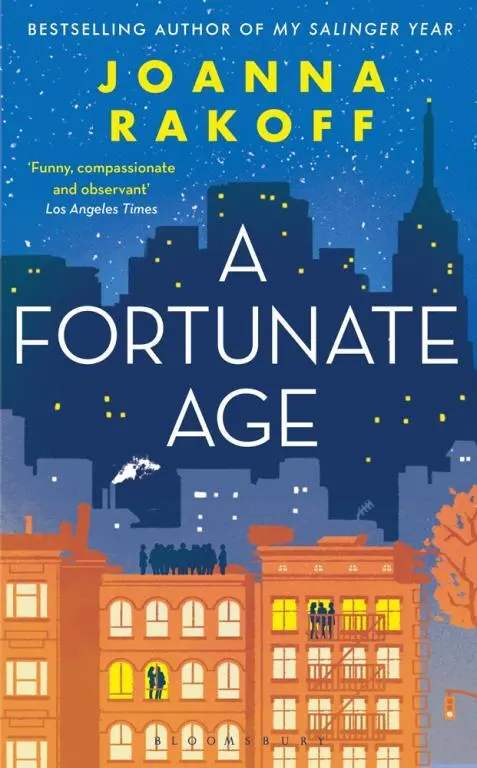
- Название:A Fortunate Age
- Автор:
- Издательство:Bloomsbury
- Жанр:
- Год:2015
- Город:London
- ISBN:978-1-4088-6239-1
- Рейтинг книги:4 / 5. Голосов: 1
-
Избранное:Добавить в избранное
- Отзывы:
-
Ваша оценка:
A Fortunate Age: краткое содержание, описание и аннотация
Предлагаем к чтению аннотацию, описание, краткое содержание или предисловие (зависит от того, что написал сам автор книги «A Fortunate Age»). Если вы не нашли необходимую информацию о книге — напишите в комментариях, мы постараемся отыскать её.
When the group come together to celebrate a marriage, anything seems possible. But soon the reality of rent, marriage and family will test them all. For this fortunate age can’t last for ever, and the group must face adulthood, whether they are ready for it or not.
Sprawling and richly drawn, A Fortunate Age traces the lives of the group during some of the most defining years of modern America—from the decadence of the dot com boom through to the sobering events of September 11 and the trailing years that followed—this brilliant, ambitious debut novel perfectly captures the hopes, anxieties and dreams of a generation.
A Fortunate Age — читать онлайн бесплатно полную книгу (весь текст) целиком
Ниже представлен текст книги, разбитый по страницам. Система сохранения места последней прочитанной страницы, позволяет с удобством читать онлайн бесплатно книгу «A Fortunate Age», без необходимости каждый раз заново искать на чём Вы остановились. Поставьте закладку, и сможете в любой момент перейти на страницу, на которой закончили чтение.
Интервал:
Закладка:
“Will you excuse me for just a moment?” she said, rattling the ice cubes in her plastic cup. “I’m afraid it’s time to—”
“Her entire family talks like that,” Lil said.
“No, they don’t,” she said, giving them a small wave and turning toward the kitchen. Here it comes , she thought. And, yes, a moment later, Lil’s voice came at her.
“They’re kind of an old New York family, but in the Jewish way. Like in Laurie Colwin?”
Sadie’s family was a favorite topic with Lil, who imagined the Peregrines to be terribly special and genteel and charming, playing chess on long winter nights, arguing about subjects intellectual, engaging in quaint customs at the holidays. To some extent this was true—or sort of true—but that didn’t necessarily make them fun, and regardless, Sadie disliked having her life read back to her, transmogrified into mythology. But that was Lil, making myths out of accidents, deciding that, say, the sidecar was “ our drink” or Von was “ our bar” or even determining that their little circle of friends constituted a “set” (a word she appeared to have gleaned from Gatsby ), when in reality they were just a bunch of people who were friends in college (though equally friends with other people, like Maya Decker and Abe Hausman) and had ended up living together, and thus grown close. But to Lil, the very groupness of their little group was as important as the individual friendships that comprised it. Sadie knew, of course, the reason for this: that Lil felt herself an alien in her own brash family and, thus, sought a sort of hysterical comfort in her friends—not to mention Sadie’s own family. And Lil’s parents, from the little Sadie had seen of them, were indeed a bit horrible, but then so were Sadie’s own. Lil just never saw that side of them, never saw the ways in which Rose could be cruel and controlling, and James silent and remote.
By raising the volume on her “excuse me’s,” and pushing aggressively on the elbow of a young man whose muttonchop sideburns curled fiendishly toward each other, Sadie managed to make it to the kitchen area, where she wove in and out of the various bodies opening and closing and drinking from bottles of wine and beer and liquor, and, at last, wrapped her arms around Tal’s narrow waist and looked up into his face. It was an odd face. The mouth too wide. The nose long, sharp, like one of Picasso’s women. The whole thing just slightly too compressed, too small for his long body. He would never be a leading man, though it wasn’t clear to her—even after all the years she’d known him, the long nights talking, the dark walks around campus, years back—if he wanted to be. His latest round of headshots, she supposed, supplied the answer: a three-quarter view, which minimized the slope of his nose, his dark eyes gazing stormily at the camera from lowered lids. “It’s your George Clooney shot,” she’d told him. “My agent picked it,” he’d said with a shrug.
“Hey,” he said to her now, flatly. Who knew how long he’d been standing here on his own, half crushed against the counter, waiting for her or Dave to come rescue him from abject boredom.
“Are you okay?” she asked.
“Yeah, yeah.” He untwined her arms from him, put his bottle down on the counter, and stretched his arms up over his head, yawning. “Dave and I were talking about getting something to eat.”
“You don’t want to see the band?” To her left they were setting up, laying out a complicated network of wires and amps.
He shook his head. “They suck.”
“Okay.” Though she wasn’t sure she needed one, she began making herself another drink: fresh ice, slosh of bourbon, cherry juice. “Are you heading out now?”
“Soon.” He turned to face her. “Do you want to come with us?”
She took a sip. Too sweet. “You guys should do your guy thing. Drink beer. Eat hamburgers. Talk about football.”
“I think it’s baseball season.” He turned to face her, hunching over the counter.
“I’m impressed that you know that.”
“Well, I’m not sure, actually.” He smiled.
“Okay,” she said, sighing. Against her will, she felt wounded by this small abandonment. Stupid, stupid , she thought. She saw him almost every night. But in a couple of weeks he’d be in L.A. and she had a suspicion he wouldn’t be coming back.
“I’ll see you tomorrow?” he asked.
“No,” she said, perhaps too curtly. “I have brunch. Then I’ve got to work.”
From behind her, Lil and Tom Satville materialized, grabbing tall bottles of wine and sniffing them.
“A gewürztraminer,” Tom Satville cried.
“Sadie brought that,” Lil responded, clapping her hands and shooting Sadie a look of amazement, which Sadie chose to ignore. “Is it one of your dad’s?” Lil pressed.
“No.” Sadie caught Tal’s eye. “It’s from the wine shop on Court Street. The one that looks kind of ghetto. With the bulletproof glass.” She turned to Tom Satville. “Have you met Tal?”
“Sadie’s dad collects wine and sometimes he gives us his castoffs,” Lil confided. “Her parents are amazing .”
“Amazing,” said Tal, nodding.
Lil ignored him. “Tell Tom about your mother,” she instructed.
“What about my mother?” she asked, though she knew full well what Lil wanted—tales of the wacky Peregrine clan, straight from the annals of Salinger. Why don’t we talk about your family, she sometimes wanted to say, for she knew Lil had funny stories about her father’s practice—the aging porn star who wanted to up her cup size to J (Dr. Roth had refused, saying breasts of such magnitude would be disproportionate to her height—five two); the lingerie model who’d asked for fat to be sucked from her pubic area, because it “puffed out too much” (on this, he had obliged)—and her general rearing in Los Angeles, a city of vast mystery and fascination to New Yorkers. “My mother’s really not that interesting,” she said, with a yawn.
Lil rolled her eyes. “ Sadie ,” she complained, shaking her head. “Sadie’s mother is the most amazing woman. She’s actually from Greenpoint! She grew up there, in the fifties.”
“The forties, actually,” said Sadie, smiling at Tal, who shook his head. He didn’t share Lil’s adoration of her mother, which came as something of a relief to Sadie.
“The forties?” said Tom Satville skeptically. “She must have had you late in life.”
“She was forty-two,” confirmed Sadie. “It was scandalous at the time. Everyone used to think my dad was my grandfather.”
“You must have older siblings,” the man said, rather presumptuously, she thought. She was used to this question, and yet it always bothered her. The funny thing was, now it was perfectly normal for people to have kids in their forties. And yet everyone always acted like it was just bizarre that her parents were two generations removed. “Are you one of many?”
“I have a brother. A half brother.” She refrained from mentioning that this brother was dead. For this, in fact, was how her parents had met: Her father’s child from his first marriage, a boy named Ellison, arrived at the Dalton infirmary—where her mother, widowed by the Korean War, doled out aspirin and bismuth—complaining of a headache. Thirty hours later he was dead of meningitis. Or something like it. Sadie wasn’t exactly clear on this, the disease itself. She’d never asked and neither of her parents had ever volunteered the grim particulars, not even Ellison’s age at his death. Her father’s first marriage hadn’t survived the tragedy. The story came to her from her aunt Dora, her father’s sister, after Sadie happened upon some photos in a drawer (a beautiful boy, with her own deep-set eyes), and was later confirmed by her cousin Bab, in London. Sadie herself hated mentioning this brother, for what did she have to say about him but that he was dead. She hadn’t known him, nor had her parents told her anything about him—and yet it seemed somehow dishonest to say she had no siblings.
Читать дальшеИнтервал:
Закладка:
Похожие книги на «A Fortunate Age»
Представляем Вашему вниманию похожие книги на «A Fortunate Age» списком для выбора. Мы отобрали схожую по названию и смыслу литературу в надежде предоставить читателям больше вариантов отыскать новые, интересные, ещё непрочитанные произведения.







Обсуждение, отзывы о книге «A Fortunate Age» и просто собственные мнения читателей. Оставьте ваши комментарии, напишите, что Вы думаете о произведении, его смысле или главных героях. Укажите что конкретно понравилось, а что нет, и почему Вы так считаете.