Joanna Rakoff - A Fortunate Age
Здесь есть возможность читать онлайн «Joanna Rakoff - A Fortunate Age» весь текст электронной книги совершенно бесплатно (целиком полную версию без сокращений). В некоторых случаях можно слушать аудио, скачать через торрент в формате fb2 и присутствует краткое содержание. Город: London, Год выпуска: 2015, ISBN: 2015, Издательство: Bloomsbury, Жанр: Современная проза, на английском языке. Описание произведения, (предисловие) а так же отзывы посетителей доступны на портале библиотеки ЛибКат.
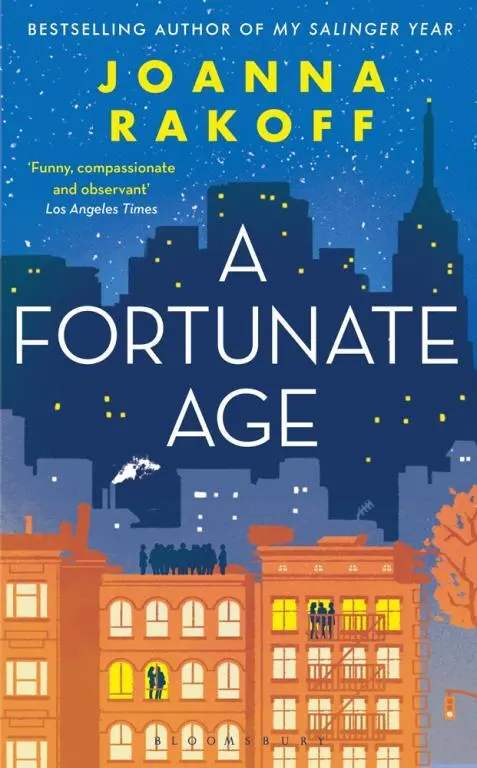
- Название:A Fortunate Age
- Автор:
- Издательство:Bloomsbury
- Жанр:
- Год:2015
- Город:London
- ISBN:978-1-4088-6239-1
- Рейтинг книги:4 / 5. Голосов: 1
-
Избранное:Добавить в избранное
- Отзывы:
-
Ваша оценка:
A Fortunate Age: краткое содержание, описание и аннотация
Предлагаем к чтению аннотацию, описание, краткое содержание или предисловие (зависит от того, что написал сам автор книги «A Fortunate Age»). Если вы не нашли необходимую информацию о книге — напишите в комментариях, мы постараемся отыскать её.
When the group come together to celebrate a marriage, anything seems possible. But soon the reality of rent, marriage and family will test them all. For this fortunate age can’t last for ever, and the group must face adulthood, whether they are ready for it or not.
Sprawling and richly drawn, A Fortunate Age traces the lives of the group during some of the most defining years of modern America—from the decadence of the dot com boom through to the sobering events of September 11 and the trailing years that followed—this brilliant, ambitious debut novel perfectly captures the hopes, anxieties and dreams of a generation.
A Fortunate Age — читать онлайн бесплатно полную книгу (весь текст) целиком
Ниже представлен текст книги, разбитый по страницам. Система сохранения места последней прочитанной страницы, позволяет с удобством читать онлайн бесплатно книгу «A Fortunate Age», без необходимости каждый раз заново искать на чём Вы остановились. Поставьте закладку, и сможете в любой момент перейти на страницу, на которой закончили чтение.
Интервал:
Закладка:
“Okay,” whispered Lil, forcing herself to smile. Rob’s pies were disgusting. “That sounds great. I’m going to go check on the pasta.”
“Okay, I’ll have a quick shower.” He turned back to the phone. “You still there, Robby?” Lil shut the door and went back to the kitchen.
Lil always forgot about Rob and Caitlin in cataloging her friends, as they didn’t fit neatly into any particular category, and yet she and Tuck generally regarded the fact of the couple’s existence as a happy accident, a sign that the Roth-Hayes were meant—if not fated —to be together. Rob Gold was a childhood friend of Tuck’s, who’d dropped out of Bard to trek through Asia, then resurfaced a few years later in Portland, Oregon, living in a squat and heading up some sort of anarchist group. It was he who had tipped Tuck off to the story that had gotten him in so much trouble.
Lil, meanwhile, knew Caitlin Green from Oberlin. Like Lil and Sadie and Beth, Caitlin had studied English—the four of them, in fact, were the only women selected for the Honors seminar their senior year. Her parents taught biology at Haverford or Swarthmore, someplace Quaker, and her early and prolonged exposure to academe had lent her a too-warm sense of her own intellectual superiority and sophistication, which, in turn, led her to regard her fellow students with unconcealed disdain. She adopted a world-weary pose in all her classes, even the Honors seminar, resting her round cheek on one black-nailed fist, sighing whenever someone asked a question she found particularly elementary, and periodically trying to catch the professor’s eye, so the two might commiserate over these sad products of the American education system, who didn’t fully grasp Bataille’s concept of sovereignty. Her field of specialty was “queer theory” and she habitually accused professors and peers alike of “unconscious gender bias” and such, when not organizing rallies for the LGB union and “students of color,” though she herself was neither gay nor visibly ethnic . If questioned, she said that she was bisexual and that Jews were “the original persons of color.”
In college, Lil had hated Caitlin, particularly after she launched a campaign against George Wadsworth, Lil’s and Sadie’s advisor, whom she considered dangerously misogynistic (“Why,” she shouted, on Tappan Square, “are there only four women in Honors English?”), but she seemed to have changed, matured, in the ensuing years, during which she’d met and married Rob, who was slight, and odd, and serious. His latest project was a nonprofit aimed at curbing the prison industry, which Lil had not really seen as “burgeoning” and “sinister” until Rob explained it all to her—that prisons were now run by private companies, which had, of course, a profit motive for getting as many people as possible behind bars. A week after their wedding, she and Tuck had run into the couple on Bedford and discovered the coincidence of their mutual acquaintance. Caitlin had lost weight. She was now gaunt (but still, Lil noted, wide-hipped ) and her eyes were smeary with dark circles, which lent her face a hollow, exhausted look that, Lil decided, was strangely sexy, as though Caitlin had traveled many places and done many things.
“Will you guys be okay?” Beth asked as they finished their coffee. They were both restless and reluctant to step out into the cold. “Did he get severance?”
“He did,” said Lil. “But it’s getting hard. We just have to find ways to cut back.”
“I’m sure Caitlin Green can help with that,” said Sadie. The Green-Golds lived like monks, making do with almost nothing, in a dingy railroad apartment they’d cordoned off into small, nooklike rooms, subsisting on various grains and nuts and legumes, and riding their bikes around the city rather than taking the train or a taxi.
Lil rolled her eyes. “I know. We went over there the night Tuck was fired.”
Her friends let out a chorus of groans.
“I was a wreck. And I was stupidly honest with her.” She paused, unsure if she should speak honestly again. “I told her our apartment was too expensive and that this was going to push us over the edge.”
“What did she say?” asked Sadie. “That you should become vegan?”
“Yes!” marveled Lil. Sadie shrugged. “She’s just too much . She was like”—Lil adopted Caitlin’s ripe vowels—“‘It’s unbelievable how much you can drop on cow pus alone.’”
“Cow pus?” queried Beth, her mouth bunched in revulsion.
“Milk,” Emily told her.
“And I told her I love milk. I just can’t imagine giving it up. And she said, ‘Dairy cows are raped, like, twelve times a day.’”
“Even the organic ones?” asked Beth skeptically.
“That’s exactly what I said,” cried Lil, turning her palms upward. “She says even the organic ones.” Lil sighed. “They only spend forty dollars a week on food.”
“Well, that’s not hard when all you eat is beans and rice,” said Emily.
“True,” said Sadie, with a roll of her eyes. But Lil felt there was something admirable about such frugality, though in Rob and Caitlin’s case, it seemed slightly histrionic, because Rob was rich. Truly rich. His father owned half of Atlanta and all of Richmond. Their apartment was studded with heavy bureaus and thick rugs and oils of long-nosed ancestors filched from his great-grandfather’s Rhinebeck “cottage.” It was all a game to them. They could live on nothing but get married on Baldhead Island. They could eat beans but buy Hindu Kush.
This should have made their choices seem more heroic—they had simply opted out of conspicuous consumption—but for Lil it only made them seem less so, a childish pretense, their convictions mere self-righteousness. And Tuck’s infatuation all the more galling, particularly when he held Lil up to their model for comparison—and, of course, found her lacking. “Everything is in its place,” Tuck liked to say, almost angrily, after visiting the Green-Golds. “Their apartment is small, but they’ve made the best of it. They use every bit of space.” Or “They don’t have piles of shoes and books lying around. Did you see Caitlin’s desk? There was nothing on it.” Lil’s own desk, at any given time, was covered in mounds of papers—Xeroxed articles, drafts of her own papers, student essays, coupons, receipts, Post-it notes with scrawled reminders on them, gum and candy wrappers, dog-eared legal pads containing her copious notes for her dissertation proposal, grocery lists, to-do lists, recipes clipped from the Dining In section.
“I would have run out of there screaming,” said Emily.
“I did, kind of.” Lil pressed the heels of her hands into her eyes. “I was so tired, I just felt like I couldn’t stay awake another minute. It was kind of crazy. I told them I had to go home, I had all these papers to grade, but Caitlin, of course, was like, ‘I have papers to grade, too. We can go to the L tomorrow and just plow through them.’”
“As if you can’t grade papers alone,” said Beth, contemplating the remains of their cookie. “That’s just weird.”
“I know! It was too much ”—she paused, unsure whether her friends would think her actions deranged—“and I just kind of left .”
“You didn’t say good-bye?” asked Sadie, starting to laugh.
“I couldn’t! I just had to get out of there.”
“Wow,” said Emily. “Good for you.”
What she didn’t tell them was that Tuck had come running after her, furious, shouting her name down the block. At the corner of Marcy he’d caught up with her and made to grab her arm. “Don’t touch me,” she’d shouted, in a voice she didn’t recognize, low and tear-choked. “Don’t talk to me like that,” he’d shouted back. “I’m your husband. Do you not love me anymore? Because it doesn’t seem like it.” But before she could answer, an electronic ring pierced the air between them: her new cell phone, obtained for her, against her wishes, by Tuck, who’d become umbilically attached to his own since starting at Boom Time . She fished it out of her pocket and pressed the talk button. “Hello?” she said, the word emerging more as a question.
Читать дальшеИнтервал:
Закладка:
Похожие книги на «A Fortunate Age»
Представляем Вашему вниманию похожие книги на «A Fortunate Age» списком для выбора. Мы отобрали схожую по названию и смыслу литературу в надежде предоставить читателям больше вариантов отыскать новые, интересные, ещё непрочитанные произведения.






Обсуждение, отзывы о книге «A Fortunate Age» и просто собственные мнения читателей. Оставьте ваши комментарии, напишите, что Вы думаете о произведении, его смысле или главных героях. Укажите что конкретно понравилось, а что нет, и почему Вы так считаете.