Joanna Rakoff - A Fortunate Age
Здесь есть возможность читать онлайн «Joanna Rakoff - A Fortunate Age» весь текст электронной книги совершенно бесплатно (целиком полную версию без сокращений). В некоторых случаях можно слушать аудио, скачать через торрент в формате fb2 и присутствует краткое содержание. Город: London, Год выпуска: 2015, ISBN: 2015, Издательство: Bloomsbury, Жанр: Современная проза, на английском языке. Описание произведения, (предисловие) а так же отзывы посетителей доступны на портале библиотеки ЛибКат.
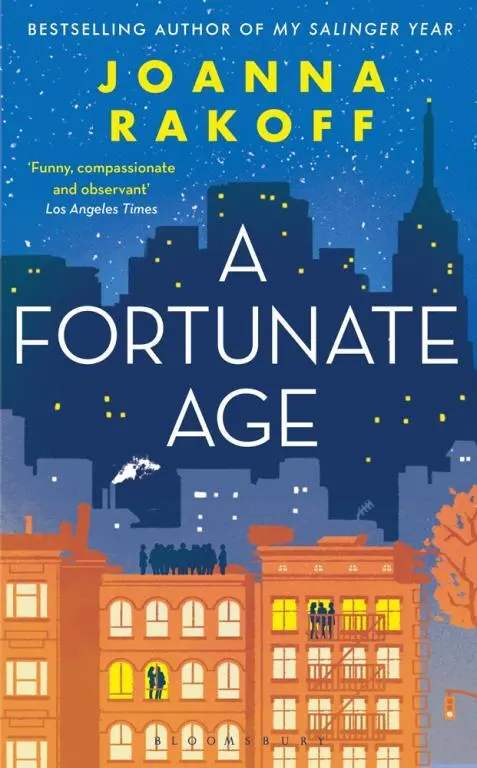
- Название:A Fortunate Age
- Автор:
- Издательство:Bloomsbury
- Жанр:
- Год:2015
- Город:London
- ISBN:978-1-4088-6239-1
- Рейтинг книги:4 / 5. Голосов: 1
-
Избранное:Добавить в избранное
- Отзывы:
-
Ваша оценка:
A Fortunate Age: краткое содержание, описание и аннотация
Предлагаем к чтению аннотацию, описание, краткое содержание или предисловие (зависит от того, что написал сам автор книги «A Fortunate Age»). Если вы не нашли необходимую информацию о книге — напишите в комментариях, мы постараемся отыскать её.
When the group come together to celebrate a marriage, anything seems possible. But soon the reality of rent, marriage and family will test them all. For this fortunate age can’t last for ever, and the group must face adulthood, whether they are ready for it or not.
Sprawling and richly drawn, A Fortunate Age traces the lives of the group during some of the most defining years of modern America—from the decadence of the dot com boom through to the sobering events of September 11 and the trailing years that followed—this brilliant, ambitious debut novel perfectly captures the hopes, anxieties and dreams of a generation.
A Fortunate Age — читать онлайн бесплатно полную книгу (весь текст) целиком
Ниже представлен текст книги, разбитый по страницам. Система сохранения места последней прочитанной страницы, позволяет с удобством читать онлайн бесплатно книгу «A Fortunate Age», без необходимости каждый раз заново искать на чём Вы остановились. Поставьте закладку, и сможете в любой момент перейти на страницу, на которой закончили чтение.
Интервал:
Закладка:
Earlier, she had, in fact, tried to do exactly this, only to find that the door, of course, wouldn’t lock from the inside (nor, she later discovered, would the bathroom door). And her fiddling had summoned the attention of yet another sour nurse. “Is something wrong?” she’d asked.
“Everything’s fine, thanks,” Lil told her impatiently.
But the woman lingered, maddeningly. “Are you sure?”
“Yes,” Lil said. “I’m fine . I don’t need anything .” And slammed the door right in the nurse’s face. Later, when this same nurse—a short, plain-faced woman of indeterminate ethnicity, with a greasy gray braid—brought her lunch, she’d refused it just to spite her. “I don’t want it,” she’d complained, in a whiny voice that now embarrassed her (why had she made such a fuss, particularly since she was actually hungry?).
“Well, I’ll just leave it right here, okay?” the nurse said calmly, as if she were talking to a child. “In case you get hungry.”
“I don’t want it,” Lil insisted. “The smell is making me sick. I’m not going to eat it. Please just take it away.”
“I need to leave it, hon,” the nurse said calmly. “We can’t have people saying we starve them, can we?”
Now the tray sat beside her bed, gravy congealed into a gelatinous mass, reminding her of her rashness and stupidity. What she really wanted was to stand up and stretch. To move her legs a bit and hang straight over from the waist, as she did in yoga class. But she was afraid that the nurses might barge in and find her in this position, her body revealed by the flapping gown. And so she stayed in bed and picked at the skin that had formed on the pudding. It was good, she found, in a terrible way—the appealing metallic of artificial vanilla—and sweetly reminded her of her childhood, which had been punctuated with lime Jell-O and pudding from a box and other such toxic, processed foods, which people simply didn’t feed their kids anymore. Normal people, that is.
Earlier, Lil had thought she might call her mother—which showed how desperate she was feeling—but there was no phone in her room and the nurses had confiscated her cell phone when she was admitted, along with a host of other things from her purse: pens, cuticle scissors, lip gloss, keys. She’d asked one of the nurses if she might have the cell phone back, just for a minute, to call her mother. But the woman had told her no, that her husband would take care of all that, and she shouldn’t worry. Lil had argued, but now she saw that she wouldn’t have made the call anyway. She couldn’t tell her mother that she was in a mental hospital. It had been hard enough to tell her, for the third time, that she was miscarrying. “We’re all so fertile in my family,” her mother had said with typical callousness. “I can’t imagine what the problem is!” The implication, of course, was that there was something defective about Lil or perhaps Tuck or the two of them together, and that if Lil had married a nice doctor, someone like her father, and bought a ranch in the Palisades—rather than staying in the dirty, expensive, outmoded East and forcing her parents to send her checks every month or two so that she and her bohemian husband wouldn’t starve—none of this would be happening. Well. Perhaps it wouldn’t. But she could never have gone back—could never go back—to L.A., to that stultifying sort of life. The blondes in their huge, beastly cars. The kids who’d made fun of her. They were all still there, working in film or television as midlevel producers or agents or entertainment lawyers; taking meetings with their frat brothers from UCLA; stocking their glass houses with kids; meeting their parents for brunch on Sunday. Their lives unfolded before her all too vividly. “Yech,” she said aloud, and polished off the pudding, just as Josh walked in the door.
“Not bad, right?” he said.
“No,” she agreed, “it’s pretty good.”
“You should try the rest,” he told her. “It’s really much better than it looks. And I can guarantee you’ll feel better after you eat something. They taught me that in medical school.” Lil laughed. This was just the sort of joke her father often made. Perhaps that’s what they were taught in medical school—a barrage of self-deprecating witticisms. “I’d bring you something from outside, but it’s strictly against the rules. We could be putting a file in the cake. You know.” Lil smiled at him. She felt, instinctively, that he was on her side—that he believed, perhaps also instinctively, in the force of her sanity and the extent of Tuck’s villainy even more so than did Emily, who knew her better, like a sister, and was slightly prone to disbelieving Lil. Men had always liked Lil better than did women. “I don’t need a file,” she told Josh now, with a smile. The pudding had made her feel better and she shot an inquiring glance down at the mashed potatoes. “There are no bars on the windows.”
“True,” he said. “So no file for you. But listen, how are you doing?”
She wasn’t sure how to answer this question. “Emily told you…” she began tentatively.
He nodded. “Emily gave me the gist of it. And I got the rest from Dr. Goldstein—the doctor who spoke with you this morning—and Dr. Mukherjee, who spoke with you last night.”
“So you know I was kind of tricked into coming here,” she said.
“Well,” he said briskly, “I’m not sure I’d put it that way. I’m thinking you feel you were tricked. But it sounds more like you might have misunderstood—maybe you didn’t want to understand—some of what Dr. Mukherjee told you last night. Maybe the painkillers and the anesthetic and the pain and lack of sleep and the general stress of the situation impaired your judgment, but—” Lil began to speak but he held up his hand. “I was going to say that you’re a very intelligent person and my take on the situation is: You understood, if only partly, that you would be brought here to the clinic, a psychiatric hospital. But later, after you agreed, you regretted your choice.”
His voice maintained its original gentle, friendly tone, but his words now took on a scientific efficiency that, like his joke, reminded her of her father, lecturing her about 401(k)s and filing her taxes on time. How could Emily— Emily , of all people—have married a doctor ?
“Does that sound at all right to you?” he asked, squaring his eye with hers. It did and it didn’t. Instead of answering, she found herself beginning to cry, the knowledge, inescapable, that these tears weren’t exactly genuine making them come all the faster.
“I guess you think I’m crazy and I belong here,” she sobbed.
He shook his head. “People belong here if they need help.”
She rolled her eyes. “So do you think I need help?”
“From what I’ve heard and seen in the last few minutes?” he said, raising his finger pedantically.
“Yes—”
Again, he held her off with a small gesture. “Do I think you’re mentally ill? No.” Lil let loose a stream of air. She’d been holding her breath, she realized, while she awaited his verdict. Why do you care? she thought. Why do you always need everyone’s fucking approval?
“Really?” she said. “You don’t think there’s anything wrong with me?”
“No more than the next person. I’d say that, from what I know of it, you’ve had a big shock. A miscarriage can be devastating, especially if there’s no specific cause. And especially if you’ve been trying to conceive for a significant period of time. That aside, I’d say maybe circumstances have contrived to make you feel like your life is no longer within your control.”
Читать дальшеИнтервал:
Закладка:
Похожие книги на «A Fortunate Age»
Представляем Вашему вниманию похожие книги на «A Fortunate Age» списком для выбора. Мы отобрали схожую по названию и смыслу литературу в надежде предоставить читателям больше вариантов отыскать новые, интересные, ещё непрочитанные произведения.










Обсуждение, отзывы о книге «A Fortunate Age» и просто собственные мнения читателей. Оставьте ваши комментарии, напишите, что Вы думаете о произведении, его смысле или главных героях. Укажите что конкретно понравилось, а что нет, и почему Вы так считаете.