Joanna Rakoff - A Fortunate Age
Здесь есть возможность читать онлайн «Joanna Rakoff - A Fortunate Age» весь текст электронной книги совершенно бесплатно (целиком полную версию без сокращений). В некоторых случаях можно слушать аудио, скачать через торрент в формате fb2 и присутствует краткое содержание. Город: London, Год выпуска: 2015, ISBN: 2015, Издательство: Bloomsbury, Жанр: Современная проза, на английском языке. Описание произведения, (предисловие) а так же отзывы посетителей доступны на портале библиотеки ЛибКат.
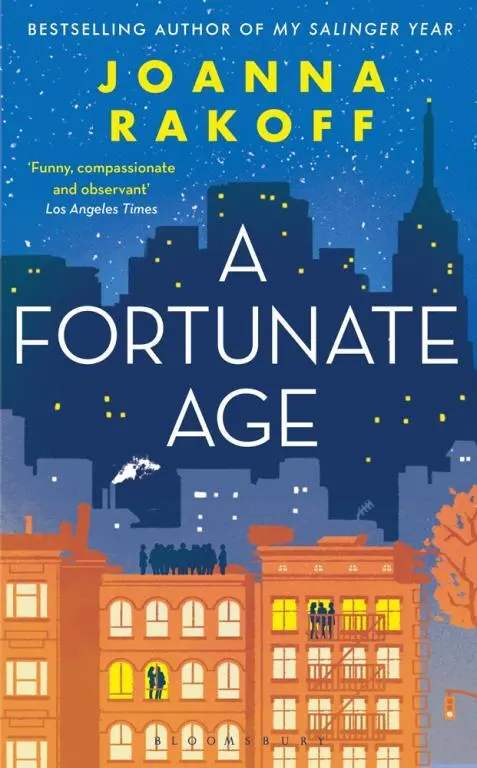
- Название:A Fortunate Age
- Автор:
- Издательство:Bloomsbury
- Жанр:
- Год:2015
- Город:London
- ISBN:978-1-4088-6239-1
- Рейтинг книги:4 / 5. Голосов: 1
-
Избранное:Добавить в избранное
- Отзывы:
-
Ваша оценка:
A Fortunate Age: краткое содержание, описание и аннотация
Предлагаем к чтению аннотацию, описание, краткое содержание или предисловие (зависит от того, что написал сам автор книги «A Fortunate Age»). Если вы не нашли необходимую информацию о книге — напишите в комментариях, мы постараемся отыскать её.
When the group come together to celebrate a marriage, anything seems possible. But soon the reality of rent, marriage and family will test them all. For this fortunate age can’t last for ever, and the group must face adulthood, whether they are ready for it or not.
Sprawling and richly drawn, A Fortunate Age traces the lives of the group during some of the most defining years of modern America—from the decadence of the dot com boom through to the sobering events of September 11 and the trailing years that followed—this brilliant, ambitious debut novel perfectly captures the hopes, anxieties and dreams of a generation.
A Fortunate Age — читать онлайн бесплатно полную книгу (весь текст) целиком
Ниже представлен текст книги, разбитый по страницам. Система сохранения места последней прочитанной страницы, позволяет с удобством читать онлайн бесплатно книгу «A Fortunate Age», без необходимости каждый раз заново искать на чём Вы остановились. Поставьте закладку, и сможете в любой момент перейти на страницу, на которой закончили чтение.
Интервал:
Закладка:
Emily drew in a breath. So it was as she’d initially thought. “There’s a lot of paperwork. Insurance companies.”
“Yeah, and we had to wait for a bed.” She nodded, but her mind had left Tuck. She needed to call Josh immediately and get his take on this. And she needed to find Lil. It was all she could do not to run toward the elevator bank, leaving Tuck alone at the table without so much as a good-bye. But she was due at her desk in ten minutes. The bird lady was big on punctuality. She also wasn’t sure they’d let her in to see Lil, unaccompanied by Josh.
“You should go home and get some sleep,” she said, more sharply than she intended.
“Yeah,” he said, his voice cracking on this one small word. “I have to bring Lil some things. She doesn’t have anything to wear. Her clothes are all a mess.” Suddenly, Emily felt sorry for him. Was it his fault he was broken? If she were Lil, would she have stayed with him? Probably. Yes, probably. “I may have some stuff in my office. An extra sweater, at least. I’ll go up and see her. Do you know what room she’s in?”
“I can’t remember.”
“Doesn’t matter. I can find out.” Emily stood and glanced at her watch. “I’ll go up to her as soon as I can.”
From her desk, in the antechamber of the neuropsychiatrist’s mahogany-lined office, she left a message on Josh’s voice mail, explaining the situation sotto voce, so as not to alert the nosy receptionist whose desk adjoined hers. Twenty long minutes later, as she halfheartedly fiddled with spreadsheets on brain activity, he called her back. “She’s probably fine,” he said, against a backdrop of blaring horns. “Just overwrought and exhausted. Do you want to go up and see her now? Will Barbara let you out for a sec?”
The door to the bird lady’s office was closed. “I could probably sneak out for a few minutes.”
“Okay,” said Josh, his voice breaking up slightly in the wind. “I should be there in about ten minutes. We’ll go up. Or do you want to go right this second? I can call and let them know you’re coming.”
“No, no, I’ll wait for you,” said Emily.
At the front desk, they found a plump nurse talking intently to a tall, bald doctor, “The patient is recalcitrant. She keeps insisting we let her out. Says she’s here by mistake. Usual stuff.” Emily was continually amazed by the eerie manner in which the hospital staff’s conversations exactly mirrored those on hospital dramas.
“Bob,” Josh called to the doctor, who took his eyes off his clipboard at the sound of his name.
“Hey, what’s up?” said the doctor. His plastic name tag read “Dr. Robert Goldstein.”
“You know my wife, Emily, right? She’s working with Barbara.”
Bob held out his hand. “I’ve seen you around, I know. How do you like the bird lady?”
“She’s great,” said Emily, through gritted teeth—her stomach had started flopping the minute they entered the clinic. She remembered visiting Clara after her first breakdown, Clara, hollow eyed and furious, screaming at Emily, at her parents, that they’d ruined her life.
“We’ve got a situation,” said Josh, with another grin, mimicking the clipped tones of a cinematic cop. “A friend of Emily’s was admitted last night. From the ER.”
“Right, right,” he said, pulling out his cell phone and scrolling through messages. “The miscarriage. Lillian Roth.”
“Lillian Roth- Hayes ,” Emily piped in.
The doctor gave her an irritated glance. “A bit paranoid, possibly delusional, hostile to the nurses. Generally friendly to me. Eager to please. She’s seriously not happy to be here, though.”
Josh nodded. “What are you thinking?” Bob puffed out his cheeks and blew out a gust of air. “Well, I just did the intake interview—we’re swamped today—so these are just preliminary ideas.” He gave Emily an appraising glance, as if trying to gauge how many words to mince in her presence. “You know, I can see why they sent her over—couldn’t stop crying, was screaming about it all being the husband’s fault, all that—but she doesn’t seem depressed to me, just upset about the miscarriage.”
“So you’re thinking acute problem, few days’ rest, send her home?” asked Josh.
“Actually, I’m tossing around narcissistic personality disorder.” He raised his eyebrows at them, as if to say, How do you like them apples . “Maybe dependency disorder,” he added, glancing back down at his cell phone, which he held flat in his palm, like a detonator.
“Dependency disorder?” said Emily. “Lil is”—her voice began to fail her—“ so independent.”
Bob turned to her again, this time more kindly, his voice taking on the formal tone she knew he must use with patients. “I’m sure she is,” he said. “And she certainly seems very opinionated and able to speak her mind. But dependency disorder is more about an emotional dependence on another person, or people, that”—he moved his hands in circles—“is so strong that you lose yourself, literally, in that other person. You’re so dependent on that other person’s moods and desires that you can’t determine your own. You seek approval constantly.”
“Oh,” said Emily. She hadn’t realized that such a thing qualified as mental illness. How, in all her reading on psychological complaints, had she not come across this particular malady? It sounded fake, like something spoofed on Saturday Night Live .
“Your friend Lillian’s relationship with her husband seems to indicate possible dependency disorder,” Bob went on, sliding his phone back into a holster on his belt and picking his clipboard off the counter. “But. Well. These are just preliminary thoughts. I need to talk to her more. Talk to the husband, too, get some background.”
“Tuck! You’re going to talk to Tuck?”
“Yes, we generally talk to the person responsible for the patient, so we can get a sense of history. Behavior patterns.” She thought he might ask if there was a reason why he should not speak to Tuck, but instead he turned to Josh and said, “It’s also possible there’s nothing wrong with her. Emotional strain. Difficulties in the marriage. Normal stuff.” Josh pushed his lips together. “Okay if we stop in and see her?” Bob nodded. “She’s in 406-B. Alone for now.”
Inside room 406-B, they found Lil lying on her side in the bed nearest the window, her face turned away from them, several layers of thin white blankets pulled up around her shoulders, which were covered in the pale green of the hospital’s standard surgical gown. Splayed out on the pillow, her hair looked fuzzy and dull, preternaturally black, and her skin yellow and raw under the room’s cruel fluorescents. On a rolling table beside the bed sat an untouched lunch tray, containing pale blobs of food, vaguely recognizable as pudding, mashed potatoes, and some sort of poultry. Tonight, Emily knew, Lil would have to eat dinner in the cafeteria, with the rest of the patients, presuming Tuck arrived with her clothes. From the pocket of her lab coat, Emily extracted her glasses—she wore them only for distance, but now she felt she might need a shield between Lil and herself—and watched as her friend stirred. “Who is it?” she called, her voice thick with sleep. Emily rushed to the far side of the bed and sat down in the chair beside it. “Emily!” Lil cried, bolting up and embracing her friend. “I was hoping you’d come! I wasn’t sure if you’d find out that I was here, like, automatically. Like if a list of patients gets circulated to the whole staff or something? I asked Tuck to call you but I didn’t think he really would. He asked me for your number. Isn’t that crazy? I’m lying there on a gurney, bleeding, and he wants me to find him a phone number—which he has anyway, in his phone.” She swallowed, hard, and Emily handed her the cup of water that sat on her tray. “Thanks,” she said. “I’m so thirsty.” She drank again, with a loud gulp. “I’m so glad you’re here!”
Читать дальшеИнтервал:
Закладка:
Похожие книги на «A Fortunate Age»
Представляем Вашему вниманию похожие книги на «A Fortunate Age» списком для выбора. Мы отобрали схожую по названию и смыслу литературу в надежде предоставить читателям больше вариантов отыскать новые, интересные, ещё непрочитанные произведения.












Обсуждение, отзывы о книге «A Fortunate Age» и просто собственные мнения читателей. Оставьте ваши комментарии, напишите, что Вы думаете о произведении, его смысле или главных героях. Укажите что конкретно понравилось, а что нет, и почему Вы так считаете.