Ольга Токарчук - Flights
Здесь есть возможность читать онлайн «Ольга Токарчук - Flights» весь текст электронной книги совершенно бесплатно (целиком полную версию без сокращений). В некоторых случаях можно слушать аудио, скачать через торрент в формате fb2 и присутствует краткое содержание. Город: Melbourne, Год выпуска: 2017, ISBN: 2017, Издательство: Text Publishing Company, Жанр: Современная проза, на английском языке. Описание произведения, (предисловие) а так же отзывы посетителей доступны на портале библиотеки ЛибКат.
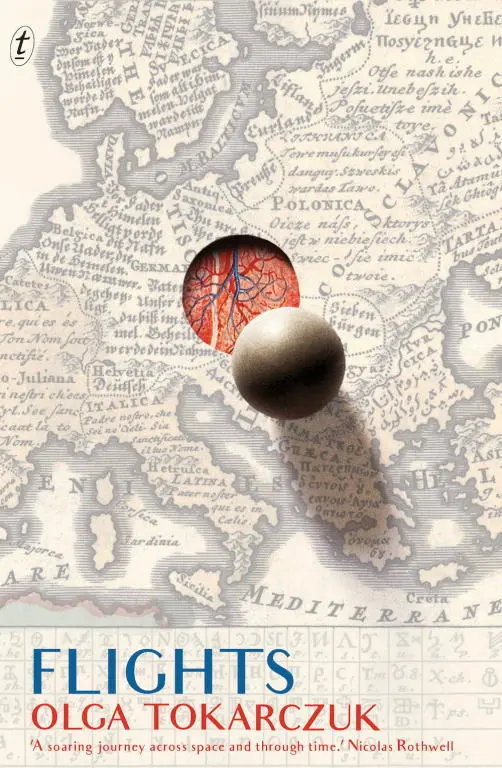
- Название:Flights
- Автор:
- Издательство:Text Publishing Company
- Жанр:
- Год:2017
- Город:Melbourne
- ISBN:978-1-925-60314-9
- Рейтинг книги:4.5 / 5. Голосов: 2
-
Избранное:Добавить в избранное
- Отзывы:
-
Ваша оценка:
Flights: краткое содержание, описание и аннотация
Предлагаем к чтению аннотацию, описание, краткое содержание или предисловие (зависит от того, что написал сам автор книги «Flights»). Если вы не нашли необходимую информацию о книге — напишите в комментариях, мы постараемся отыскать её.
‘A magnificent writer.’ Svetlana Alexievich, Nobel Prize in Literature laureate 2015
‘Tokarczuk examines questions of travel in our increasingly interconnected and fast-moving world… Trained as a psychologist, Tokarczuk is interested in what connects the human soul and body. It is a leitmotif that, despite the apparent lack of a single plot, tightly weaves the text’s different strands—of fiction, memoir and essay—into a whole.’ Spectator
‘Reading Flights is like finally hearing from a weird old best friend you lost touch with years ago and assumed was gone forever because people that amazing and inventive just don't last. Wrong—they were off rediscovering the world on your behalf, just as Olga Tokarczuk does.’ Toby Litt, author of Hospital
‘I have always considered her a person of great literary abilities. With Flights I have my proof. This is one of the most important Polish books I have read for years.’ Jerzy Sosnowski
‘A novel in essays, a world-exploration in words, a soaring journey across space and through time.’ Nicolas Rothwell
Flights — читать онлайн бесплатно полную книгу (весь текст) целиком
Ниже представлен текст книги, разбитый по страницам. Система сохранения места последней прочитанной страницы, позволяет с удобством читать онлайн бесплатно книгу «Flights», без необходимости каждый раз заново искать на чём Вы остановились. Поставьте закладку, и сможете в любой момент перейти на страницу, на которой закончили чтение.
Интервал:
Закладка:
Needless to say, neither book contained everything – but can anything ever contain everything? Copernicus was missing the rest of the Solar System, planets like Uranus, which was still waiting for the right time to be discovered, on the eve of the French Revolution. Vesalius, meanwhile, lacked a number of specific mechanical solutions in the human body, spans, joints, connections – such as, to give just one example, the tendon that joins the calf to the heel.
But maps of the world, of this internal and that external world, had already been drawn up, and that order, once glimpsed, irradiated the mind, etching into it the primary – the fundamental – lines and planes.
Let’s say it is the warm November of 1689, some time in the afternoon. Filip Verheyen is doing what he usually does, sitting at the table, in the pool of light that flows in through the window, as though specially projected for this very purpose. He examines tissues arrayed over the table’s surface. Pins driven into the wood keep grey nerves in place. With his right hand, without looking at the paper, he sketches what he sees.
Seeing, after all, means knowing.
But now there’s someone banging on the door, and the dog’s barking ferociously, and Filip must get up. He is reluctant. His body has already adopted its favourite position, his head inclined over the specimen; now he must lean on his intact leg and drag out from beneath the table the leg that exists as a wooden peg. Limping, he goes to the door, where he manages to calm the dog down. At the door stands a young man whom Verheyen recognizes – but only after a considerable pause – as his student, Willem van Horssen. He’s hardly pleased by these visits, though no visit would please him, but still he takes a step backwards, his wooden leg tapping at the stone slabs of the entrance, and he invites his guest inside.
Van Horssen is tall, with lush, curly hair and a joyful face. He goes over to the kitchen table and sets down the things he bought en route: a wheel of cheese, a loaf of bread, apples and wine. He talks loudly, brags about tickets – this is the reason for his having come today. Filip has to make an effort not to let his face betray his irritation with the grimace of a person who’s just landed in the middle of some horrendous clamour. He guesses that the reason for the arrival of this fellow – a nice fellow, at that – is explained in the letter that lies uncut in the entrance on the little table. As the guest lays out the victuals, the host cleverly hides the letter, and will henceforth pretend he knows its contents.
He will also pretend he hasn’t been able to find a hostess, although he hasn’t actually sought one out at all. He will pretend that he recognizes all the names his visitor will mention, although in reality his memory isn’t good. He is a rector at the University of Leuven, but since the summer he has been holed up in the countryside, complaining of his health.
Together they kindle a fire and sit down to eat. The host eats reluctantly, but then it’s clear that each bite further awakens his appetite. The wine goes well with the cheese and meat. Van Horssen shows him the tickets. They look at them in silence, and then Filip goes up to the window and sets the lenses of his glasses so as to better see the intricate drawing and lettering. Because even the ticket itself is a work of art – below the text at the top there is a beautiful illustration by Master Ruysch, a tableau of skeletons of human fetuses. Two of them sit around a composition consisting of rocks and dried branches, holding in their hands some musical instruments, one of which looks like a trumpet, another like a harp. Looking carefully at the tangle of lines, there are even more bones and skulls, fine and delicate, and any attentive observer would certainly make out of them still more little fetuses.
‘It’s beautiful, isn’t it?’ asks the guest, looking over the host’s shoulder.
‘What about it?’ Filip Verheyen answers off-handedly. ‘Human bones.’
‘It’s art.’
But Filip can’t be dragged into discussion, bears no resemblance to that Filip Verheyen whom van Horssen knew from the university. The conversation doesn’t exactly flow, and you might get the impression that the host is absorbed by something else, perhaps solitude has stretched out his thoughts into long strands, and accustomed him to internal dialogues.
‘Do you still have it, Filip?’ asks his old student after a long interlude.
Verheyen’s laboratory is located in a small outbuilding, reached through a door in the entrance. He is not at all surprised by the sight inside, more reminiscent of an engraver’s workshop, full of plates, etching basins, chiseling sets hanging on the wall, ready prints drying everywhere, and tangles of tow scattered across the floor. The guest unintentionally walks up to the printed sheets of paper – all of them show muscles and blood vessels, tendons and nerves. Carefully marked, absolutely transparent, perfect. There is also a microscope here, first-rate, an instrument that would be the envy of many, with lenses ground by Benedictus Spinoza, through which Filip observes the bundles of blood vessels.
Under the single, but large, south window there stands a clean broad table, and on it, the same specimen that has been there for years. Next to it you can see a jar containing nothing but straw-coloured fluid that fills it two-thirds full.
‘If we’re to go to Amsterdam tomorrow, help me tidy this all up,’ says Filip, adding reproachfully: ‘I’ve been working.’
He begins with his long fingers to delicately detach the tissues and vessels stretched out with the aid of tiny pins. His hands are as fast and as light as the hands of a butterfly-catcher, rather than an anatomist, or an engraver gouging grooves into hard metal that acid will later turn into a negative of an engraving. Van Horssen merely holds a jar of tincture in which parts of the specimen drown in a transparent, lightly brown liquid, as though returning home.
‘Do you know what this is?’ says Filip and points with the nail of his pinky finger to the lighter substance above the bone. ‘Touch it.’
The guest’s finger extends to the dead tissue, but doesn’t reach it remaining suspended in mid-air. The skin was cut in such a way as to reveal this place in a completely unexpected manner. No, he doesn’t know what it is, but he makes a guess:
‘It’s the musculus soleus , a component of it.’
His host looks at him for quite a while, as though looking for words.
‘From now on it is the Achilles Cord,’ he says.
Van Horssen repeats after Verheyen, as though memorizing these two words.
‘The Achilles tendon.’
His hands, which he’s wiped off with a rag, now take out from under the files of papers a diagram sketched out from four perspectives, incredibly accurate: the lower leg and foot comprise a single whole, and it is already hard to believe that once they were not so put together, that in this place there was nothing at all, just some blurred image, now completely forgotten; everything had remained separate, and now it is together. How could this tendon never have been noticed? It’s hard to believe that parts of one’s own body are discovered as though one were forging one’s way upriver in search of sources. In the same way one follows with a scalpel along some blood vessel and establishes its start. White patches get covered with the network of a drawing.
One discovers, and names. Conquers and civilizes. A piece of white cartilage will from now on be subject to our laws, we’ll do with it what we will now.
But the thing that strikes young van Horssen most is the name. He’s a poet, in fact, and despite his medical training, he would prefer to be writing verses. It is the name that opens up fairy-tale images in his mind, as though he were looking at Italian canvases peopled by full-blooded nymphs and gods. Could this part of the body be named any better, this part by which the goddess Thetis grabbed onto little Achilles to bathe him in the Styx and immunize him from death for all eternity?
Читать дальшеИнтервал:
Закладка:
Похожие книги на «Flights»
Представляем Вашему вниманию похожие книги на «Flights» списком для выбора. Мы отобрали схожую по названию и смыслу литературу в надежде предоставить читателям больше вариантов отыскать новые, интересные, ещё непрочитанные произведения.


Обсуждение, отзывы о книге «Flights» и просто собственные мнения читателей. Оставьте ваши комментарии, напишите, что Вы думаете о произведении, его смысле или главных героях. Укажите что конкретно понравилось, а что нет, и почему Вы так считаете.