Ольга Токарчук - Flights
Здесь есть возможность читать онлайн «Ольга Токарчук - Flights» весь текст электронной книги совершенно бесплатно (целиком полную версию без сокращений). В некоторых случаях можно слушать аудио, скачать через торрент в формате fb2 и присутствует краткое содержание. Город: Melbourne, Год выпуска: 2017, ISBN: 2017, Издательство: Text Publishing Company, Жанр: Современная проза, на английском языке. Описание произведения, (предисловие) а так же отзывы посетителей доступны на портале библиотеки ЛибКат.
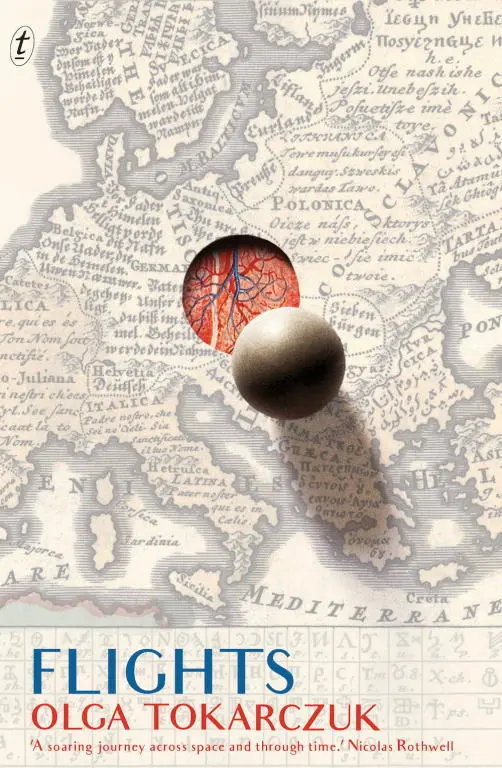
- Название:Flights
- Автор:
- Издательство:Text Publishing Company
- Жанр:
- Год:2017
- Город:Melbourne
- ISBN:978-1-925-60314-9
- Рейтинг книги:4.5 / 5. Голосов: 2
-
Избранное:Добавить в избранное
- Отзывы:
-
Ваша оценка:
Flights: краткое содержание, описание и аннотация
Предлагаем к чтению аннотацию, описание, краткое содержание или предисловие (зависит от того, что написал сам автор книги «Flights»). Если вы не нашли необходимую информацию о книге — напишите в комментариях, мы постараемся отыскать её.
‘A magnificent writer.’ Svetlana Alexievich, Nobel Prize in Literature laureate 2015
‘Tokarczuk examines questions of travel in our increasingly interconnected and fast-moving world… Trained as a psychologist, Tokarczuk is interested in what connects the human soul and body. It is a leitmotif that, despite the apparent lack of a single plot, tightly weaves the text’s different strands—of fiction, memoir and essay—into a whole.’ Spectator
‘Reading Flights is like finally hearing from a weird old best friend you lost touch with years ago and assumed was gone forever because people that amazing and inventive just don't last. Wrong—they were off rediscovering the world on your behalf, just as Olga Tokarczuk does.’ Toby Litt, author of Hospital
‘I have always considered her a person of great literary abilities. With Flights I have my proof. This is one of the most important Polish books I have read for years.’ Jerzy Sosnowski
‘A novel in essays, a world-exploration in words, a soaring journey across space and through time.’ Nicolas Rothwell
Flights — читать онлайн бесплатно полную книгу (весь текст) целиком
Ниже представлен текст книги, разбитый по страницам. Система сохранения места последней прочитанной страницы, позволяет с удобством читать онлайн бесплатно книгу «Flights», без необходимости каждый раз заново искать на чём Вы остановились. Поставьте закладку, и сможете в любой момент перейти на страницу, на которой закончили чтение.
Интервал:
Закладка:
After a seemingly endless series of trials, tribulations, and tragedies, my father was bought out of slavery on Corsica by the Prince of Lichtenstein’s kind-hearted wife and presented at court. This was how he wound up in Vienna, where Her Majesty the Princess developed a great affection for the child, and perhaps even, if I may, love. Thanks to her he was raised and educated in a meticulous manner. That education seems to have replaced in his memory his distant exotic origins. As his only daughter, I never heard him speak about his roots. Never even did I see him seem nostalgic. His heart was always fully in the service of Your Majesty’s uncle.
He became known, of course, as a distinguished politician, an intelligent envoy, and an endearing man. He was always surrounded by friends. He was loved and respected. He also enjoyed one special privilege: the friendship of Emperor Joseph, known as the Second – Your Majesty’s uncle, who entrusted to my father on a number of occasions missions requiring tremendous intelligence.
In 1768 he married my mother Magdalena Christiani, the widow of a Dutch general, with whom he lived in domestic bliss for fourteen years, until her death in 1782. I am the sole fruit of that union. After many years of useful contributions, he undertook the decision to retire from the service of the Prince of Lichtenstein, his benefactor, though he always maintained his relationship with the court and always continued to serve the Emperor.
I know how much my father owed to human kindness, and to the human tendency to help. Many people whose stories began as unhappily as my father’s did were simply lost, dissolving into the chaos of the world. Few black-skinned slave children had the opportunity to attain as high and important a position as my father. But this is precisely the reason why his case is so significant – it shows that as beings created by the hand of God, we are all His children, and we are brothers and sisters to one another.
A number of my dear departed father’s friends have already written to Your Majesty regarding this matter. I join them here in requesting that Your Majesty release my father’s body and allow him to have the Christian burial he deserves.
Hopefully,
Josefine Soliman von Feuchtersleben
AMONG THE MAORI
The heads of deceased family members are mummified and conserved as objects of mourning. Stages of mummification include steaming, smoking, and coating in oil. Through such treatments, the heads may be maintained in good condition, with their hair, skin, and teeth.
DR BLAU’S TRAVELS (II)
He was emerging now from the body of the plane, down long tunnels, following the arrows and illuminated notices that gently divided passengers between those who had reached their destinations and those who were still en route. The streams of people in the large airport swelled and then dispersed again. This painless selection process led him to the escalators, and then a long, broad hallway, where fluidity was hastened by a moving walkway. Those in a hurry took advantage of technology’s advances and now leaped into another rate of time – at a leisurely pace they passed by others. Blau passed the glassed-in smoking area where nicotine fanatics, having fasted during extended flights, now gave in to their addictions with evident bliss. To Blau they seemed a separate species, living in an element that wasn’t air, but rather a mixture of carbon dioxide and smoke. He watched them through the glass with vague astonishment, as though watching animals in a terrarium – on the plane they’d seemed so like him, but here their distinct biological make-up had been revealed.
He handed over his passport, and the officer sized him up with a quick, professional glance, comparing both faces – the one on the photo and the one on the other side of the pane. Apparently he didn’t raise suspicions, because without delay they let him onto the terrain of this foreign nation.
The taxi pulled into the train station, where he showed his electronic ticket at the window. Since he still had over two hours he went to a bar. It reeked of stale grease, and as he waited for his fish, he examined those sitting around him.
The station didn’t have any particular characteristics to set it apart. The large screen over the departures table showed all the same ads, for shampoo and credit cards. A familiar logo made this foreign world feel safe. He was hungry. The artificial airplane food had left no trace he was aware of in his body. It was as though it had contained no substance – only shape and smell – which was apparently the food they’d serve in paradise. Food for hungry souls. But now the piece of fried fish served with salad, the piece of white meat fried golden, fortified the doctor’s compact body. He also ordered wine, served here in handy little bottles, its contents equal to one generous glass.
On the train, he fell asleep. He didn’t miss much – the train slogged through the city, through some tunnels and the suburbs, confusingly similar to other suburbs, with the same graffitied patterns repeated on the viaducts and the garages they went past. When he came to, he saw the sea, a thin bright belt between the cranes at the port and some ugly warehouse buildings and the shipyards.
‘My dear sir,’ she had written him. ‘Your questions and their formulations have instilled within me, I must confess, complete and profound trust. A person who knows what he’s asking is someone who can expect an answer soon. Perhaps what you need is that proverbial pinch that tips the scales.’
He wondered what sort of pinch she had in mind. He checked the dictionary thoroughly. He didn’t know any proverbs that had to do with scales and pinches. She had taken her husband’s last name, but her first name was fairly exotic – Taina. Which might suggest she came from some distant land and equally exotic language, in which both pinch and scale worked perfectly fine as proverb. ‘Needless to say, it would be best for us to meet. I’ll try to examine your dossier and all your articles in the meantime. Please come and see me. This is where my husband worked right up until the end, and his presence is still felt here. This will no doubt aid us in our conversations.’
It was a small seaside village stretching down the shore, belted by a straight asphalt highway. The taxi pulled off just before the last sign with the village’s name on it, heading downhill, towards the sea, and now they passed wood houses, pleasant to look at, with terraces and balconies. The house he was looking for turned out to be big, and the most elegant along this gravel road. It was surrounded by a wall of medium height thickly covered with some local vine. The gate was kept open, but he asked the driver to stop on the road and, taking out his wheeled suitcase, he went up the gravel-strewn driveway on foot. The focal point of the neat yard was a magnificent tree, clearly coniferous, but with a deciduous aspect, like an oak with leaves that had somehow been stunted into needles. He’d never seen such a tree, its almost white bark looked like an elephant’s skin.
No one responded to his knocking, so for a moment he stood there on the wooden porch, unable to make up his mind; he summoned his courage and turned the handle. The door opened, admitting him into a bright, spacious living room. The window opposite was completely taken up by the sea. A big orange cat came up to his feet, meowed and slipped outside, completely ignoring the houseguest. The doctor was sure there was no one home, so he set down his suitcase and went out on the porch to wait for his hostess. He stood there for a quarter of an hour or so, examining that mighty tree, and then he slowly started to go around the house, which was encircled, like the others in this area, by a wooden terrace, on which (as in every other place in the world) stood lightweight furniture with throw pillows. In the back he found a garden with a meticulously mown lawn, densely planted with flowering bushes. In one of them he recognized a fragrant honeysuckle, and guided by a path lined with smooth, round rocks, he discovered a passage he thought must lead straight to the sea. He hesitated for a moment. Then he set forth.
Читать дальшеИнтервал:
Закладка:
Похожие книги на «Flights»
Представляем Вашему вниманию похожие книги на «Flights» списком для выбора. Мы отобрали схожую по названию и смыслу литературу в надежде предоставить читателям больше вариантов отыскать новые, интересные, ещё непрочитанные произведения.



Обсуждение, отзывы о книге «Flights» и просто собственные мнения читателей. Оставьте ваши комментарии, напишите, что Вы думаете о произведении, его смысле или главных героях. Укажите что конкретно понравилось, а что нет, и почему Вы так считаете.