J.G. Ballard - Cocaine Nights
Здесь есть возможность читать онлайн «J.G. Ballard - Cocaine Nights» — ознакомительный отрывок электронной книги совершенно бесплатно, а после прочтения отрывка купить полную версию. В некоторых случаях можно слушать аудио, скачать через торрент в формате fb2 и присутствует краткое содержание. Жанр: Современная проза, на английском языке. Описание произведения, (предисловие) а так же отзывы посетителей доступны на портале библиотеки ЛибКат.
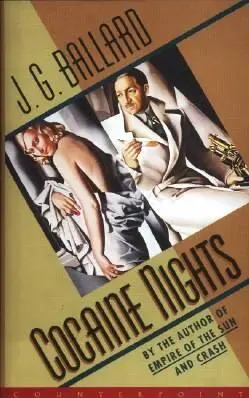
- Название:Cocaine Nights
- Автор:
- Жанр:
- Год:неизвестен
- ISBN:нет данных
- Рейтинг книги:5 / 5. Голосов: 1
-
Избранное:Добавить в избранное
- Отзывы:
-
Ваша оценка:
Cocaine Nights: краткое содержание, описание и аннотация
Предлагаем к чтению аннотацию, описание, краткое содержание или предисловие (зависит от того, что написал сам автор книги «Cocaine Nights»). Если вы не нашли необходимую информацию о книге — напишите в комментариях, мы постараемся отыскать её.
Outward appearances suggest the wholesale adoption of a new ethos of high-spirited, well-controlled collective exuberance. But there’s the matter of the fire: The house and household of an aged, wealthy industrialist has gone up in flames, claiming five lives, while virtually the entire town stood and watched. There’s the matter of the petty crime, the burglaries, muggings, and auto thefts which have begun to nibble away at the edges of Estrella Del Mar’s security despite the guardhouses and surveillance cameras. There’s the matter of the new, flourishing trade in drugs and pornography. And there’s the matter of Frank Prentice, who sits in Marbella jail awaiting trial for arson and five counts of murder, and who, despite being clearly innocent, has happily confessed.
It is up to Charles Prentice, Frank’s brother, to peel away the onionlike layers of denial and deceit which hide the rather ugly truth about this seaside idyll, its residents, and the horrific crime which brought him here. But as is usually the case in a J.G. Ballard book, the truth comes with a price tag attached, and likely without any easing of discomfort for his principal characters.
Cocaine Nights marks a partial return on Ballard’s part to the provocative, highly-successful mid-career methodology employed in novels such as Crash and High Rise: after establishing himself as a science fiction guru in the 1960s, Ballard stylistically shifted gears towards an unnerving, futuristic variant on social realism in the 1970s. Both Crash and High Rise were what-if novels, posing questions as to what the likely results would be if our collective fascination with such things as speed, violence, status, power, and sex were carried just a little bit further: How insane, how brutal could our world become if we really cut loose?
Cocaine Nights asks a question better suited to the ’90s, the age of gated communities and infrared home security systems: Does absolute security guarantee isolation and cultural death? Conversely, is a measure of crime an essential ingredient in a vibrant, living, properly functioning social system? Is it true, as a character asserts, that “Crime and creativity go together, always have done,” and that “total security is a disease of deprivation”? Suffice to say that the answers presented in Nights will be anathema to moral absolutists; the world of Ballard’s fiction, like life in the hyperkinetic, relativistic 1990s, abounds with uncomfortable grey areas.
On the surface, Cocaine Nights is a whodunit and a race against time, but as it proceeds – and as preconceived conceptions of good and evil begin to dissolve – it evolves into a thoughtful, faintly frightening look at under-examined aspects of 1990s western society. As is his wont, Ballard confronts his readers with some faintly outlandish hypotheses unlikely to be embraced by many, but which nonetheless serve to provoke both thought and a bit of paranoia; it’s a method that Ballard has developed and refined on his own, and as usual, it propels his novel along marvellously.
Cocaine Nights doesn’t have either the broad sweep or brute impact of the landmark Crash, but it retains enough social relevance and low-key creepiness to more than satisfy Ballardphiles. As is often the case in Ballard’s alternate reality, it’s a given that his most appealing, human characters turn out to be the most twisted, and that even the most normal of events turn out to be governed by a perverse, malformed logic; that this logic turns out to be grounded in sound sociological and psychological principles is its most horrific feature.
David B. Livingstone
Cocaine Nights — читать онлайн ознакомительный отрывок
Ниже представлен текст книги, разбитый по страницам. Система сохранения места последней прочитанной страницы, позволяет с удобством читать онлайн бесплатно книгу «Cocaine Nights», без необходимости каждый раз заново искать на чём Вы остановились. Поставьте закладку, и сможете в любой момент перейти на страницу, на которой закончили чтение.
Интервал:
Закладка:
The next morning, when I passed the marina on my way to the sports club, a police launch circled the debris-strewn water. A small crowd stood on the quay, watching a frogman dive to the submerged sloop. The usually silent yachts and cruisers had begun to stir with activity. A few owners were testing their rigging and engines, while their wives aired the cabins and buffed the brass. Only Andersson sat quietly in the boatyard, face as bleak as ever, smoking a roll-up cigarette as he stared at the rising sails.
I left him to his vigil and drove across the plaza to the club. A car turned through the gates ahead of me and parked by the entrance. Two middle-aged couples, dressed in their crispest tennis whites, stepped nimbly from the car, rackets swinging in their hands.
'Mr Prentice? Good morning to you.' One of the husbands, a retired dentist I had seen in the wine store, strolled up to me. 'We're not members, but we'd like to join. Can you sign us up?'
'Of course.' I shook his hand and beckoned the party towards the entrance. 'You'll be glad to know that the first year's membership is entirely free.'
Bobby Crawford's first recruits were signing on for duty.
22 An End to Amnesia
The residencia costasol had come to life. A sun-bleached cadaver of a community, lying inertly beside a thousand swimming pools, had raised itself on one elbow to taste the quickening air. Waiting for Crawford to begin his morning inspection tour, I sat in the Citroen and listened to the eager chorus of hammers nailing together the proscenium arch of the open-air theatre beside the marina. Led by Harold Lejeune, a sometime marine surveyor at Lloyd's Register of Shipping, a team of enthusiastic carpenters was putting together a creditable copy of an end-of-pier playhouse.
Lejeune squatted astride the crown pole, baseball cap rakishly across his head, nails clamped in his strong teeth as he waited for the last section of the pitched gable to be hoisted into place. A furious salvo of hammerheads signalled the raising of the roof by this work-gang of former accountants, lawyers and middle-managers.
Below them, shielding their ears from the din, their wives were unrolling the bolts of silky bombazine that would form the side and rear walls of the theatre. A group of energetic daughters unloaded a stack of collapsible metal chairs from a pick-up truck beside the quay, adding them to the rows of seats that faced the stage.
The Marina Players were about to mount their first production, a performance of The Importance of Being Earnest, which would alternate with Who's Afraid of Virginia Woolf?.
Future productions included plays by Orton and Coward, all to be directed by Arnold Wynegarde, a Shaftesbury Avenue veteran, their amateur casts stiffened by several one-time stage professionals.
Green shoots of a forgotten metropolitan culture were poking through the property developer's plaster and lath. When the hammers paused briefly from their work I could hear the strains of Giselle from the gymnasium, where a ballet class of younger wives were practising their fouettés and arabesques. They would end the session bouncing in their leotards to a rock number, then lie panting by the swimming pool.
In the five weeks since Crawford had taken me on my first tour of the complex a remarkable transformation had occurred. Refurbished restaurants and boutiques had opened in the shopping mall, briskly profitable as they prospered under Elizabeth Shand's steely gaze. An impromptu arts festival had conjured itself from the air, drawing troupes of eager volunteers from the sleepy afternoons.
The Residencia Costasol had decided that it needed a facelift. A rush to activity of every kind was on, the quest for a new civic pride expressed in parties and barbecues, tea-dances and church services. Newsletters circulated on the e-mail computer screens, inviting residents to stand for a new municipal council and its projected sub-committees.
The sounds of serve and volley came from the tennis courts, where Helmut drilled his eager pupils, and there was a heavy splash in the swimming pool as Wolfgang demonstrated a jackknife and reverse swallow to his diving class. Water-skis, trampolines and exercycles were being moved by the groundsmen from forgotten storerooms under the gymnasium. Below the arched bridge of the coastal road the first yachts of the morning were setting out for the open sea. The once-silent marina echoed to the strains of capstan and hawser as hulls weakened by osmosis were drained and varnished by Andersson and his Spanish repair team.
Meanwhile, in the centre of the marina, a fire-ravaged sloop was lashed to a steel lighter, the half-submerged hulk of the Halcyon. Its charred mast and blackened sails presided over the waterways, urging the yachtsmen of the Residencia Costasol to reef their sails and search for the keenest winds and steepest seas.
A hand held my shoulder, then clasped my temples before I could raise my head, pinning me to the driving seat of the Citroen. I had fallen asleep in the car, and someone had slipped into the seat behind me.
'Bobby…!' I pushed his hand away, angered by his brutal humour. 'That's a -'
'Mean trick to play?' Crawford chuckled to himself like a child savouring a favourite joke. 'Charles, you were sound asleep. I hired you as my bodyguard.'
'I thought I was your literary adviser. You were supposed to be here at ten.'
'Pressing work. All kinds of things are happening. Tell me, what were you dreaming about?'
'Some sort of… fire-storm. The yachts in the marina were blazing. God knows why.'
'Strange. Did you wet the bed as a child? Never mind. How's everything at the club? It sounds busy.'
'It is. Membership's up to three hundred, with another fifty application forms in. There's already a waiting list for the courts.'
'Good, good…' Crawford scanned the pool, smiling at the sight of so many handsome women oiling themselves in the sun. Wolfgang was demonstrating a back-flip, whipping the board under his feet with a crack that roused everyone from their seats. 'Handsome fellow-any Greek sculptor would have given his eye-teeth to stick him in a frieze. It looks great, Charles. You've done a superb job. You may not realize it, but your real ambition is to run a nightclub in Puerto Banus.'
He patted my back and gazed at the busy scene, smiling in an almost innocent way, delighted by these signs of civic renewal and at that moment wholly unconscious of the means he had used to achieve them. Despite myself, I was glad to see him. As always I felt buoyed by his evangelical zeal and his selfless commitment to the people of the Residencia. At the same time I was still sceptical about his belief that the crime wave he had launched was the engine of change. The theatre and sports clubs, like their counterparts at Estrella de Mar, flourished as a result of some small but significant shift in people's sense of themselves, a response to something no more radical than simple boredom. Crawford had seized on the coincidence to give vent to a latent strain of violence in his make-up, an almost childlike faith that he could provoke the world to rise on its toes and respond in kind. Just as he had willed the tennis machine to beat him, he now urged the Costasol complex to rally itself against the secret enemy within its walls.
Yet his affection for the residents was unfeigned. When we left the sports club and drove past the Marina Players he reached over me and sounded the Citroen's horn. He waved his baseball cap at Lejeune and his fellow-carpenters on the roof and whistled at the wives tacking up their bombazine.
'When do the tickets go on sale?' he shouted cheerily. 'Let's do a drag version – I'll play Lady Bracknell…' He lay back in the rear seat and clapped his hands. 'Right, Charles, we're off. Let's visit your new home. You're now a paid-up resident of the Costasol complex.'
Читать дальшеИнтервал:
Закладка:
Похожие книги на «Cocaine Nights»
Представляем Вашему вниманию похожие книги на «Cocaine Nights» списком для выбора. Мы отобрали схожую по названию и смыслу литературу в надежде предоставить читателям больше вариантов отыскать новые, интересные, ещё непрочитанные произведения.










Обсуждение, отзывы о книге «Cocaine Nights» и просто собственные мнения читателей. Оставьте ваши комментарии, напишите, что Вы думаете о произведении, его смысле или главных героях. Укажите что конкретно понравилось, а что нет, и почему Вы так считаете.