Amy Tan - The Joy Luck Club
Здесь есть возможность читать онлайн «Amy Tan - The Joy Luck Club» весь текст электронной книги совершенно бесплатно (целиком полную версию без сокращений). В некоторых случаях можно слушать аудио, скачать через торрент в формате fb2 и присутствует краткое содержание. Жанр: Современная проза, на английском языке. Описание произведения, (предисловие) а так же отзывы посетителей доступны на портале библиотеки ЛибКат.
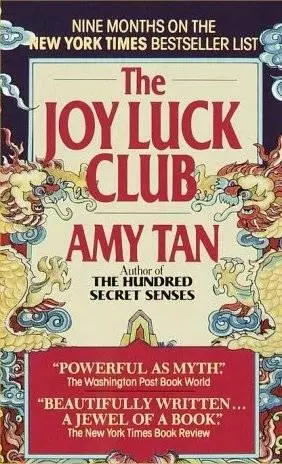
- Название:The Joy Luck Club
- Автор:
- Жанр:
- Год:неизвестен
- ISBN:нет данных
- Рейтинг книги:5 / 5. Голосов: 1
-
Избранное:Добавить в избранное
- Отзывы:
-
Ваша оценка:
The Joy Luck Club: краткое содержание, описание и аннотация
Предлагаем к чтению аннотацию, описание, краткое содержание или предисловие (зависит от того, что написал сам автор книги «The Joy Luck Club»). Если вы не нашли необходимую информацию о книге — напишите в комментариях, мы постараемся отыскать её.
Amy Tan wrote The Joy Luck Club to try to understand her own relationship with her mother. Tan's Chinese parents wanted Americanized children but expected them to think like Chinese. Tan found this particularly difficult as an adolescent. While the generational differences were like those experienced by other mothers and daughters, the cultural distinctions added another dimension. Thus, Tan wrote not only to sort out her cultural heritage but to learn how she and her mother could get along better.
Critics appreciate Tan's straightforward manner as well as the skill with which she talks about Chinese culture and mother/daughter relationships. Readers also love The Joy Luck Club: women of all ages identify with Tan's characters and their conflicts with their families, while men have an opportunity through this novel to better understand their own behaviors towards women. Any reader can appreciate Tan's humor, fairness, and objectivity.
The Joy Luck Club — читать онлайн бесплатно полную книгу (весь текст) целиком
Ниже представлен текст книги, разбитый по страницам. Система сохранения места последней прочитанной страницы, позволяет с удобством читать онлайн бесплатно книгу «The Joy Luck Club», без необходимости каждый раз заново искать на чём Вы остановились. Поставьте закладку, и сможете в любой момент перейти на страницу, на которой закончили чтение.
Интервал:
Закладка:
And when I got into the car, I still had the glow of that feeling and I touched his hand and said, "Harold, I love you." And he looked in the rearview mirror, backing up the car, and said, "I love you, too. Did you lock the door?" And just like that, I started to think, It's just not enough.
Harold jingles the car keys and says, "I'm going down the hill to buy stuff for dinner. Steaks okay? Want anything special?"
"We're out of rice," I say, discreetly nodding toward my mother, whose back is turned to me. She's looking out the kitchen window, at the trellis of bougainvillea. And then Harold is out the door and I hear the deep rumble of the car and then the sound of crunching gravel as he drives away.
My mother and I are alone in the house. I start to water the plants. She is standing on her tiptoes, peering at a list stuck on our refrigerator door.
The list says " Lena " and "Harold" and under each of our names are things we've bought and how much they cost:
Lenu
chicken, veg., bread, broccoli, shampoo, beer $19.63
Maria (clean + tip) $65 groceries
(see shop list) $55.15
petunias, potting soil $14.11
Photo developing $13.83
Harold
Garage stuff $25.35
Bathroom stuff $5.41
Car stuff $6.57
Light Fixtures $87.26
Road gravel $19.99
Gas $22.00
Car Smog Check $35
Movies amp; Dinner $65
Ice Cream $4.50
The way things are going this week, Harold's already spent over a hundred dollars more, so I'll owe him around fifty from my checking account.
"What is this writing?" asks my mother in Chinese.
"Oh, nothing really. Just things we share," I say as casually as I can.
And she looks at me and frowns but doesn't say anything. She goes back to reading the list, this time more carefully, moving her finger down each item.
And I feel embarrassed, knowing what she's seeing. I'm relieved that she doesn't see the other half of it, the discussions. Through countless talks, Harold and I reached an understanding about not including personal things like "mascara," and "shaving lotion," "hair spray" or "Bic shavers," "tampons," or "athlete's foot powder."
When we got married at city hall, he insisted on paying the fee. I got my friend Robert to take photos. We held a party at our apartment and everybody brought champagne. And when we bought the house, we agreed that I should pay only a percentage of the mortgage based on what I earn and what he earns, and that I should own an equivalent percentage of community property; this is written in our prenuptial agreement. Since Harold pays more, he had the deciding vote on how the house should look. It is sleek, spare, and what he calls "fluid," nothing to disrupt the line, meaning none of my cluttered look. As for vacations, the one we choose together is fifty-fifty. The others Harold pays for, with the understanding that it's a birthday or Christmas present, or an anniversary gift.
And we've had philosophical arguments over things that have gray borders, like my birth control pills, or dinners at home when we entertain people who are really his clients or my old friends from college, or food magazines that I subscribe to but he also reads only because he's bored, not because he would have chosen them for himself.
And we still argue about Mirugai, the cat-not our cat, or my cat, but the cat that was his gift to me for my birthday last year.
"This, you do not share!" exclaims my mother in an astonished voice. And I am startled, thinking she had read my thoughts about Mirugai. But then I see she is pointing to "ice cream" on Harold's list. My mother must remember the incident on the fire escape landing, where she found me, shivering and exhausted, sitting next to that container of regurgitated ice cream. I could never stand the stuff after that. And then I am startled once again to realize that Harold has never noticed that I don't eat any of the ice cream he brings home every Friday evening.
"Why you do this?"
My mother has a wounded sound in her voice, as if I had put the list up to hurt her. I think how to explain this, recalling the words Harold and I have used with each other in the past: "So we can eliminate false dependencies…be equals…love without obligation…" But these are words she could never understand.
So instead I tell my mother this: "I don't really know. It's something we started before we got married. And for some reason we never stopped."
When Harold returns from the store, he starts the charcoal. I unload the groceries, marinate the steaks, cook the rice, and set the table. My mother sits on a stool at the granite counter, drinking from a mug of coffee I've poured for her. Every few minutes she wipes the bottom of the mug with a tissue she keeps stuffed in her sweater sleeve.
During dinner, Harold keeps the conversation going. He talks about the plans for the house: the skylights, expanding the deck, planting flower beds of tulips and crocuses, clearing the poison oak, adding another wing, building a Japanese-style tile bathroom. And then he clears the table and starts stacking the plates in the dishwasher.
"Who's ready for dessert?" he asks, reaching into the freezer.
"I'm full," I say.
" Lena cannot eat ice cream," says my mother.
"So it seems. She's always on a diet."
"No, she never eat it. She doesn't like."
And now Harold smiles and looks at me puzzled, expecting me to translate what my mother has said.
"It's true," I say evenly. "I've hated ice cream almost all my life."
Harold looks at me, as if I, too, were speaking Chinese and he could not understand.
"I guess I assumed you were just trying to lose weight… Oh well."
"She become so thin now you cannot see her," says my mother. "She like a ghost, disappear."
"That's right! Christ, that's great," exclaims Harold, laughing, relieved in thinking my mother is graciously trying to rescue him.
After dinner, I put clean towels on the bed in the guest room. My mother is sitting on the bed. The room has Harold's minimalist look to it: the twin bed with plain white sheets and white blanket, polished wood floors, a bleached oakwood chair, and nothing on the slanted gray walls.
The only decoration is an odd-looking piece right next to the bed: an end table made out of a slab of unevenly cut marble and thin crisscrosses of black lacquer wood for the legs. My mother puts her handbag on the table and the cylindrical black vase on top starts to wobble. The freesias in the vase quiver.
"Careful, it's not too sturdy," I say. The table is a poorly designed piece that Harold made in his student days. I've always wondered why he's so proud of it. The lines are clumsy. It doesn't bear any of the traits of "fluidity" that are so important to Harold these days.
"What use for?" asks my mother, jiggling the table with her hand. "You put something else on top, everything fall down. Chunwang chihan ."
I leave my mother in her room and go back downstairs. Harold is opening the windows to let the night air in. He does this every evening.
"I'm cold," I say.
"What's that?"
"Could you close the windows, please."
He looks at me, sighs and smiles, pulls the windows shut, and then sits down cross-legged on the floor and flips open a magazine. I'm sitting on the sofa, seething, and I don't know why. It's not that Harold has done anything wrong. Harold is just Harold.
And before I even do it, I know I'm starting a fight that is bigger than I know how to handle. But I do it anyway. I go to the refrigerator and I cross out "ice cream" on Harold's side of the list.
"What's going on here?"
"I just don't think you should get credit for your ice cream anymore."
He shrugs his shoulders, amused. "Suits me."
Читать дальшеИнтервал:
Закладка:
Похожие книги на «The Joy Luck Club»
Представляем Вашему вниманию похожие книги на «The Joy Luck Club» списком для выбора. Мы отобрали схожую по названию и смыслу литературу в надежде предоставить читателям больше вариантов отыскать новые, интересные, ещё непрочитанные произведения.



Обсуждение, отзывы о книге «The Joy Luck Club» и просто собственные мнения читателей. Оставьте ваши комментарии, напишите, что Вы думаете о произведении, его смысле или главных героях. Укажите что конкретно понравилось, а что нет, и почему Вы так считаете.