Amy Tan - The Joy Luck Club
Здесь есть возможность читать онлайн «Amy Tan - The Joy Luck Club» весь текст электронной книги совершенно бесплатно (целиком полную версию без сокращений). В некоторых случаях можно слушать аудио, скачать через торрент в формате fb2 и присутствует краткое содержание. Жанр: Современная проза, на английском языке. Описание произведения, (предисловие) а так же отзывы посетителей доступны на портале библиотеки ЛибКат.
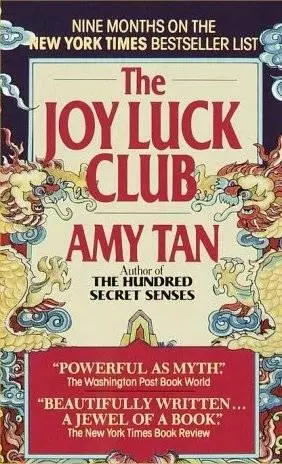
- Название:The Joy Luck Club
- Автор:
- Жанр:
- Год:неизвестен
- ISBN:нет данных
- Рейтинг книги:5 / 5. Голосов: 1
-
Избранное:Добавить в избранное
- Отзывы:
-
Ваша оценка:
The Joy Luck Club: краткое содержание, описание и аннотация
Предлагаем к чтению аннотацию, описание, краткое содержание или предисловие (зависит от того, что написал сам автор книги «The Joy Luck Club»). Если вы не нашли необходимую информацию о книге — напишите в комментариях, мы постараемся отыскать её.
Amy Tan wrote The Joy Luck Club to try to understand her own relationship with her mother. Tan's Chinese parents wanted Americanized children but expected them to think like Chinese. Tan found this particularly difficult as an adolescent. While the generational differences were like those experienced by other mothers and daughters, the cultural distinctions added another dimension. Thus, Tan wrote not only to sort out her cultural heritage but to learn how she and her mother could get along better.
Critics appreciate Tan's straightforward manner as well as the skill with which she talks about Chinese culture and mother/daughter relationships. Readers also love The Joy Luck Club: women of all ages identify with Tan's characters and their conflicts with their families, while men have an opportunity through this novel to better understand their own behaviors towards women. Any reader can appreciate Tan's humor, fairness, and objectivity.
The Joy Luck Club — читать онлайн бесплатно полную книгу (весь текст) целиком
Ниже представлен текст книги, разбитый по страницам. Система сохранения места последней прочитанной страницы, позволяет с удобством читать онлайн бесплатно книгу «The Joy Luck Club», без необходимости каждый раз заново искать на чём Вы остановились. Поставьте закладку, и сможете в любой момент перейти на страницу, на которой закончили чтение.
Интервал:
Закладка:
And I think that feeling of fear never left me, that I would be caught someday, exposed as a sham of a woman. But recently, a friend of mine, Rose, who's in therapy now because her marriage has already fallen apart, told me those kinds of thoughts are commonplace in women like us.
"At first I thought it was because I was raised with all this Chinese humility," Rose said. "Or that maybe it was because when you're Chinese you're supposed to accept everything, flow with the Tao and not make waves. But my therapist said, Why do you blame your culture, your ethnicity? And I remembered reading an article about baby boomers, how we expect the best and when we get it we worry that maybe we should have expected more, because it's all diminishing returns after a certain age."
And after my talk with Rose, I felt better about myself and I thought, Of course, Harold and I are equals, in many respects. He's not exactly handsome in the classic sense, although clear-skinned and certainly attractive in that wiry intellectual way. And I may not be a raving beauty, but a lot of women in my aerobics class tell me I'm "exotic" in an unusual way, and they're jealous that my breasts don't sag, now that small breasts are in. Plus, one of my clients said I have incredible vitality and exuberance.
So I think I deserve someone like Harold, and I mean in the good sense and not like bad karma. We're equals. I'm also smart. I have common sense. And I'm intuitive, highly so. I was the one who told Harold he was good enough to start his own firm.
When we were still working at Harned Kelley amp; Davis, I said, "Harold, this firm knows just what a good deal it has with you. You're the goose who lays the golden egg. If you started your own business today, you'd walk away with more than half of the restaurant clients."
And he said, laughing, "Half? Boy, that's love."
And I shouted back, laughing with him, "More than half! You're that good. You're the best there is in restaurant design and development. You know it and I know it, and so do a lot of restaurant developers."
That was the night he decided to "go for it," as he put it, which is a phrase I have personally detested ever since a bank I used to work for adopted the slogan for its employee productivity contest.
But still, I said to Harold, "Harold, I want to help you go for it, too. I mean, you're going to need money to start this business."
He wouldn't hear of taking any money from me, not as a favor, not as a loan, not as an investment, or even as the down payment on a partnership. He said he valued our relationship too much. He didn't want to contaminate it with money. He explained, "I wouldn't want a handout any more than you'd want one. As long as we keep the money thing separate, we'll always be sure of our love for each other."
I wanted to protest. I wanted to say, "No! I'm not really this way about money, the way we've been doing it. I'm really into giving freely. I want…" But I didn't know where to begin. I wanted to ask him who, what woman, had hurt him this way, that made him so scared about accepting love in all its wonderful forms. But then I heard him saying what I'd been waiting to hear for a long, long time.
"Actually, you could help me out if you moved in with me. I mean, that way I could use the five hundred dollars' rent you paid to me…"
"That's a wonderful idea," I said immediately, knowing how embarrassed he was to have to ask me that way. I was so deliriously happy that it didn't matter that the rent on my studio was really only four hundred thirty-five. Besides, Harold's place was much nicer, a two-bedroom flat with a two-hundred-forty-degree view of the bay. It was worth the extra money, no matter whom I shared the place with.
So within the year, Harold and I quit Harned Kelley amp; Davis and he started Livotny amp; Associates, and I went to work there as a project coordinator. And no, he didn't get half the restaurant clients of Harned Kelley amp; Davis. In fact, Harned Kelley amp; Davis threatened to sue if he walked away with even one client over the next year. So I gave him pep talks in the evening when he was discouraged. I told him how he should do more avantgarde thematic restaurant design, to differentiate himself from the other firms.
"Who needs another brass and oakwood bar and grill?" I said. "Who wants another pasta place in sleek Italian moderno? How many places can you go to with police cars lurching out of the walls? This town is chockablock with restaurants that are just clones of the same old themes. You can find a niche. Do something different every time. Get the Hong Kong investors who are willing to sink some bucks into American ingenuity."
He gave me his adoring smile, the one that said, "I love it when you're so naive." And I adored his looking at me like that.
So I stammered out my love. "You…you…could do new theme eating places…a…a…Home on the Range! All the home-cooked mom stuff, mom at the kitchen range with a gingham apron and mom waitresses leaning over telling you to finish your soup.
"And maybe…maybe you could do a novel-menu restaurant…foods from fiction…sandwiches from Lawrence Sanders murder mysteries, just desserts from Nora Ephron's Heartburn . And something else with a magic theme, or jokes and gags, or…"
Harold actually listened to me. He took those ideas and he applied them in an educated, methodical way. He made it happen. But still, I remember, it was my idea.
And today Livotny amp; Associates is a growing firm of twelve full-time people, which specializes in thematic restaurant design, what I still like to call "theme eating." Harold is the concept man, the chief architect, the designer, the person who makes the final sales presentation to a new client. I work under the interior designer, because, as Harold explains, it would not seem fair to the other employees if he promoted me just because we are now married-that was five years ago, two years after he started Livotny amp; Associates. And even though I am very good at what I do, I have never been formally trained in this area. When I was majoring in Asian-American studies, I took only one relevant course, in theater set design, for a college production of Madama Butterfly .
At Livotny amp; Associates, I procure the theme elements. For one restaurant called The Fisherman's Tale, one of my prized findings was a yellow varnished wood boat stenciled with the name "Overbored," and I was the one who thought the menus should dangle from miniature fishing poles, and the napkins be printed with rulers that have inches translating into feet. For a Lawrence of Arabia deli called Tray Sheik, I was the one who thought the place should have a bazaar effect, and I found the replicas of cobras lying on fake Hollywood boulders.
I love my work when I don't think about it too much. And when I do think about it, how much I get paid, how hard I work, how fair Harold is to everybody except me, I get upset.
So really, we're equals, except that Harold makes about seven times more than what I make. He knows this, too, because he signs my monthly check, and then I deposit it into my separate checking account.
Lately, however, this business about being equals started to bother me. It's been on my mind, only I didn't really know it. I just felt a little uneasy about something . And then about a week ago, it all became clear. I was putting the breakfast dishes away and Harold was warming up the car so we could go to work. And I saw the newspaper spread open on the kitchen counter, Harold's glasses on top, his favorite coffee mug with the chipped handle off to the side. And for some reason, seeing all these little domestic signs of familiarity, our daily ritual, made me swoon inside. But it was as if I were seeing Harold the first time we made love, this feeling of surrendering everything to him, with abandon, without caring what I got in return.
Читать дальшеИнтервал:
Закладка:
Похожие книги на «The Joy Luck Club»
Представляем Вашему вниманию похожие книги на «The Joy Luck Club» списком для выбора. Мы отобрали схожую по названию и смыслу литературу в надежде предоставить читателям больше вариантов отыскать новые, интересные, ещё непрочитанные произведения.








Обсуждение, отзывы о книге «The Joy Luck Club» и просто собственные мнения читателей. Оставьте ваши комментарии, напишите, что Вы думаете о произведении, его смысле или главных героях. Укажите что конкретно понравилось, а что нет, и почему Вы так считаете.