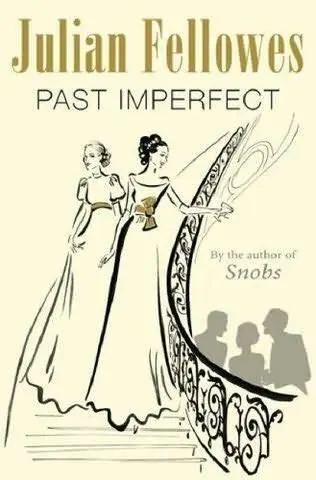
Julian Fellowes - Past Imperfect
Здесь есть возможность читать онлайн «Julian Fellowes - Past Imperfect» весь текст электронной книги совершенно бесплатно (целиком полную версию без сокращений). В некоторых случаях можно слушать аудио, скачать через торрент в формате fb2 и присутствует краткое содержание. Жанр: Современная проза, на английском языке. Описание произведения, (предисловие) а так же отзывы посетителей доступны на портале библиотеки ЛибКат.
- Название:Past Imperfect
- Автор:
- Жанр:
- Год:неизвестен
- ISBN:нет данных
- Рейтинг книги:3 / 5. Голосов: 1
-
Избранное:Добавить в избранное
- Отзывы:
-
Ваша оценка:
Past Imperfect: краткое содержание, описание и аннотация
Предлагаем к чтению аннотацию, описание, краткое содержание или предисловие (зависит от того, что написал сам автор книги «Past Imperfect»). Если вы не нашли необходимую информацию о книге — напишите в комментариях, мы постараемся отыскать её.
Past Imperfect — читать онлайн бесплатно полную книгу (весь текст) целиком
Ниже представлен текст книги, разбитый по страницам. Система сохранения места последней прочитанной страницы, позволяет с удобством читать онлайн бесплатно книгу «Past Imperfect», без необходимости каждый раз заново искать на чём Вы остановились. Поставьте закладку, и сможете в любой момент перейти на страницу, на которой закончили чтение.
Интервал:
Закладка:
Actually, unlike many modern, sartorial adjustments, this was an improvement, as between the church and the reception there was hardly a moment to wear it and one always ending up leaving it in a pile behind a curtain, where it was liable to be taken in error, leaving you with an even worse one. The hat did, however, remain compulsory for race meetings and here there was a complication, because there came a point when they stopped making proper silk hats, I imagine for some politically correct, ecological reason, so the struggle was on to get hold of one before they either vanished completely or soared into the thousands to buy. As a result, you could tell the smart people as half the men were wearing hats that had clearly not been either made or bought for them, and were instead relics of dead fathers or grandfathers, or discards from uncles or cousins of their mothers, slightly bashed, slightly rubbed and either too big or too small. My own, courtesy of my dear old dad, balanced on the top of my head like a wobbly 1950s cocktail hat, but I made do.
‘Goodness,’ I said by way of greeting. ‘Wherever I go, there you are.’
‘Then you must go to all the right places.’ He laughed, as his companion turned at the sound of my voice. It was Serena.
There are few markers of small-mindedness so clear as when people resent their friends becoming friendly with each other. But I am sorry to say that you see it often, a slight biting of the lip when they hear that this couple has met up with that couple and, despite their making the original introduction, they have not been invited. ‘We’re just so grateful to you for giving us the Coopers,’ say the happy ones, and they are greeted with a cold smile and a murmured acknowledgement, but nothing more than this. Of course, some people pay no attention to the new amity that has been born over their own dinner table, others have the largeness of spirit to be pleased that their friends like each other, but there is a depressingly sizeable group that can never get over the feeling they have somehow been excluded, left out, ignored, that they are less loved because the love these men and women can give is going to each other and not, as it once did, to them. As the thinking world knows, this is an ignoble emotion, diminishing, sad, even pathetic, and should be avoided, certainly in public where it is as attractive as picking one’s nose. And yet…
If it is bad enough with friends, it is much worse with lovers, or rather with would-be but never-were lovers. To witness someone you have adored unsuccessfully from afar actually fall in love with another of your so-called friends, so that you must watch this warm, well-suited, reciprocal, relationship bloom, in such sharp contrast to the withered, one-sided, bitter thing you cherished in the darkness of your secret thoughts, to stand by and watch all this is very hard. Particularly as you know you demean yourself by giving so much as a tiny clue as to your true feelings. But you lie in the bath or wait in a queue at the post office, and your inner being is hot with anger, boiling with hatred and destruction, even towards those whom, at one and the same time, you love with all your heart. So it was, I blush to admit, with me and Serena, or rather, with me and Damian since he was the author of all my woes.
That arm, so casually laid across the back of her pink Christian Dior suit, his hand lightly resting on the curve where her hip swelled softly down from her waist, that arm was a grotesque, violating betrayal. I’d touched her arm in greeting as people do; I had taken her hand, even brushed her cheek with mine, but all these privileges were available to anyone she had met more than twice. I had never touched her in any way that might imply intimacy. I had touched her as a friendly human being, but never as a man. I found myself wondering what the texture of her skirt must feel like. Was the slight roughness of the weave in the cotton imprinting itself on the edge of his palm and tantalising his fingertips with the almost undetectable movement of her body beneath? Could he feel its warmth? In my mind I could feel it and yet, unlike Damian, I could not feel it.
‘Any ideas for the two thirty?’ said Damian and I woke up.
‘Don’t ask me,’ I said. ‘I only ever bet on names that remind me of something else entirely.’
‘Wildest Dreams,’ said Serena, speaking into my hidden longings. ‘Fletcher gave me a list and he was sure about Wildest Dreams. Then he says You’ll Be Lucky for the Gold Cup.’ Was there no horse running whose name did not encapsulate the hopelessness of my desires?
‘Who’s Fletcher?’ asked Damian.
‘Our groom at Gresham.’ It was as if that simple sentence, carrying as it did in the few words it was made of the absolute divide between her life and his, flung him away from her side.
‘Joanna Langley’s waving at us.’ He pulled his arm off Serena’s flank, and started to walk across the grass towards the group centred on Joanna’s miniskirted and lustrous form. I took his place, with Minna still loitering rather discontentedly on my other side.
‘Did you see that nonsense at the gate?’ Minna was squinting into the sun to get a clearer view of them.
‘No, but I heard about it.’ Serena smiled. ‘It sounded quite funny but I don’t really see the point.’
‘She’ll be all over the papers tomorrow,’ I said.
I must have sounded like a complete idiot. ‘I know that,’ she said. ‘But what does she want from it? What does she get out of it?’
‘Fame?’
‘But fame for doing what? Taking off her trousers? It might make her famous for being famous but what’s the point of that?’ Serena was bewildered by the choice that Joanna had made at the gate that morning, and as far as I recall, Minna and I just nodded and agreed with her. Perhaps it was what we both thought, or if it wasn’t, it was what we all knew we were supposed to think.
The idea of being famous for being famous, a phrase we often used, was a risible and pejorative dismissal in those distant days, but the concept was, of course, a harbinger of our own time. The current fame mania is often mistakenly described as the Cult of Celebrity, but this at least is not new. There were always famous people and they were always interesting to the public. Nor, as again the argument goes today, were they all famous for doing wonderful things. There have always been well-known rakes and showgirls and criminals and worthless stowaways among the great, but as a rule they developed personalities that justified their stardom. What is genuinely new is the Cult of Non-Celebrity, the celebration as if they were famous of men and women who are perfectly ordinary. The oxymoron of the unknown celebrity really is a modern innovation. Maybe it was a sense of this coming fashion, this dawning interest in fame for fame’s sake that would inevitably open the gates of Valhalla wider, that prompted the likes of Mrs Langley to exploit its possibilities. But there was a confusion at the core of her planning and that was in her intended audience. She was playing to the wrong gallery. The upper classes have never been attracted by fame. At least, they may sometimes enjoy famous visitors to their galaxy, but they do not see it as an appropriate attribute among their own kind. Even now, they don’t need it to stand out in the crowd, and they do not, as a rule, see the point of it for any other reason. Maybe the modern heirs will occasionally employ these vulgar methods to promote their interests, but there still remains a moral obligation, even among this younger, savvier group, to pretend that publicity is invariably demeaning and worthless.
Joanna herself understood this fundamental truth, which her mother had not grasped. She saw that the more she became a darling of the press, the more she was invited on to Top of the Pops, or whatever it was in those days, the less welcome she would be in the world to which her mother was so wrong-headedly anxious for her to belong. I am afraid that poor, misguided Mrs Langley genuinely believed that her beautiful daughter was improving her chances of an eligible husband, and a place in Society, by these shenanigans when, in fact, she was diminishing them to the point of invisibility.
Читать дальшеИнтервал:
Закладка:
Похожие книги на «Past Imperfect»
Представляем Вашему вниманию похожие книги на «Past Imperfect» списком для выбора. Мы отобрали схожую по названию и смыслу литературу в надежде предоставить читателям больше вариантов отыскать новые, интересные, ещё непрочитанные произведения.







Обсуждение, отзывы о книге «Past Imperfect» и просто собственные мнения читателей. Оставьте ваши комментарии, напишите, что Вы думаете о произведении, его смысле или главных героях. Укажите что конкретно понравилось, а что нет, и почему Вы так считаете.