Malcolm Bradbury - Doctor Criminale
Здесь есть возможность читать онлайн «Malcolm Bradbury - Doctor Criminale» весь текст электронной книги совершенно бесплатно (целиком полную версию без сокращений). В некоторых случаях можно слушать аудио, скачать через торрент в формате fb2 и присутствует краткое содержание. Город: London, Год выпуска: 2000, ISBN: 2000, Издательство: Picador, Жанр: Современная проза, на английском языке. Описание произведения, (предисловие) а так же отзывы посетителей доступны на портале библиотеки ЛибКат.
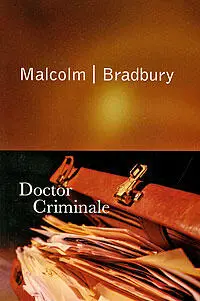
- Название:Doctor Criminale
- Автор:
- Издательство:Picador
- Жанр:
- Год:2000
- Город:London
- ISBN:978-0330390347
- Рейтинг книги:5 / 5. Голосов: 1
-
Избранное:Добавить в избранное
- Отзывы:
-
Ваша оценка:
Doctor Criminale: краткое содержание, описание и аннотация
Предлагаем к чтению аннотацию, описание, краткое содержание или предисловие (зависит от того, что написал сам автор книги «Doctor Criminale»). Если вы не нашли необходимую информацию о книге — напишите в комментариях, мы постараемся отыскать её.
Doctor Criminale — читать онлайн бесплатно полную книгу (весь текст) целиком
Ниже представлен текст книги, разбитый по страницам. Система сохранения места последней прочитанной страницы, позволяет с удобством читать онлайн бесплатно книгу «Doctor Criminale», без необходимости каждый раз заново искать на чём Вы остановились. Поставьте закладку, и сможете в любой момент перейти на страницу, на которой закончили чтение.
Интервал:
Закладка:
As we sat, a row of silver carts passed us by, bearing large pink lobsters on their final funeral journey to stoke the meditations of a group of European Foreign Ministers, informally gathered together to put a few finishing touches to the looming of the year 1992. On banquettes in another corner, a dark-clad band of the Higher Eurocrats – Commissioners and Directors-General, Chefs de Cabinet, Directors and Principal Administrators A4, certainly nothing lower nor less – were calling to the maître d’, Armand, to bring them their usual order, and opening up their slimline leather document cases to consider some fundamental European Community crux: the noise emission levels, say, of petrol-driven lawnmowers in urban and semi-urban areas, or whatever may have been worrying them about the Euro-future that night. In various alcoves, huddled over bottles of the finest claret and burgundy, Euro-lawyers and Euro-lobbyists, Euro-fixers and Euro-framers, were wheeling and dealing, dealing and wheeling, while the glossy, backlessly-dressed Euro-bimbos they had brought with them for purposes of elegant decoration yawned frankly into their makeup mirrors and glanced seductively around the room. A visiting delegation of Arab sheikhs, in their best white robes, sat together at a central table, drinking the spirituous liquors forbidden to them at home, while their foodtasters, dressed in appropriate black, sat together quietly at a smaller table behind.
Meanwhile a pianist of concert standard, or even better, played somewhere unobtrusively in the background. Great crystal chandeliers tinkled and twinkled just above our heads. Dark-suited and near-invisible waiters, one hand held behind their backs, slipped small boatlike pâtisseries of herbs, caviars and other rare goodies onto the crested plates in front of us, trying subtly to tempt us towards the complex erotic joys of future gastronomic adventure. ‘This really is quite a place, Cosima,’ I said, looking around appreciatively. ‘Oh, yes, I think so,’ said Cosima Bruckner. ‘About the best I’ve ever been in,’ I said, ‘And you come here often?’ ‘Not so very often,’ said Cosima, ‘It would be a month’s salary. But naturally in my job it is necessary to come here from time to time and check on how those in the Commission spend their expenses.’ ‘Well, naturally,’ I said, ‘So just explain to me, what is your job? You told me once you were a sort of sherpa on the Beef Mountain.’
‘This was not exactly true,’ said Cosima, ‘Oh look, do you see who is sitting over there, under the mirror?’ ‘Who is it?’ I asked. ‘The King of the Belgians,’ said Cosima, ‘You don’t recognize him?’ ‘I’m afraid not,’ I said. ‘Such a pity, nobody ever does,’ said Cosima, ‘But of course you know this man who has just come in. With the Yves Saint-Laurent suit, and the Legion d’Honneur in the buttonhole?’ I looked at the small sharp bird-eyed man, glancing around the restaurant. He looked important, but he was entirely unfamiliar. ‘No, I don’t think so,’ I said, ‘Who is it?’ ‘That is only the Deputy-President of the European Commission, the man under Jacques Delors,’ said Cosima, ‘He comes here all the time.’ ‘So he’s powerful, then?’ I asked. ‘Powerful?’ asked Cosima, ‘This is the man who has been put in charge of 1992. I work to him also. His name is Jean-Luc Villeneuve.’ ‘How fascinating,’ I said. ‘But this man is not at all what he seems,’ said Cosima, leaning forward confidentially. ‘No, of course not,’ I said. Now I knew I was back, firmly back, in the strange conspiratorial Euro-world of Cosima Bruckner.
So how did I come to be there, tête-à-tête in the heart of the heart of the heart of Europe: the New Europe where, as at some great medieval court, the world’s princes and plenipotentiaries gathered, where the ministers of great nations came to consult, the lawyers to plead, the modern courtiers to make their courtly careers, the framers to frame, the fixers to fix, the sick, the poor and the foreign to beg for crumbs from the princely European table? Well, as it happens, it happened something like this. After I had jumbo-jetted my way back from Argentina, I spent, I admit, a depressed and directionless few weeks. For several months I had been obsessed by a quest that had confused me, challenged me, fascinated me, elated me, but which had now ended in disappointment. I felt upset and dismayed by the tale of Bazlo Criminale that Gertla had told me. Whether it was true or not was no longer quite the question. It had burdened me with things I really did not want to know.
How can I explain it? Here I was, a good latter-day liberal humanist, if that isn’t too grandiose a term to describe the chaotic mixture of tolerance, permissiveness, pragmatism, moral uncertainty, global anxiety and (as you know) deconstructive scepticism I had come to steer my small life by. I lived (as I knew perfectly well, because all the experts kept telling me) in the age of historyless history, the time after the great meta-narratives. Rather like some amiable American who had spent rather too long on the West Coast, I perceived the recent European past as a handy aid to the present: a birthplace I had long left behind, a festering ground of old political resentments, a theme park for constant nostalgia, a useful source of designer imports. In other words, I gladly took the fruit off the European tree, plucking from it just what I needed in the way of decoration, ambience, mental backcloth, occasional ideological food and drink. Taking the fruit, I had never bothered to look very hard at the tree itself.
Then, thanks to an excess of professional curiosity, a brash careerist wanting a story, I had started examining the knotted trunk more carefully: I discovered that I didn’t like what I found. The familiar if not entirely companionable past had turned into an ugly, twisted growth, hung about with deceits, obscurities and betrayals. The story Gertla had poured out on the pampa was of course a very old tale: thirty-five years old, in fact, set well and truly before my birth, in a time I had never touched. But it concerned a Criminale whom I had (after a long search) met and, having met him, liked. I had no complaints of him. I found him human and benign, generous and serious. He had done me no harm; no, he had done me good. His ideas gave me pleasure, his thought had made a difference. He had shared with me his confidence, a certain passing friendship, even – on the boat on Lake Geneva – his cigars. I had no wish at all to find him flawed.
I also had no need either. The Eldorado programme had definitely been aborted, pronounced defunct by all formerly interested parties. I had quite lost touch with Ros. I had no Lavinia breathing down my neck, asking for thrills and spills, loves and crimes, trips and travels and tickets for the opera. If the story made my present newspaper, it would go somewhere at the back, after the much more familiar scandals about the Royals that obsess British national life. I had no scores to settle, no advantage to gain. I knew no easy way of checking if what Gertla said was actually true. Even if it was, I remembered the other thing she had said: that if Criminale had taken the side of Irini, he would probably have gone the same way as she did, gone to prison, become an un-person. Then we would have had no Bazlo Criminale. The fruit of the tree was perfectly good: why start trying to show it was corrupted?
So I did what most good latter-day liberal humanists would very probably have done in the circumstances: nothing, that is. But there is one trouble with human curiosity, a.k.a. the need to investigate. Once you have nourished it, it doesn’t go away. Which is why, over the next weeks, you could have frequently found me (if, that is, you had cared to) sitting alone in some Islington pub or other, a large glass of lager in one hand, a small German dictionary in the other, reading – no, I mean re-reading – Codicil’s little life of Criminale. Now re-reading is not like reading; it is something you do with changed eyes. This time, I knew that the book by Codicil was almost certainly not by him at all, but by one of the several other people who had crossed my life over the recent months. And if the author was doubtful, so, of course, was the subject. The book’s Criminale wasn’t the real Criminale, and certainly not my Criminale – who in turn no doubt wasn’t the real Criminale either. And if writer and subject had changed, so had the reader. After what had happened during my recent wanderings, I was certainly not quite the same person who so gaily had given his witless opinions over the tele-waves at the Booker.
Читать дальшеИнтервал:
Закладка:
Похожие книги на «Doctor Criminale»
Представляем Вашему вниманию похожие книги на «Doctor Criminale» списком для выбора. Мы отобрали схожую по названию и смыслу литературу в надежде предоставить читателям больше вариантов отыскать новые, интересные, ещё непрочитанные произведения.




Обсуждение, отзывы о книге «Doctor Criminale» и просто собственные мнения читателей. Оставьте ваши комментарии, напишите, что Вы думаете о произведении, его смысле или главных героях. Укажите что конкретно понравилось, а что нет, и почему Вы так считаете.