Malcolm Bradbury - Doctor Criminale
Здесь есть возможность читать онлайн «Malcolm Bradbury - Doctor Criminale» весь текст электронной книги совершенно бесплатно (целиком полную версию без сокращений). В некоторых случаях можно слушать аудио, скачать через торрент в формате fb2 и присутствует краткое содержание. Город: London, Год выпуска: 2000, ISBN: 2000, Издательство: Picador, Жанр: Современная проза, на английском языке. Описание произведения, (предисловие) а так же отзывы посетителей доступны на портале библиотеки ЛибКат.
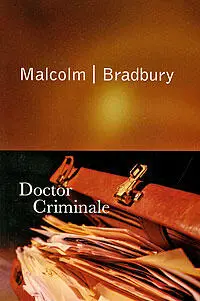
- Название:Doctor Criminale
- Автор:
- Издательство:Picador
- Жанр:
- Год:2000
- Город:London
- ISBN:978-0330390347
- Рейтинг книги:5 / 5. Голосов: 1
-
Избранное:Добавить в избранное
- Отзывы:
-
Ваша оценка:
Doctor Criminale: краткое содержание, описание и аннотация
Предлагаем к чтению аннотацию, описание, краткое содержание или предисловие (зависит от того, что написал сам автор книги «Doctor Criminale»). Если вы не нашли необходимую информацию о книге — напишите в комментариях, мы постараемся отыскать её.
Doctor Criminale — читать онлайн бесплатно полную книгу (весь текст) целиком
Ниже представлен текст книги, разбитый по страницам. Система сохранения места последней прочитанной страницы, позволяет с удобством читать онлайн бесплатно книгу «Doctor Criminale», без необходимости каждый раз заново искать на чём Вы остановились. Поставьте закладку, и сможете в любой момент перейти на страницу, на которой закончили чтение.
Интервал:
Закладка:
In every respect, then, Bazlo Criminale: Life and Thought (Wien: Schnitzer Verlag, 1987, pp. 192) was now not the book I, or he, had read before. In fact my Sussex tutor – who, you might like to know, had resigned his post during the year, and opened a French restaurant in Hove famous for its experimental kiwi-fruity menus – would probably have been proud of me, as I picked up the authorless text, noted the disappearance of the subject, and read the text not for what it said but only for what it didn’t. Now I indeed deconstructed: read for the omissions and elisions, the obscurities and absences, the spaces and the fractures, the linguistic and ideological contradictions. I read it, in fact, as a fiction, which of course is what I should really have done in the first place. But now I read it with the benefit of alternative facts, which of course were also, as it were, fictions, to set against its fiction. I had alternative authors to try out on it, alternative Criminales to poke into its pages. This was a text – I could work on.
With benefit of my new wisdom, it was now very plain to me what kind of book it was: a progressive, uplifting and piously Victorian story about a virtuous man of virtuous mind who is confronted with conflict and adversity, but finally triumphs in a reasonably happy ending. In other words, it was a whitewash. It also matched and mirrored the line of recent European history fairly exactly. It started in the time of Hiroshima and the Holocaust, of angoisse and Angst , of the collapse of the old pre-war philosophies and the need for new ones. It opened in the terrible, shameful chaos of Europe after 1945, and the growth of dreams of a new, anti-fascist Utopia. It followed those brave new dreams into times when they were cursed and corrupted, and then shifted into the age of Adidas and IBM, the materialist, multiple, post-technological age, the era of the economic miracle, when the vague proletarian dream gave way to the late-twentieth-century bourgeois revolution, hi-tech, scattered, multi-national. It started in hard ideology; it ended in random, uncertain metaphysics. You could say, if you were European, it was more or less the story of us all.
It was also, of course, a romantic tale,of a man and his female muses: the Bazlo Criminale version of the mistresses of Borges. In the ruins, physical, political, moral, and philosophical, of postwar beaten Berlin, two student lovers, Bazlo and Pia, he a young scholar from Bulgaria with philosophical inclinations, she a keen anti-Nazi and Marxist, met and married. They gave their lives to anti-fascism, the building of the progressive and socialist future. Then, somehow, their lives separated. The where, how and why of this were unclear, but I gathered it had something to do with their ideological disagreements over the East German Workers’ Uprising of 1953 (an event which I had totally forgotten). It was hard to see who was on which side, but I fancied Criminale dissented from Ulbrecht’s repression. Now Pia disappeared from the story, as, I had gathered from others, she had disappeared from life itself. What should have appeared in Criminale’s love-life next, as I knew now, was Irini. However she didn’t; she was not mentioned at all. Instead the next important figure, in love and life alike, was Gertla, the Hungarian writer and painter who took up the muse-like role for most of the remainder of the story.
They had met and fallen in love: but where and when? In this section dates became strangely obscure: the entire period between 1954 and 1968 was treated as if continuous. Criminale —– was now the reforming socialist democrat in the glacial Cold War age. He was under constant attack from younger Stalinist critics, one in particular (could it be Sandor Hollo?). His books ran into trouble; some were banned in the Marxist countries, presumably at Russian behest; others appeared but then were withdrawn. Yet, by one of those strange ‘Aesopian’ arrangements that occurred in the Marxist world at the time; he was allowed, even encouraged, to print them in the West. This had worried me from the moment I first read this book in Ros’s house. But I was naive then, and I understood a little bit better now. This was one of Ildiko’s arrangements under the table, which the times and Party deviousness sometimes permitted. Now, though, I realized it was possible that, for political reasons, Criminale had been deliberately asked to play the role of East-West linkman. At any rate, this was when his influence began to spread, his reputation as a reformer began to rise, he became a world traveller, and took on international fame.
Conspicuously omitted was any mention of the events in Hungary in 1956: Imre Nagy’s democratic reform government, the Russian invasion, the suppression, the mass arrests, the imprisonment of Nagy. Unlike the reference to the German Workers’ Uprising, where the implication was that Criminale had taken a critical line, here he had no role. In fact the general impression given was that Criminale and Gertla were nowhere near Budapest at the time. The stress was on his travels, his rising fame, his high philosophical detachment, his continuing intellectual voyage beyond Marx and Lenin, Heidegger and Sartre. There was also little about his general lovelife. Conspicuous throughout was Gertla’s role, which was represented as quite opposite to everything she had told me in Argentina about herself and her links with the regime. Here she played a part more like that of the nebulous Irini. She was the loyal wife, the intellectual helpmeet, the supporter, above all the brave companion in daring revisionist thought. And even after the marriage had broken up (this was briefly referred to, with no how or why), she retained the role of intellectual muse through the later years.
Now, of course, Sepulchra – our great La Stupenda – popped up in the story. But it was only in a perfunctory role, as the attractive artist’s model and lowlife bohemian who had become a sexual and secretarial appendage to the now undeniably great man. Of course, anyone who had met them both would know that, in stature, Sepulchra did not compare with Gertla. But this was an unkind portrait, and she might just as well have been omitted altogether, along with Irini. The other women in his life – I realized now there must have been many – were not touched on at all. I particularly looked for a mention of Ildiko, whom I naturally hunted for in the text just as I did elsewhere, but there was no sign. And nowhere in the book was it suggested that Criminale had clay feet, that in the view of the author he had ever committed any serious error, moral, philosophical, or political. Yet, as I’d noticed earlier, the book also seemed quite distant and critical. And this was particularly true of one section that I had not really taken in before.
This was actually not too surprising, since it was an extremely obscure discussion of something the book called ‘Criminale’s silence’. It turned on various deep philosophical concepts, as well as on some splendid German compound nouns that reached parts of thought that even my larger German dictionary did not reach. But it concerned his interpretation of Martin Heidegger, die German philosopher with whom he had had, in print, a very famous quarrel (it was over irony, you will probably recall). Criminale’s attack was in English translation, and by putting this and the book together I was able to grasp rather more of the issue this time round. Briefly, the question was whether it was possible to elevate thought over circumstance. The issue was Heidegger’s famous silence after 1945, when the acknowledgedly great German thinker had refused to give any real account or explanation of his activities both as a philosopher and as a university rector over the Nazi years. (Incidentally, there is plenty written about this, if you want to follow it up.) Despite being banned from teaching for a while, Heidegger simply insisted that his thought lay so immeasurably far above and beyond the historical episode of Hitlerism and the Holocaust that it required no explanation, no confession, no apology.
Читать дальшеИнтервал:
Закладка:
Похожие книги на «Doctor Criminale»
Представляем Вашему вниманию похожие книги на «Doctor Criminale» списком для выбора. Мы отобрали схожую по названию и смыслу литературу в надежде предоставить читателям больше вариантов отыскать новые, интересные, ещё непрочитанные произведения.




Обсуждение, отзывы о книге «Doctor Criminale» и просто собственные мнения читателей. Оставьте ваши комментарии, напишите, что Вы думаете о произведении, его смысле или главных героях. Укажите что конкретно понравилось, а что нет, и почему Вы так считаете.