Malcolm Bradbury - Doctor Criminale
Здесь есть возможность читать онлайн «Malcolm Bradbury - Doctor Criminale» весь текст электронной книги совершенно бесплатно (целиком полную версию без сокращений). В некоторых случаях можно слушать аудио, скачать через торрент в формате fb2 и присутствует краткое содержание. Город: London, Год выпуска: 2000, ISBN: 2000, Издательство: Picador, Жанр: Современная проза, на английском языке. Описание произведения, (предисловие) а так же отзывы посетителей доступны на портале библиотеки ЛибКат.
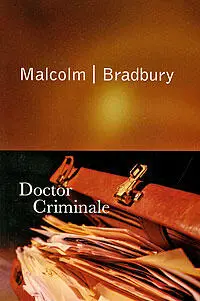
- Название:Doctor Criminale
- Автор:
- Издательство:Picador
- Жанр:
- Год:2000
- Город:London
- ISBN:978-0330390347
- Рейтинг книги:5 / 5. Голосов: 1
-
Избранное:Добавить в избранное
- Отзывы:
-
Ваша оценка:
Doctor Criminale: краткое содержание, описание и аннотация
Предлагаем к чтению аннотацию, описание, краткое содержание или предисловие (зависит от того, что написал сам автор книги «Doctor Criminale»). Если вы не нашли необходимую информацию о книге — напишите в комментариях, мы постараемся отыскать её.
Doctor Criminale — читать онлайн бесплатно полную книгу (весь текст) целиком
Ниже представлен текст книги, разбитый по страницам. Система сохранения места последней прочитанной страницы, позволяет с удобством читать онлайн бесплатно книгу «Doctor Criminale», без необходимости каждый раз заново искать на чём Вы остановились. Поставьте закладку, и сможете в любой момент перейти на страницу, на которой закончили чтение.
Интервал:
Закладка:
To Criminale, Heidegger was here taking the line of Hegel: ‘So much the worse for the world if it does not follow my principles.’ But this, Criminale said, led his thought into a fundamental philosophical error. This arose from two contradictory beliefs: thought stood above history, but also created it. For Heidegger, the task of the philosopher was to deliver history, and the task of the German philosopher (Heidegger saw Germany as the true philosophical nation) was therefore to deliver German history. That Heidegger tried. He thus trapped philosophy in an impossible position. He was fundamental to modern philosophy, no doubt about that. He placed it over and above history; yet the philosophy helped make the history, and it proved disastrous. Criminale held that this was in fact inevitable, since history could never satisfy philosophy, being made of muddle, conflict and uncertainty. But that is what led to ‘Heidegger’s silence’, which was impotence, and marked the end of the road not just for his thought but for his concept of the philosopher’s task itself.
So Criminale took the opposite view: the philosopher’s work was what he called ‘thinking with history’. This meant that philosophy itself was actually ‘a form of irony’, one of his more famous remarks. It observed failure, and dismantled itself. It did not consider a truth was something that corresponded to a reality. It assumed there was no escape from time and chance. However the author of the book (this made the who, who, who much more interesting) argued that this had simply caught Criminale in the opposite trap. His view tied philosophy irretrievably to muddle, historical directionlessness, moral confusion. It also robbed him of the means of being free to think, or even to decide. So if one path led to ‘Heidegger’s silence’, the other way led to what was called ‘Criminale’s silence’, which prevented him from constructing any form of mental or ethical independence. A familiar state, I thought, not unlike my own.
Of course I found this highly obscure, as I expect you do too. It somehow reminded me of the term we spent at Sussex with my tutor on the complex matter of Nietzsche’s umbrella (we had to discuss whether Nietzsche’s umbrella was, as Derrida argued, a hermeneutic device, or whether it was a thing that stopped him getting wet when it rained). Both of these were philosophical silences. Both had a strange aroma both of honour and betrayal. Heidegger had not stood out against a time of evil, perhaps because to do so was impossible, perhaps because he had not seen that the time was turning to evil, the problem of so many in our century. But when the chance came he had not ‘confessed’, perhaps because it is hard to confess that a considered thought is wrong, or that all that comes out of our time of history is wrong. The same might be said of Criminale. His silence had become a philosophical paradox, but he too had not ‘confessed’, brought his contradiction into the open. If Criminale, a hero of thought, had betrayed, is there any way he would or should have ‘confessed’?
Do we call those things betrayals? Yes; if you accepted Gertla’s story on the pampa, then philosophy or ideological conviction did not save him. Indeed betrayal and deceptive silence simply had to be read back into the book’s record, onto almost every single page. There was romantic betrayal: he had loved Irini but allowed her to be silenced, to disappear. There was intellectual betrayal: the radical and revisionist philosopher had, by Gertla’s account, signed a Devil’s Pact with Stalinism in 1956. Then that meant political betrayal: he had become a creature of a corrupt and conspiratorial regime and system, repressive to its marrow, and everything he said and did thereafter could be considered suspect. There was personal betrayal: when Criminale made his high-level contacts and friendships in the West, he was reporting everything back to Gertla, who was herself pillow-talking with the Hungarian (which must also have meant the Russian) secret police. There was perhaps even financial betrayal, in the special accounts in Switzerland that had so interested Ildiko Hazy and Cosima Bruckner.
But to measure all that, it seemed important to decide who really had written the book, to make up my mind about the absent author. Here I had quite a rich choice: Otto Codicil, Criminale himself, Sandor Hollo maybe, Gertla Riviero. I thought of others: Sepulchra, say, even Ildiko. But by the time I had put the book down I had little doubt; I was more or less sure it was really Gertla. She came out as a kind of heroine. In fact if the book was a whitewash of Criminale, it was even more a whitewash of Gertla, or what I understood of Gertla. I checked the things I could check. She had the opportunity: when the book was written, in the mid-Eighties, she was still living in Budapest and could have sent it via Hollo to Codicil. She had the motive. For the book came from the age when Marxism-Leninism was coming apart, in Gorbachev’s Soviet Union, during the great time of glasnost and then perestroika, and in the Eastern European countries – almost everywhere, you could say, except in China and the seminar rooms of some British and American universities. Reform was spreading, history moving fast. The pointless inhumanity of the system, the prison walls built round it, the shameless manipulations of its power-brokers and bully-boys were plain, and even the old Party hacks and hardliners were busy rewriting their histories in case. Criminale, Great Thinker of the Age of Glasnost, tough but tender, revolutionary yet reformist, a philosopher of reconciliation and rapprochement , was a perfect mask.
There was only one problem with all this. If the mask was there above all to protect Gertla, why would she now want to take it off? Why say something different and opposite now – and not just to me, but through me, a known and convicted journalist, to the world beyond? Why, if she was the secret police agent who had, in effect, corrupted Criminale, would she want that known – especially at a time like this, when the files were opening everywhere, the scores were being settled, and everyone was claiming virtue? At first, on the plane, my thought, as you know, was this came from the jealousy of a strong-minded, powerful woman who, in a time of change, was losing her influence over a world-famous man. Something like that wasn’t new. It was what I had heard from the Mistresses of Borges; it was what I remembered from the great fights among the lovers and friends of Jean-Paul Sartre over who had the ‘right’ to his thought when he changed his opinions in his final, ailing years. But now I saw that made very little sense. If she was changing her position, and trying to undermine and expose Criminale, there had to be another, better reason.
Having got here, I knew even less just what to do next. There was Criminale’s secret, there was Gertla’s secret, and goodness knows what other obscurities else. I put it all aside. Like Jean-Paul Sartre on his summer holidays, I felt I wanted a rest from all this Angst for a bit. My desk was piling up with the new spring books, which burst out like crocuses at this season. I did my work and let the story ride. But then one day, typing down the computer linkline in my all too open open-plan newspaper office, I had a thought on pure impulse: I knew someone who might know. I picked up the phone and rang the European Commission in Brussels. There followed the usual confusions: multi-lingual chatter, switchboard misdirections, cries of Ciao, invitations to please hold onto your piece. Then a familiar voice was on the line. ‘Ah, ja, Bruckner?’ it said.
‘Oh, Bruckner, guess who?’ I said, ‘Your contact in London.’ ‘Ah, ja, which contact in London?’ asked Bruckner. ‘It’s quite all right to talk?’ I asked. ‘Why not, we talk all the time in the European Commission,’ said Bruckner. ‘It’s Francis Jay, remember,’ I said. ‘Ah, ja,’ said Bruckner. ‘I promised I’d call if I knew any more about Bazlo . . .’ ‘Wait, I transfer this to a more secure line with a certain device,’ said Bruckner. ‘I thought you might,’ I said patiently. A moment later, her voice sounding strangely magnified, Bruckner was back again. ‘So you, my friend, you found out something?’ ‘It may not be important,’ I said, ‘But I was in Argentina and met Criminale’s second wife.’ ‘Gertla Riviero?’ asked Bruckner. ‘You know her?’ I asked. ‘Of course,’ said Bruckner, ‘You just saw her there? So how is she like?’ ‘Well, re-married, rich, and starting a whole new life,’ I said. ‘Yes, I think so,’ said Bruckner, ‘So what did you really find out?’
Читать дальшеИнтервал:
Закладка:
Похожие книги на «Doctor Criminale»
Представляем Вашему вниманию похожие книги на «Doctor Criminale» списком для выбора. Мы отобрали схожую по названию и смыслу литературу в надежде предоставить читателям больше вариантов отыскать новые, интересные, ещё непрочитанные произведения.



Обсуждение, отзывы о книге «Doctor Criminale» и просто собственные мнения читателей. Оставьте ваши комментарии, напишите, что Вы думаете о произведении, его смысле или главных героях. Укажите что конкретно понравилось, а что нет, и почему Вы так считаете.