Malcolm Bradbury - Doctor Criminale
Здесь есть возможность читать онлайн «Malcolm Bradbury - Doctor Criminale» весь текст электронной книги совершенно бесплатно (целиком полную версию без сокращений). В некоторых случаях можно слушать аудио, скачать через торрент в формате fb2 и присутствует краткое содержание. Город: London, Год выпуска: 2000, ISBN: 2000, Издательство: Picador, Жанр: Современная проза, на английском языке. Описание произведения, (предисловие) а так же отзывы посетителей доступны на портале библиотеки ЛибКат.
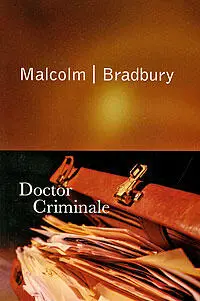
- Название:Doctor Criminale
- Автор:
- Издательство:Picador
- Жанр:
- Год:2000
- Город:London
- ISBN:978-0330390347
- Рейтинг книги:5 / 5. Голосов: 1
-
Избранное:Добавить в избранное
- Отзывы:
-
Ваша оценка:
Doctor Criminale: краткое содержание, описание и аннотация
Предлагаем к чтению аннотацию, описание, краткое содержание или предисловие (зависит от того, что написал сам автор книги «Doctor Criminale»). Если вы не нашли необходимую информацию о книге — напишите в комментариях, мы постараемся отыскать её.
Doctor Criminale — читать онлайн бесплатно полную книгу (весь текст) целиком
Ниже представлен текст книги, разбитый по страницам. Система сохранения места последней прочитанной страницы, позволяет с удобством читать онлайн бесплатно книгу «Doctor Criminale», без необходимости каждый раз заново искать на чём Вы остановились. Поставьте закладку, и сможете в любой момент перейти на страницу, на которой закончили чтение.
Интервал:
Закладка:
And so the discussion began. The British crime novelist spoke about crime and Borges, the British campus novelist-critic spoke about European experimental fiction and Borges, the Argentine writers talked about Latin American writing and Borges, and the mistress of Borges talked about herself, occasionally mentioning her relationship with Borges. On the rafters above the podium there appeared a very large rat, evidently a visitant from nature to culture; it strolled along until it was above the speakers and looked down at them with great interest. This delighted the audience, and by the time the evening was done it seemed clear that cultural relations had resumed in great good humour. ‘But why was it so important to have the mistress of Borges?’ I asked my journalist friend, as he led me through the crowds again to the official party that was to follow. ‘Maybe in a moment you will understand,’ he said.
Over the next half-hour, in another part of the tent, where writers and Argentinian officials jostled to get to the lavish supply of wine, I slowly did. I’ve no real idea of what kind of sex-life Borges enjoyed, or not, during his lifetime, probably about the same as most of us. But he was certainly enjoying a very remarkable one after his death. Nearly every woman I spoke to in the wet tent during that evening had at some time or another been the mistress of Borges. Some were beautiful others not; some were old, like the lady on the platform and some young enough to make the final years of the blind old master into utter scandal. Some told me of his tenderness others of his pure detachment. Some called him generous others thought him mean. Some celebrated his artistic wisdom others bemoaned his political follies. Each one spoke rudely of all the others; every one had a Borgesian tale to tell. Within half an hour I had met at least ten mistresses of Borges.
I went back to my Argentine friend. ‘How did he manage it?’ I asked, ‘How did he enjoy all these women and write as well?’ ‘Remember, he wrote only forty-five stories, some poems, never a novel,’ said my friend. ‘But he was also professor at the university, head of the National Library,’ I said, ‘And he changed all modern writing.’ ‘Also he was a chicken inspector,’ said my friend, ‘Peron made him one. Those bastards have wonderful insults, no?’ I looked across the party at the women. ‘Surely they can’t all have been mistresses of Borges,’ I said, ‘Some of them must have been about twelve when he died.’ ‘Perhaps not actual mistresses,’ said my friend slowly. ‘What other kind are there?’ I asked. ‘I was never in his bedroom, how do I know?’ asked my friend, ‘But don’t forget, this was a great man, a world writer. He belonged to everyone. Here to be a mistress of Borges is a kind of profession, especially if you are a woman and want to be a famous writer.’
‘So the mistresses of Borges weren’t really the mistresses of Borges?’ I asked. ‘In these matters, what is “really”?’ asked my friend. ‘You sound like Otto Codicil,’ I said. ‘Please?’ he asked. ‘Oh, no one you ever heard of,’ I said, ‘Someone I met in Vienna. I forgot where I was.’ A little later the British Ambassador and his lady departed, evidently called to duties elsewhere; after that the party showed signs of rapid deterioration, as the writers began to turn back into gauchos and literary and political rivalries flared. I moved to leave, and was detained by a quiet, dignified, elderly and very well-dressed publisher I had met earlier. ‘It gets worse now,’ he said, ‘I wonder, do you care to do me the excellent honour of dining with me at my apartment? Some authors I publish will be there, I think they would like to meet you, also you them. And it will be more select than this, I do promise. Also good food and no rats.’
I accepted, of course; and not much later I found myself standing outside the tented city, getting into one of a row of limousines that was waiting to drive a group of us to a fine modernist apartment block in an elegant part of town. Soon I was rising up above the dark and dangerous streets in a stainless-steel elevator; at the door of a great penthouse apartment high above the city, a white-coated butler opened the door, a maid in gloves took my coat. The walls were hung with remarkable Impressionist and Modernist paintings; I stopped in amazement in front of a Van Gogh (I think his Carnations ). ‘You like it?’ asked my host very quietly, ‘You know I may have paid too much. Fifteen million at Sotheby New York, and now the art boom is over. But I like it very much. Also in a country like this it is well to have something you can carry away, if things go a bit wrong.’
I moved into the room, filled with elegant and designer-dressed people, talked to a professor from the university who was writing a book on Neo-Platonism in South America (‘Of course I must include Borges’), and then we moved to table and sat down. As the butler and maid began to serve, I turned to my neighbours on either side. One was a young married woman in diamonds, clearly passionately in love with her neighbour on the further side, to whom she wasn’t married. My other companion was a fine-featured woman, around sixty, her grey hair wonderfully tinted and coiffured, her shape very slim. She wore bright jewels and a low-cut dress covered in black beads, and she wanted to talk. ‘You went to this official thing?’ she asked, ‘I do not think I like Book Fairs, they are all books. And I have had too many official occasions in my life. But did anything interesting happen?’
So, hoping to be amusing (as I’ve said, from time to rime I can be a little amusing), I told her the story of the flag, the writers, the rat, and the mistresses of Borges. ‘You must be careful when you tell such stories,’ said the woman, ‘Perhaps I also was a mistress of Borges.’ ‘Were you?’ I asked. ‘I was not,’ said the woman, ‘How nice for once to be so unusual. But this is what happens to a famous and distinguished man. He finds one day he does not possess himself. Everyone needs him, so he becomes two people. In fact Borges himself wrote very well about this, do you know? His essay, “Borges and I”, do you remember it?’ At once I did. ‘Yes, he says he suddenly became not the dreamer but the dreamt,’ I said, ‘Not the writer, but the reader of himself.’ ‘“My life is a flight, and I lose everything, and everything belongs to oblivion, or to him,”’ quoted the lady beside me, ‘He no longer knew who he was. Do you know who you are?’
‘I’m Francis Jay,’ I said, ‘Just visiting from Britain.’ ‘And I, well, I am a painter here,’ said the woman, ‘My name is Gertla Riviero.’ ‘Gertla, that’s an unusual name,’ I said boringly. ‘You have never heard it before?’ asked the woman. ‘I have,’ I said, ‘One of the wives of Bazlo Criminale was called Gertla. I don’t suppose you know who I mean.’ ‘The Hungarian philosopher, sometimes called the Lukacs of the Nineties,’ said the woman. ‘You do know him,’ I said. ‘Better than that,’ said the woman, ‘Maybe I was never the mistress of Borges. But I was the wife of Criminale Bazlo. Is that as good?’ ‘But Gertla was Hungarian,’ I said. ‘And so was I,’ said the woman, ‘Who do you think they are, the people in this room? Most came from Europe not so long ago. I did too. For love, of course. Another love. But how do you know all that? You are interested in Criminale Bazlo?’
‘Yes,’ I said, looking up from my soup to examine her, ‘I did some research on him once.’ ‘Another professor?’ she asked, ‘There is a tango about professors.’ ‘No, a journalist,’ I said. ‘And you are from London?’ she asked, ‘What is your paper? A good one, very responsible?’ ‘Oh very,’ I said grandly. ‘And you know Criminale’s story?’ asked Gertla. ‘A version of it,’ I said. ‘Whose version?’ she asked. The Codicil version,’ I said. She looked at me. ‘And you are still interested?’ she asked, ‘I have a weekend place, a hacienda, out on the pampa, quite a way from here. Come out on Saturday, if you like to talk some more. Friends from B A will come, and they can drive you. But it will take a whole day, maybe your life is too busy.’ ‘No,’ I said quickly, ‘I’d like to come.’
Читать дальшеИнтервал:
Закладка:
Похожие книги на «Doctor Criminale»
Представляем Вашему вниманию похожие книги на «Doctor Criminale» списком для выбора. Мы отобрали схожую по названию и смыслу литературу в надежде предоставить читателям больше вариантов отыскать новые, интересные, ещё непрочитанные произведения.










Обсуждение, отзывы о книге «Doctor Criminale» и просто собственные мнения читателей. Оставьте ваши комментарии, напишите, что Вы думаете о произведении, его смысле или главных героях. Укажите что конкретно понравилось, а что нет, и почему Вы так считаете.