Malcolm Bradbury - Doctor Criminale
Здесь есть возможность читать онлайн «Malcolm Bradbury - Doctor Criminale» весь текст электронной книги совершенно бесплатно (целиком полную версию без сокращений). В некоторых случаях можно слушать аудио, скачать через торрент в формате fb2 и присутствует краткое содержание. Город: London, Год выпуска: 2000, ISBN: 2000, Издательство: Picador, Жанр: Современная проза, на английском языке. Описание произведения, (предисловие) а так же отзывы посетителей доступны на портале библиотеки ЛибКат.
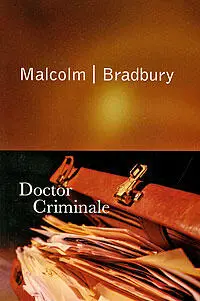
- Название:Doctor Criminale
- Автор:
- Издательство:Picador
- Жанр:
- Год:2000
- Город:London
- ISBN:978-0330390347
- Рейтинг книги:5 / 5. Голосов: 1
-
Избранное:Добавить в избранное
- Отзывы:
-
Ваша оценка:
Doctor Criminale: краткое содержание, описание и аннотация
Предлагаем к чтению аннотацию, описание, краткое содержание или предисловие (зависит от того, что написал сам автор книги «Doctor Criminale»). Если вы не нашли необходимую информацию о книге — напишите в комментариях, мы постараемся отыскать её.
Doctor Criminale — читать онлайн бесплатно полную книгу (весь текст) целиком
Ниже представлен текст книги, разбитый по страницам. Система сохранения места последней прочитанной страницы, позволяет с удобством читать онлайн бесплатно книгу «Doctor Criminale», без необходимости каждый раз заново искать на чём Вы остановились. Поставьте закладку, и сможете в любой момент перейти на страницу, на которой закончили чтение.
Интервал:
Закладка:
Just a little later on that December morning, K. left the bank and walked into the Lausanne street. He looked round. All seemed normal, except that two men washing a window seemed to glance at him in a peculiar way, and a young man who oddly resembled Hans de Graef was taking photographs further down the street. Carrying his small amount of luggage, K. hurried to the railway station, where he boarded an express which took him directly to Geneva International Airport. Here he bought some cheese, a new overcoat, and a club-class ticket on the noon flight to London. He was last seen going through passport control, one of a long line of people, quite evidently no longer looking for Doctor Bazlo Criminale.
13
In 1991 I found myself in Buenos Aires . . .
In the April of 1991 I found myself, believe it or not (certainly I hardly could), in the Argentine capital of Buenos Aires, no longer looking for Bazlo Criminale in any way whatever. The visit came at the end of a long row of disorienting and inconsequential events that happened, as it happened, pretty much like this. When I got back to London from Lausanne, life took a definite turn for the worse. Lavinia, of course, had written my contract properly, so effectively that I not only found myself jobless, redundant, superfluous, in excess of requirements, but also due no money at all from the Criminale Project. The whole affair dissolved into legal bitterness, with very expensive letters from even more expensive solicitors flying this way and that. To make matters worse, Lavinia had evidently passed on to Ros some scurrilous rumour, probably from Codicil via Gerstenbacker, that my stay at Barolo had not been entirely celibate, which meant that I never saw Ros or her little town house behind Liverpool Street station ever again.
But these were only a few of my worries. Though my trip seemed to me to have taken years, my flat, in the basement under the basement, had actually been empty only a few weeks. But as home it proved to be no home at all. Cats were squatting in the bedroom; many of the contents, including my Amstrad word-processor and CD player, had departed, taken off either by local thieves or good friends with big pockets who knew exactly where I hid the key. In a few weeks, the whole world had changed; and so had I. Thanks to the Great Thatcherite Economic Miracle, Britain was now enjoying a deep recession. War fever was growing worse, international shuttle diplomacy was proving useless with Saddam and his moustaches, and conflict seemed certain. Newspapers were folding by the handful, and jobs in the media were disappearing – unless you were the kind of journo who didn’t mind being targeted by smart bombs while being chased by Baghdad security police, or living in a fox- or camel-hole in the desert under fire and strict military censorship.
So my problems mounted, and all this took me a long way away from the fortunes (or presumably now the lack of them) of the great philosopher Bazlo Criminale. From time to time, I did spare a thought or two for the Great Thinker of the Age of Glasnost. Was he off touring the world, his funds severely depleted, with the splendid Miss Belli? Or had he perhaps returned to Barolo, Sepulchra, and the Great Padrona, or gone home to his apartment in Budapest? But if I thought of him now and again, of Ildiko Hazy I thought quite frequently. This was not only because I missed her – though I did, very much – but also because I had plenty of explaining and compensating to do with the various credit-card companies who had risked their capital in loaning me plastic. Fortunately the funds so safely invested in the Credit Mauvais in Lausanne proved more than enough to cover the problem. In fact it was to them I owed my survival over the next couple of months, when I felt deserted by everyone and everything.
Now and again I thought I might hear something of Ildiko.-Of course I had no address for her, and she had none for me. But there were other possible ways of finding out what happened to her. In fact day after day I checked the newspapers, half-expecting to see Ildiko waving at me through the bars of some Euro-police van, or illustrating some report on a great fraud perpetrated on the unsuspecting gnomes of Lausanne. The papers were filled with financial fraudulence; it was turning into the great international sport. Half the world’s brokers and investment bankers were apparently spending Yuletide behind bars that year. Indeed that Christmas it seemed that everyone everywhere was beginning to think – like me —just a little bit Hungarian.
So Yuletide, season of paranoia and general ill-will, seemed that year to be turning even gloomier than usual. But then the winebar I’d once worked for in Covent Garden hired me back, and I picked up several commissions for New Musical Express and various other learned journals. Then one night, as I whizzed round the winebar, clad in butcher’s apron, dispensing a fatal mixture of cheesecake and Spumante to some big-spending and fast-vomiting seasonal office party or other, one of the group picked himself up from the floor and affably recognized me. He was a journo ex-colleague who had been convinced by drink that he was a friend of mine, and he advised me of a job he had just been interviewed for and had chosen to turn down. I followed his lead, got an interview, and found myself in work again, hired to slave on the literary pages of yet another new paper, this time not a Serious Sunday, but an Almost Serious Daily of vague intellectual pretensions.
Here, as the Gulf War exploded, smart bombs dissolved concrete bunkers and the entire Saudi desert caught fire, I did what I did best. I opined, I interviewed, I columnized, I reviewed, I freebied. After television, it came as a great relief; as I told you, I am really a verbal person, not a visual person. And I had learned just a few things during my quest for Bazlo Criminale. I wrote more soberly, more thoughtfully, less aggressively than before. What’s more, Ros in her wisdom had proved perfectly right: my Booker Prize TV appearance had done me a power of good. Though the winning novel had been virtually forgotten (except in the USA, where it sold millions), everyone remembered the little prick at the Booker. Publishers chased me, all the Fionas gladly wined and dined me, and gave me interesting literary stories, which I made even more interesting and printed, and I took advantage of all the new writerly acquaintances I had made at Barolo.
Then the Gulf War ended, in a final sickening explosion of horror, genocide, exile, starvation and global pollution, and suddenly, in the gap between crises, the world started reading books again. With the mess of a new conflict to resolve, it now came time to settle an older one, the Falklands/Malvinas War. In April the resumption of Anglo-Argentine cultural relations was to be pronounced. Some government agency thought it would be good for my newspaper to cover the event, and a freebie flight was made available. The event was to be declared at the Buenos Aires Book Fair, the Frankfurt of Latin America, where all the readers and writers of South America gathered once a year. My Arts Editor saw that this meant we could not only cover an important cultural moment but bring our wise readers up to date on the current state of Magical Realism as well. Selflessly – or rather because she was midway through some foetid love affair that it was dangerous to interrupt – she turned the assignment down, and passed it on to me.
And so, once again, I made my way to Heathrow, to board the Saturday overnight flight, BA to BA. By now, having travelled rather more lately, I was getting smart enough to realize that sixteen-hour long-haul flights on jumbo jets are not as amusing as all that. In fact these things are roughly the modern equivalent of the old Greek slave galleys, except even those poor sweating creatures, chained in rows, were spared the ultimate indignity of having to watch an inflight movie with Arnold Schwarzenegger in it. So, turning on the overhead light, I devoted my trip to a quick skim-read of the great Magical Realists, Borges and Marquez, Carpentier, Cortazar and Fuentes, writers wise enough to know that history and reality deserved to be treated with a sense of wry absurdity. Inflight gins and tonics helped my Spanish considerably, and while my bodily fluids drained away into the aircraft pressure system, and Schwarzenegger moved like a mad violent buffoon round the silent screen in front of me, I read. My neighbours complained about the overhead light. But tough titty, I told them; I’m a verbal person, not a visual person.
Читать дальшеИнтервал:
Закладка:
Похожие книги на «Doctor Criminale»
Представляем Вашему вниманию похожие книги на «Doctor Criminale» списком для выбора. Мы отобрали схожую по названию и смыслу литературу в надежде предоставить читателям больше вариантов отыскать новые, интересные, ещё непрочитанные произведения.





Обсуждение, отзывы о книге «Doctor Criminale» и просто собственные мнения читателей. Оставьте ваши комментарии, напишите, что Вы думаете о произведении, его смысле или главных героях. Укажите что конкретно понравилось, а что нет, и почему Вы так считаете.