Malcolm Bradbury - Doctor Criminale
Здесь есть возможность читать онлайн «Malcolm Bradbury - Doctor Criminale» весь текст электронной книги совершенно бесплатно (целиком полную версию без сокращений). В некоторых случаях можно слушать аудио, скачать через торрент в формате fb2 и присутствует краткое содержание. Город: London, Год выпуска: 2000, ISBN: 2000, Издательство: Picador, Жанр: Современная проза, на английском языке. Описание произведения, (предисловие) а так же отзывы посетителей доступны на портале библиотеки ЛибКат.
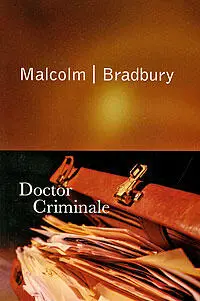
- Название:Doctor Criminale
- Автор:
- Издательство:Picador
- Жанр:
- Год:2000
- Город:London
- ISBN:978-0330390347
- Рейтинг книги:5 / 5. Голосов: 1
-
Избранное:Добавить в избранное
- Отзывы:
-
Ваша оценка:
Doctor Criminale: краткое содержание, описание и аннотация
Предлагаем к чтению аннотацию, описание, краткое содержание или предисловие (зависит от того, что написал сам автор книги «Doctor Criminale»). Если вы не нашли необходимую информацию о книге — напишите в комментариях, мы постараемся отыскать её.
Doctor Criminale — читать онлайн бесплатно полную книгу (весь текст) целиком
Ниже представлен текст книги, разбитый по страницам. Система сохранения места последней прочитанной страницы, позволяет с удобством читать онлайн бесплатно книгу «Doctor Criminale», без необходимости каждый раз заново искать на чём Вы остановились. Поставьте закладку, и сможете в любой момент перейти на страницу, на которой закончили чтение.
Интервал:
Закладка:
I didn’t sleep well that night. Despite the fact that I was well away from Sigmund’s Vienna, I had a dream that greatly disturbed me. I was on a television programme on the subject of the future, in which I was the expert. The television studio had a vast set and a floor that rocked back and forth. Then I found myself discussing the fortunes of an unknown Eastern European country with its ambassador, who contradicted me in every detail. A limousine then drove me, late at night, to a house in which I understood I had once lived. Now it was totally unfamiliar, and being rebuilt. In the bedroom, builders’ and decorators’ ladders stood everywhere, and as I watched a paintpot toppled and spilled over the sheets and pillows of the bed in which I had slept as a child. There was a violent noise of breaking glass, and I was awake. There was a violent noise of breaking glass: someone from the hotel was disposing of last night’s bottles in the skip in the courtyard down below. Then I remembered Ildiko, two floors down. I wished that I was with her, or she with me.
Early next morning, just after seven, I hurried down to her room. The door was unlocked; I looked inside. There was her luggage, clothes, shopping bags, shopping, all thrown around in the same disorganized profusion I knew from Barolo. Her trace was everywhere; of her presence, no sign. It was becoming all too familiar, all too unnerving. I hurried down to the desk; Swiss Calvinism had resumed, the night-time muscleman was gone, and the stern daughter of the house stood behind reception. I asked for Ildiko. ‘She went out, m’sieu, half an hour past,’ said the girl rebukingly, ‘Also she did not leave her key.’ ‘Did she say where she was going?’ I asked. ‘Non, m’sieu,’ she said, ‘But she asked me some questions about where are the best shops. We have very good shops in Lausanne.’ ‘Of course,’ I said, and felt in my pocket for my wallet. It was gone, naturally; then I remembered she had not given it back to me the night before at the pier. Already the good shopkeepers of Lausanne would be rubbing their hands with delight as they noted the sudden upsurge in the day’s takings.
My first reaction was to hurry up the street in pursuit of her. Then I remembered the instructions of Cosima Bruckner. I went across the street, bought an English newspaper, and brought it back to the hotel café, where I ordered coffee and rolls. I opened the paper to discover that, during my absence, the world had taken the opportunity to fall into terrible confusion. The New World Order was already becoming all too like the Old World order. American troops, tanks and planes were being shipped into Saudi Arabia, and a large international fleet was steaming up the Persian Gulf. Saddam Hussein was crying defiance and threatening to explode a nuclear device. The beginnings of a winter famine were occurring in Soviet Russia. The CDU in what was formerly Eastern Germany was being accused of shifting 32 million deutschmarks in suitcases to Luxemburg over the previous year. There was again something wrong with a footballer called Gazza.
From time to time I checked the street, hoping to see Ildiko heaving into sight, with, I hoped, as few plastic shopping bags as possible. Once or twice I slipped upstairs to check her room. Her things were there; she was not. Coming downstairs after my third check, I noticed that a pair of black leather trousers stood at the desk, talking to the dour receptionist. I recognized them at once, of course: ‘Miss Bruckner,’ I called. ‘Remember, you have not seen me at all,’ said Cosima to the girl at the desk; then she came over to me and took me by the arm. ‘Please, names are not necessary,’ she said, ‘Ask no questions. Walk quietly outside into the street with me. There you will see a black car. Get into the back of it.’ When Cosima ordered, one somehow obeyed. I have to admit there was something rather thrilling about the world of Cosima Bruckner.
A black Mercedes waited outside the hotel, illegally parked, a severe offence in Switzerland. A driver in dark sunglasses sat behind the wheel. I got in the back; Cosima shoved in beside me. ‘Now, this bank you mentioned,’ she said, ‘The one where Criminale keeps his accounts. You know the name of it?’ ‘Of course not,’ I said. ‘You said you had evidence,’ said Bruckner, ‘What do you know? It is important.’ ‘Has he done something wrong?’ I asked. ‘That does not concern you,’ said Cosima. ‘Well, I did glimpse some bank statement on his desk at Barolo,’ I said, ‘Is there something called the Bruger Zugerbank?’ ‘Ja, ja, Fräulein Bruckner,’ said the driver. ‘Ah, you know it,’ said Cosima, ‘Go there quickly, Hans.’ The car roared up the street. ‘I don’t see how there can be anything wrong with Criminale’s accounts,’ I said, ‘He’s a world-famous author.’ ‘Of course, the perfect cover,’ said Cosima Bruckner. ‘For what?’ I asked, ‘You read too many spy stories, Cosima.’
A little later, Cosima Bruckner and I sat on modernist chairs in the elegant, glass-desked offices of Herr Max Patli, manager of the evidently extensive branch of the Lausanne Bruger Zugerbank. He looked over his gold-rimmed spectacles at us. ‘I understand very well you represent the European Community,’ he said, looking at some documents Cosima had put in front of him, ‘But you know the Commission has no jurisdiction in Suisse.’ ‘I think you are aware we have certain co-operations,’ said Cosima. ‘Money is the most delicate of all matters, Fräulein Bruckner,’ said Herr Patli, sitting there in his fine suit, ‘Here we must always preserve our fine tradition of banking secrecy. It is most precious to us. However, may I propose you try me with your questions, and I will see how I can answer.’
‘Very well,’ said Cosima Bruckner, ‘Does a Doctor Bazlo Criminale hold an account here?’ ‘An interesting question, Fraulein Bruckner,’ said Herr Patli, ‘He does not, and this I can say definitely.’ ‘You don’t need to check?’ asked Bruckner. ‘No, this is quite unnecessary,’ said Patli, ‘That is because any account he might or might not have had here was closed earlier today.’ ‘It was closed?’ asked Bruckner, ‘By Doctor Criminale himself?’ ‘No, not by the Doctor himself,’ said Patli. ‘There was another signatory?’ asked Bruckner. ‘If there had happened to be an account here, which I have not admitted, I think you would find it would be of that type,’ said Patli cautiously. ‘And the name of the second signatory?’ asked Bruckner. ‘Of course I cannot give her name, Fräulein Bruckner,’ said Patli, ‘This would be quite against the tradition of banking secrecy.’ ‘But several parties do have access to this account, do they, Herr Patli?’ ‘Well,’ said Patli cautiously, ‘Only with proper authorizations. Correct procedures are always observed, even with governments outside the IMF, if you understand me.’
‘I understand you very well, Herr Patli,’ said Cosima Bruckner, ‘Only one more question. Do you know of other similar accounts in banks in Lausanne?’ ‘I am afraid I can again tell you nothing, Fräulein Bruckner,’ said Patli, ‘I can only suggest that you go to the six leading banks here and ask exactly the same questions.’ ‘Thank you, Herr Patli, you have been very helpful,’ said Cosima, getting up from her chair. ‘I hope not,’ said Patli, rising to shake her hand, ‘I should not like you to think we do anything to help external investigations. On the other hand we expect to be members of the European Community ourselves quite shortly. For that reason we are pleased to offer the Commission a little help, so long as it has not been too much. Wiedersehen, Fräulein Bruckner. Good day, sir. I wonder, may we offer you any of our services? A pension, perhaps? Remember, we are the best in the world.’ ‘No, thank you,’ I said, and we left.
Читать дальшеИнтервал:
Закладка:
Похожие книги на «Doctor Criminale»
Представляем Вашему вниманию похожие книги на «Doctor Criminale» списком для выбора. Мы отобрали схожую по названию и смыслу литературу в надежде предоставить читателям больше вариантов отыскать новые, интересные, ещё непрочитанные произведения.



Обсуждение, отзывы о книге «Doctor Criminale» и просто собственные мнения читателей. Оставьте ваши комментарии, напишите, что Вы думаете о произведении, его смысле или главных героях. Укажите что конкретно понравилось, а что нет, и почему Вы так считаете.