Malcolm Bradbury - Doctor Criminale
Здесь есть возможность читать онлайн «Malcolm Bradbury - Doctor Criminale» весь текст электронной книги совершенно бесплатно (целиком полную версию без сокращений). В некоторых случаях можно слушать аудио, скачать через торрент в формате fb2 и присутствует краткое содержание. Город: London, Год выпуска: 2000, ISBN: 2000, Издательство: Picador, Жанр: Современная проза, на английском языке. Описание произведения, (предисловие) а так же отзывы посетителей доступны на портале библиотеки ЛибКат.
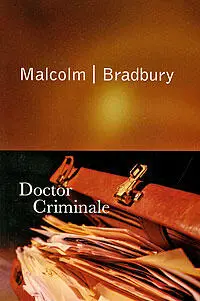
- Название:Doctor Criminale
- Автор:
- Издательство:Picador
- Жанр:
- Год:2000
- Город:London
- ISBN:978-0330390347
- Рейтинг книги:5 / 5. Голосов: 1
-
Избранное:Добавить в избранное
- Отзывы:
-
Ваша оценка:
Doctor Criminale: краткое содержание, описание и аннотация
Предлагаем к чтению аннотацию, описание, краткое содержание или предисловие (зависит от того, что написал сам автор книги «Doctor Criminale»). Если вы не нашли необходимую информацию о книге — напишите в комментариях, мы постараемся отыскать её.
Doctor Criminale — читать онлайн бесплатно полную книгу (весь текст) целиком
Ниже представлен текст книги, разбитый по страницам. Система сохранения места последней прочитанной страницы, позволяет с удобством читать онлайн бесплатно книгу «Doctor Criminale», без необходимости каждый раз заново искать на чём Вы остановились. Поставьте закладку, и сможете в любой момент перейти на страницу, на которой закончили чтение.
Интервал:
Закладка:
‘Where in the world?’ I asked. I thought at first he was posing me some philosophical question, but he waved his hand grandly at the lake in front of us. ‘Oh, on the lake,’ I said, ‘I think those lights must be Vevey.’ ‘Ah, yes, Vevey,’ said Criminale, ‘Once the exile home of a very great man.’ ‘Oh yes?’ I asked. ‘Charlie Chaplin,’ he said, ‘Do you know Adolf Hitler’s men had strict orders that the Führer must never watch his movies, for the fear that he might think the fool he was watching up there on the screen was himself?’ ‘No, I didn’t,’ I said. ‘Those two were born in the same year, 1889, by the way,’ he said, ‘Think of it, Hitler and Chaplin, the fascist and the clown. If you are a photographer, then you must visit the Chaplin Museum here, you know.’ ‘You’ve been there?’ I asked. ‘Of course, I opened the centennial exhibition of last year there myself,’ said Criminale, ‘I found it quite moving, by the way.’ ‘You seem to be a great traveller,’ I said, ‘I gather you go everywhere.’
‘No, no, I am not a traveller,’ said Criminale, There are no travellers now, only tourists. A traveller comes to see a reality that is there already. A tourist comes only to see a reality invented for him, in which he conspires.’ ‘Yes, we live in a placeless world,’ I said. He turned and looked at me in a half-puzzled way. ‘Did I perhaps say this to you before?’ he asked. I felt he was just beginning to recognize me; in fact perhaps I was half-teasing him to do so. I thought it was time to tell him a little of the truth (all of it is more than any of us can manage) and perhaps even hint at the reasons for my interest in him. ‘Something like it,’ I said, ‘I heard you lecture the other day at Barolo.’ ‘Really, at Barolo?’ he asked, looking at me over the top of the cigar he was lighting, ‘Well, I was there. You also? So what did I lecture on?’
It seemed an odd question: was he testing me, or had he in his high-mindedness managed to forget what he said? ‘You spoke about the end of history,’ I told him. ‘No, I don’t think so,’ said Criminale, ‘You see, my dear young fellow, history always goes on, always takes a shape, whether we like it or not. Perhaps you misunderstood me.’ ‘That’s possible,’ I said. ‘No, no, of course, I remember it now,’ said Criminale, excitedly shaking his cigar at me, ‘What I was talking about, I think, was the end of homo historicus , the individual who finds a meaning or an intention in history. Yes?’ ‘something like that,’ I said. ‘Oh, there are old men in China who still think history is made with the barrel of a gun,’ he said, ‘But they will go soon to their forefathers, and that will be that. And for the rest of us, well, the past embarrasses us, the future is a chaotic mystery. So we are condemned to an eternal present. We know nothing, we remember nothing. And so we cannot tell good from evil, reality from illusion. And who can guide us to another way? Perhaps you like a cigar?’
‘Thank you,’ I said, taking one from the elegant case he presented to me. I put it into my mouth, nibbling the end. ‘No, no, not like that, my friend, these are from Castro, they must be respected,’ he said, taking it back and shaping it neatly with his pocket knife, ‘You see, we have no great story for ourselves, and so we go nowhere. Isn’t it true?’ ‘Yes, I suppose it is,’ I said. And so we stood there, two friendly passengers, our cigar ends glowing, staring out over the rail as the lights of Vevey and then Montreux slipped brightly by. ‘You know, I like this lake,’ he said after a moment. ‘Yes, it’s very pleasant,’ I said. ‘The lake of exiles,’ said Criminale, ‘The people who loved it most were mostly exiles, like myself. All came looking for what you can never find. Rousseau came, looking for human innocence. It was not here. Byron came seeking political liberty. Not here. Eliot came wanting a relief from the madness of the modern. No good. Nabokov came and thought he would find Russia again. He found Swiss hotels.’ He wasn’t the only one, I thought.
I looked at him sideways. One thing, I realized, was certain: whatever erotic delights this famous and fortunate man was enjoying – or perhaps not enjoying – in the warm arms of Miss Belli, they had not diminished by one jot his teacher’s unquenchable desire to instruct and explain. I was full of questions; I wanted to ask him things, to ask him everything about his childhood, his politics, his philosophy, his experience under Karl Marx, his life, his loves. But I settled for listening, and why not? That was what you did with Bazlo Criminale. After all, in the middle of an egotistical world, very short on dignity (the photographers behind us were now turning the party raucous), he had the gift for deepening and dignifying any occasion, for adding presence and value to any thought. I found now, as I had at Barolo, that I liked the sound of his talking voice, the slow, ironic tone of his ideas, that I liked him . I liked his seriousness, his human flavour, his sense of history. He came out of confusion, but he brought a sort of order. At moments like this I knew there was nothing wrong with Criminale.
‘But the best book of this lake was Edward Gibbon, The Decline and Fall of the Roman Empire . He finished it here, a very great book. You have read it, of course?’ ‘No, I’m afraid not,’ I said. ‘Do it one day, to please me,’ said Criminale, ‘A book that shows that to all historical epochs there is a finite cycle. Also a book that began the modern re-interpretation of history. Just as I sometimes think I must someday begin the re-interpretation of philosophy.’ ‘That’s quite a project,’ I said. ‘Well, I think we were put on this earth to perform quite a project,’ said Criminale, ‘I am not like many philosophers today, who think we were put here to perform nothing at all. Of course they have a reason. All those who tried the great project in modern times have failed. Nietzsche found confusion and it drove him mad. Heidegger was deluded by those Nazis, whom he mixed up with great philosophers when they were really bully-boys, thugs. Sartre, naive like some girl with all those Stalinists, I knew those people and how they used him. But of course a philosopher is there to be used.’
‘So why do you try?’ I asked. ‘Because worse is to do nothing at all,’ said Criminale, Today they tell the philosopher, be modest, you have done enough harm. But how can he be released from philosophy? I think always we need a morality, a politics, a history, a sense of self, a sense of otherness, a sense of human significance of some kind. Now we have sceptics who invent the end of humanism. I do not agree. The task of philosophy is simply always to reinvent the task of philosophy, to subject our age and our world to thought. You are a young man, we owe you ideas. And always we need a morality, a politics, a history, a sense of self, a sense of others, a sense of eternity of some kind. So how then do we invent philosophy offer philosophy? That is the question I always ask myself ‘And how do you answer?’ I asked.
‘Well, that there is always something to divert us,’ he said, ‘Love, money, power, celebrity, boredom. Speaking of this I must go and find my young companion. You are alone?’ ‘Yes,’ I said. ‘I see,’ he said, ‘I thought I saw you with someone. What is happening?’ The paddles were churning, the ship turning; I looked down over the side. A small pier was in view below. ‘We’re docking,’ I said, ‘We must be going ashore.’ ‘Ah, yes, Chillon,’ said Criminale, dropping his cigar carelessly over the side, ‘I must get ready to give my lecture.’ ‘You’re lecturing now, here?’ I asked. ‘I think so, that is how they plan to spoil this nice evening,’ he said, ‘Don’t you have it in your programme?’ ‘Ah, I lost it,’ I said quickly, ‘Well, I look forward to hearing you.’ ‘Never look forward to a lecture,’ said Criminale, raising his hand to me, ‘Only look back on it, if it has been worth it. Good-night.’ He walked off along the deck. He was looking, I suppose, for Miss Belli, although the relationship between them struck me as far stranger than I had thought before.
Читать дальшеИнтервал:
Закладка:
Похожие книги на «Doctor Criminale»
Представляем Вашему вниманию похожие книги на «Doctor Criminale» списком для выбора. Мы отобрали схожую по названию и смыслу литературу в надежде предоставить читателям больше вариантов отыскать новые, интересные, ещё непрочитанные произведения.



Обсуждение, отзывы о книге «Doctor Criminale» и просто собственные мнения читателей. Оставьте ваши комментарии, напишите, что Вы думаете о произведении, его смысле или главных героях. Укажите что конкретно понравилось, а что нет, и почему Вы так считаете.