Malcolm Bradbury - Doctor Criminale
Здесь есть возможность читать онлайн «Malcolm Bradbury - Doctor Criminale» весь текст электронной книги совершенно бесплатно (целиком полную версию без сокращений). В некоторых случаях можно слушать аудио, скачать через торрент в формате fb2 и присутствует краткое содержание. Город: London, Год выпуска: 2000, ISBN: 2000, Издательство: Picador, Жанр: Современная проза, на английском языке. Описание произведения, (предисловие) а так же отзывы посетителей доступны на портале библиотеки ЛибКат.
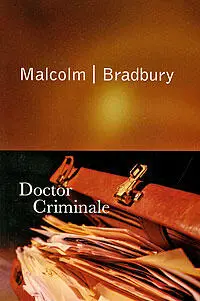
- Название:Doctor Criminale
- Автор:
- Издательство:Picador
- Жанр:
- Год:2000
- Город:London
- ISBN:978-0330390347
- Рейтинг книги:5 / 5. Голосов: 1
-
Избранное:Добавить в избранное
- Отзывы:
-
Ваша оценка:
Doctor Criminale: краткое содержание, описание и аннотация
Предлагаем к чтению аннотацию, описание, краткое содержание или предисловие (зависит от того, что написал сам автор книги «Doctor Criminale»). Если вы не нашли необходимую информацию о книге — напишите в комментариях, мы постараемся отыскать её.
Doctor Criminale — читать онлайн бесплатно полную книгу (весь текст) целиком
Ниже представлен текст книги, разбитый по страницам. Система сохранения места последней прочитанной страницы, позволяет с удобством читать онлайн бесплатно книгу «Doctor Criminale», без необходимости каждый раз заново искать на чём Вы остановились. Поставьте закладку, и сможете в любой момент перейти на страницу, на которой закончили чтение.
Интервал:
Закладка:
We stopped and refuelled in Rio de Janeiro, a row of metal gastanks seen in a glum dawn. Then we flew on south, over the pampa, across the wide gaping mouth of the River Plate, and down to Epeiza airport. Spring was autumn, there was a sub-tropical humidity. Argentina is not famous for its economic management (but then who is these days?). As I found when I got to immigration, the country had changed not only the value of its currency but even the name of it, without informing the cashier at my newspaper. There was therefore a lot of fussy trading to do before I could even enter the country, hire a taxi, and get myself driven into central Buenos Aires, some distance away. At last, though, I found myself being taxied into the city over a badly potholed, broken-down highway. Stalls sold balloons by the roadside, signs announced the electoral virtues of Menem, billboards proclaimed the Malvinas eternally Argentine. Snubnosed, bright-painted buses, broken-down farm trucks, veered from lane to lane to avoid the potholes as we rode between shanty-towns and scrubby pampa.
Then, suddenly, we were out of the pampa and on the great boulevards of a distinguished, monumental city. It was Sunday morning, time of peace. On the fine Avenida 9 de Julio everything was quiet. There were green parks filled with tropical trees and plants, squawking with green parrots. Vast marble statues stood everywhere, to conquistadores and generalissimos, to Columbus and Belgrano and San Martin and the Independence of 1810. I sat in a café over coffee and croissants; my jetlag cleared, my mood changed. Sandor Hollo, I remembered, had called Budapest the Buenos Aires of Europe. By the same token, Buenos Aires was the Budapest of Latin America, a European city that was not built in Europe at all. Its fine early modern buildings – ministries and synagogues, merchants’ palaces, great apartments, grand banks – had evidently been designed for some other site or country entirely, and then set down on strange soil amid sub-tropical vegetation, European tastes and cultural dreams laid over a world of lost history and chaotic libertarian adventuring.
Over the following week I came to fall in love with BA. I saw almost nothing of it, of course: a vast sprawling city of 12 million people scattered over a great plain. But its public spaces were grand, its gardens beautiful, its restaurants fine, its pastas splendid, its wines superb. It was a city playing at being a city. When you shopped, you found there was no agreed economy. When it rained, you found there were no underground drains. There was the intellectual life of the town and the violent life of the pampa, the world of writers and painters and the world of the gaucho, square-bodied, hide-booted, high-hatted figures who proudly jostled you into the gutters: a place where learned intellectuals were part of a culture that valued warriors, generals, knife-wielders and anyone who really fancied a fight. There was literacy and poverty, great architecture and sad shanty-towns, fine art galleries and armed soldiers riding trucks down the streets.
To my own rather literary mind – and you know by now I have a rather literary mind – it was the world according to Borges: a fiction with a resemblance to an idea of Argentina that had acquired a certain reality and decided to call itself Argentina, a world of random fragments that could only fit together by some inventive act of the mind. In the café near my hotel, fine elderly gentlemen in Parisian suits danced the tango and sang the old sentimental songs to their grey-haired old wives and the friendly young whores; later on it was explained to me that these were the very generals who had run the repression. In a park in the city Borges’s own National Library stood, halfway through construction, like a story that had been started but never finished, like someone’s uncompleted fiction.
Indeed Borges seemed everywhere, and above all at the Book Fair itself – a great tented city beside the railway, packed with hundreds of stalls and thousands of books from all lands. And if Argentina seemed to me like a book, it was also a world of readers, who passed in great swarms through the fair: businessmen and housewives, politicians and publishers, schoolchildren in long crocodiles, and gauchos. I was not surprised to find, in one of the main aisles, the plain stall of the Borges Foundation. Here were books from his personal library, experimental magazines he’d once edited, photographs of him as a dandyish young man or as a blind, basilisk-eyed old one. A youngish woman dressed in white sat at a desk on the stall. ‘But of course, the widow of Borges,’ said a friendly young Argentine journalist in the press room of the fair, ‘You didn’t interview her?’ I hurried back to the stall, but the woman in white had gone away.
And so had most of the world-famous writers whom, over the following days, I tried to track down and interview. Some were abroad, some stayed at home; some were in exile, others were presidents of their countries. I gathered Marquez was in the USA, Vargas Llosa in London, Fuentes in Paris, and so it went on. At first my visit to the Fair seemed just another replay of the Booker, but my young journalist friend proved very helpful. He took me round the many literary cafés and bars of the city, and introduced me to a number of younger, radical writers. My notebook filled, and only one thing remained to be done: to cover the resumption of Anglo-Argentinian cultural relations, an event that was to be celebrated with a formal ceremony and a bicultural panel of writers in some tented hall at the Fair towards the end of the week.
At first my Argentine journalist friend refused to come with me: ‘I do not go to official occasions,’ he said, ‘Either they are boring or they remind you of the people who like to put you back in prison.’ But I continued to press him, and eventually he agreed. On the important night, a rainy one, we pushed our way through the crowded Fair, dodging between files of formally dressed schoolchildren, and took our place on wooden benches in the wet tented hall. There was a large noisy audience, an empty platform with a long table on it, and to either side a flag on a long wooden pole: the Argentine flag to the left, the British Union Jack to the right. A small group of officials and functionaries seemed to be arguing furiously below the platform. To one side, a little aloof, stood a tall, distinguished and very well-suited figure: undoubtedly the British Ambassador. To the other side stood a smaller, more rounded figure who was doubtless the Argentine Minister of Culture. A few young Argentinian writers, some of them people I had already interviewed, stood bewildered near the doorway, and so did two writers specially flown out from Britain, a distinguished lady crime novelist, and a somewhat younger male novelist and critic whose work was associated with the campus novel.
Yet nothing happened; I turned to my neighbour. ‘Diplomatic incident, always a diplomatic incident,’ he said, ‘Perhaps someone is invited who should not be invited. Perhaps someone is not invited who should be invited. It is always the same at these occasions. You see why I never come to them.’ A few moments later, the Argentine Minister mounted the platform, reflected on the value of international cultural relations, welcomed the return of the admirable British Council to the country, and then stepped abruptly backwards, knocking into the Union Jack, which fell slowly to the floor. There were murmurs round the hall, a small burst of applause, a small explosion of laughter. ‘Did he do that on purpose?’ I asked my neighbour. ‘Hard to know,’ he said, ‘Maybe he is clumsy. You know these official occasions.’
Functionaries hurried onto the platform and tried to revive the flag, but the pole had broken. Eventually a young woman stood there and held it aloft, remaining there for the rest of the proceedings. The British Ambassador climbed to the podium, and responded as the British do in times of international crisis: he made a joke. This was followed by a brief, very elegant speech. Then the platform cleared again, and functionaries mounted the stage, putting out nameplates for the literary discussion. After a few moments, other functionaries appeared, and removed them again; there was another long period when nothing happened. I turned to my friend for explanation. ‘Oh, another diplomatic incident,’ he said, ‘Maybe some of these writers are not so good with the regime. Or they do not properly represent the spirit of our country.’ At last a row of writers mounted the platform, and a chairman took his seat. Again nothing happened, until the door to the tented hall opened suddenly, an elderly lady in a dark dress staggered in and climbed onto the platform. An extra chair was summoned; the lady sat down and looked round with belligerence. ‘Ah, that is it,’ said my friend, ‘Of course Menem or someone must have insisted she should be here.’ ‘Who is she, a writer?’ I asked. ‘Well, of a sort,’ said my friend, ‘but what is important is that honour is satisfied. Once she was the mistress of Borges.’
Читать дальшеИнтервал:
Закладка:
Похожие книги на «Doctor Criminale»
Представляем Вашему вниманию похожие книги на «Doctor Criminale» списком для выбора. Мы отобрали схожую по названию и смыслу литературу в надежде предоставить читателям больше вариантов отыскать новые, интересные, ещё непрочитанные произведения.








Обсуждение, отзывы о книге «Doctor Criminale» и просто собственные мнения читателей. Оставьте ваши комментарии, напишите, что Вы думаете о произведении, его смысле или главных героях. Укажите что конкретно понравилось, а что нет, и почему Вы так считаете.