Michael Chabon - Telegraph Avenue
Здесь есть возможность читать онлайн «Michael Chabon - Telegraph Avenue» — ознакомительный отрывок электронной книги совершенно бесплатно, а после прочтения отрывка купить полную версию. В некоторых случаях можно слушать аудио, скачать через торрент в формате fb2 и присутствует краткое содержание. Город: New York, Год выпуска: 2012, ISBN: 2012, Издательство: Harper, Жанр: Современная проза, на английском языке. Описание произведения, (предисловие) а так же отзывы посетителей доступны на портале библиотеки ЛибКат.
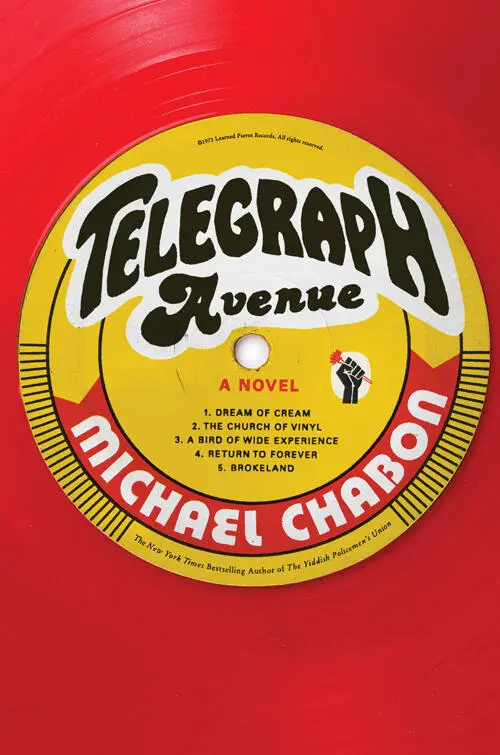
- Название:Telegraph Avenue
- Автор:
- Издательство:Harper
- Жанр:
- Год:2012
- Город:New York
- ISBN:978-0-06-149334-8
- Рейтинг книги:3.5 / 5. Голосов: 2
-
Избранное:Добавить в избранное
- Отзывы:
-
Ваша оценка:
Telegraph Avenue: краткое содержание, описание и аннотация
Предлагаем к чтению аннотацию, описание, краткое содержание или предисловие (зависит от того, что написал сам автор книги «Telegraph Avenue»). Если вы не нашли необходимую информацию о книге — напишите в комментариях, мы постараемся отыскать её.
When ex–NFL quarterback Gibson Goode, the fifth-richest black man in America, announces plans to build his latest Dogpile megastore on a nearby stretch of Telegraph Avenue, Nat and Archy fear it means certain doom for their vulnerable little enterprise. Meanwhile, Aviva and Gwen also find themselves caught up in a battle for their professional existence, one that tests the limits of their friendship. Adding another layer of complication to the couples’ already tangled lives is the surprise appearance of Titus Joyner, the teenage son Archy has never acknowledged and the love of fifteen-year-old Julius Jaffe’s life.
An intimate epic, a NorCal
set to the funky beat of classic vinyl soul-jazz and pulsing with a virtuosic, pyrotechnical style all its own,
is the great American novel we’ve been waiting for. Generous, imaginative, funny, moving, thrilling, humane, triumphant, it is Michael Chabon’s most dazzling book yet.
Telegraph Avenue — читать онлайн ознакомительный отрывок
Ниже представлен текст книги, разбитый по страницам. Система сохранения места последней прочитанной страницы, позволяет с удобством читать онлайн бесплатно книгу «Telegraph Avenue», без необходимости каждый раз заново искать на чём Вы остановились. Поставьте закладку, и сможете в любой момент перейти на страницу, на которой закончили чтение.
Интервал:
Закладка:
“Everybody knew that.” Singletary turning out to be Mr. Jones’s executor, fingers in every pie not already fingered up by Chandler Flowers. “I mean, shit, for a while he was carrying around a picture of his coffin folded up into his wallet, used to take it out and smile at it like he was looking at a centerfold or, like, a picture of Tahiti.”
“Mr. Jones, rest in peace, the man had his certain type of peculiarity, no doubt.”
“Asking to be buried in the Aztec number,” Archy said. “I heard.”
“Thing is hell of ugly,” Feyd said.
“The Aztec number was made by Ron Postal of Beverly Hills,” Archy said, grateful for the opportunity, as an alternative to adolescent slouching and mouthing off, to turn professorial and school the roostery motherfucker. “Acknowledged master of the American leisure suit. It’s truly one of a kind. Shit ought to be in the Smithsonian.”
“People can be very particular about burial attire,” Flowers said with all his perfected mildness. “No, the odd thing, what I’m talking about, maybe odd’s not the proper term. I was going through his instructions, you know, he has it all typed up single-spaced, six pages.” He opened a folder on his desk, forest green with hooks of white metal where you hung it from rails in the file drawer. With the tip of his middle finger, hardly larger than a boy’s, he began to tick off items on the first sheet of paper the folder contained. “He wanted the Cadillac hearse.”
“Naturally,” Archy said.
“Naturally. And we’re going to make that happen for him. He wanted it open casket—”
“How’s he look?”
“Now? Now he looks peaceful and dignified.”
“No sign of, uh, damage?”
“This is our art, Mr. Stallings,” Flowers said. “Our profession. Please. Man wanted the Chinese marching band, the Green Street Mortuary Band, from over in the city.” He looked up from the folder. “How’s that coming?”
“Turns out they’re already booked,” Archy said. “Morning and afternoon.”
“That is going to be a problem, then,” Flowers said.
“Please,” Archy said. He had been trading messages with Gwen’s receptionist, Kai, to see about booking her outfit, Bomp and Circumstance, to play the funeral parade. Mr. Jones had checked them out one time at the Temescal street fair. Bunch of straight-faced, brass-brandishing cute little tattooed lesbianettes playing “What a Friend We Have in Jesus” wasn’t ever going to have too much trouble putting a smile on Mr. Jones’s face. “This is my art and my profession.”
“Fair enough.”
“So I’m still waiting for the points that have come up,” Archy said. “In the fine print.”
“Well,” Flowers said, “the gentleman, rest his soul, he had an aversion, you might say, to religion. I’m sure you know.”
“He was deep, though.”
“Yes, he was. But he made it clear,” tapping the third typed sheet of paper in the green folder, “he didn’t want a preacher or a minister, didn’t want no church. Didn’t even want to hold the service here at the funeral home. What with the stained glass and, I guess, the pews in the chapels and so on. We got Bibles, we got hymnals. A general atmosphere of, call it, reverent solemnity. I mean, I try to keep the religious element unobtrusive, respectful. Technically, this is a secular operation. But, well, they are called funeral chapels , and Mr. Jones—”
“He was a true-blue atheist,” Archy said. “I remember my pops saying how Mr. Jones, at one time he was even a full-on Communist .”
“How is Luther?” Flowers said, tired, uninterested, milder than ever. Asking it pro forma. But one pop-eye peeper flicked left, checking in on Bankwell, telling the man, You pay attention, now .
“I wouldn’t know,” Archy said.
“You haven’t seen him?”
“Not for like two years. What he do this time?”
“Didn’t do anything,” Chan Flowers said. “I never said he did.”
“But you’re looking for him,” Archy said. “I get the distinct impression.”
“I might be.”
“If you’re looking for him,” Archy said, “he must of done something.”
A smile opened, thin as a paper cut, at the bottom of Flowers’s face. Archy did not know the nature of the ancient beef that Chan Flowers had with Luther Stallings. The history of the matter was banned and obscure. His aunties had made inquiries, put out feelers. For years they continued to probe the gossip pits, turn over the ashes with their sticks. But even those legendary connoisseurs of scandal never found anything to definitively explain the break, apart from whispers of a connection to some mythic murder of the Panther years. As boys, Archy knew, Chan and Luther had been famously thick, chronic co-conspirators. Then, when Archy was maybe four or five years old, around the time Luther started acting in movies, the friendship was abandoned like a house, sealed by law, condemned.
“Whatever he did, I assume it is all his fault,” Archy said. “Let me just put that out there to start.”
“You may well be right,” Flowers said. “Luther may have done something, and whatever he did is probably, I’m sorry to say, his fault. But that’s not here nor there. I just need to see the man. I just need to talk to him.”
There was a photograph that Archy remembered, hung from the wall of his father’s various apartments. It was a glossy black and white, taken by a Tribune photographer, at an Oakland Tech dance, Luther Stallings and Chan Flowers and two fly girls of the period. Everybody dolled up and smiling but possessing that precocious dignity of your ancestors when they were young.
“If I knew where he was at, Councilman, I would tell you, straight up,” Archy said. “But I don’t know. By choice. And I don’t plan to find out.”
“And you don’t know anybody knows where he’s living. Not one single soul.”
He might have been gently chiding Archy for this ignorance. Implying there could, somewhere, for somebody, still be some use left in Luther Stallings.
“Nope. No, sir, no, I don’t.”
“Well, let’s say that situation changes, or maybe you have some kind of change in the way you’re looking at that situation. Say, one day you gaze out at the neighborhood water. See that fin popping up, that old familiar shark come swimming around. Just, you know, let me know. I have something to give him. Something he needs very badly.”
“Yeah? What, a sea lion?”
Flowers fixed his sleepy eyes on Archy, laid them on like hands. Slowly, skeptically, the heavy lids lifted. “I am serious, now,” he said. “You run across him or one of his known associates and running buddies. Somebody from his old crew that ain’t died yet, few in number as they are. Just let me know. Valletta Moore, for example. I heard she’s around.”
He came at Archy’s soul then with the flashlight and the crowbar of his gaze. Archy offered no purchase and gave nothing back. Maybe the man already knew that Archy had seen Valletta; maybe he was only fishing. Archy could not have said why he decided to keep silent.
“If she should happen to show up,” Flowers said, “let’s say. You just go on and call me on my personal cell. Feyd, give him the number. All right? Will you do that for me?”
Archy said, “I’ll think about it.”
“You do that,” Flowers said. “And maybe, you never know, I might be the one ends up putting in a word for you with Mr. G Bad.”
“Is that right?”
“It’s not out of the question, by any means.”
“‘Community relations,’ huh.”
“The new Dogpile store, I have been reliably told, is going to have the most extensive, most encyclopedic, jazz section of any store in the country. Also hip-hop. R and B. Blues. Gospel. Soul. Funk. Somebody will have to run that department, Mr. Stallings.”
Читать дальшеИнтервал:
Закладка:
Похожие книги на «Telegraph Avenue»
Представляем Вашему вниманию похожие книги на «Telegraph Avenue» списком для выбора. Мы отобрали схожую по названию и смыслу литературу в надежде предоставить читателям больше вариантов отыскать новые, интересные, ещё непрочитанные произведения.








Обсуждение, отзывы о книге «Telegraph Avenue» и просто собственные мнения читателей. Оставьте ваши комментарии, напишите, что Вы думаете о произведении, его смысле или главных героях. Укажите что конкретно понравилось, а что нет, и почему Вы так считаете.