Michael Chabon - Telegraph Avenue
Здесь есть возможность читать онлайн «Michael Chabon - Telegraph Avenue» — ознакомительный отрывок электронной книги совершенно бесплатно, а после прочтения отрывка купить полную версию. В некоторых случаях можно слушать аудио, скачать через торрент в формате fb2 и присутствует краткое содержание. Город: New York, Год выпуска: 2012, ISBN: 2012, Издательство: Harper, Жанр: Современная проза, на английском языке. Описание произведения, (предисловие) а так же отзывы посетителей доступны на портале библиотеки ЛибКат.
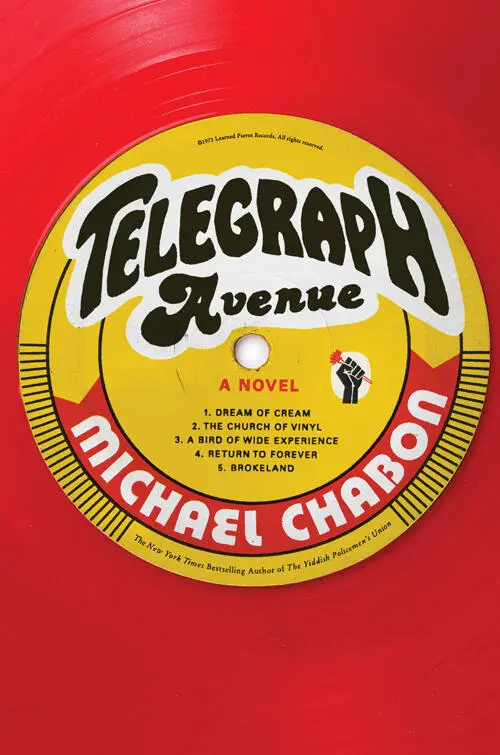
- Название:Telegraph Avenue
- Автор:
- Издательство:Harper
- Жанр:
- Год:2012
- Город:New York
- ISBN:978-0-06-149334-8
- Рейтинг книги:3.5 / 5. Голосов: 2
-
Избранное:Добавить в избранное
- Отзывы:
-
Ваша оценка:
Telegraph Avenue: краткое содержание, описание и аннотация
Предлагаем к чтению аннотацию, описание, краткое содержание или предисловие (зависит от того, что написал сам автор книги «Telegraph Avenue»). Если вы не нашли необходимую информацию о книге — напишите в комментариях, мы постараемся отыскать её.
When ex–NFL quarterback Gibson Goode, the fifth-richest black man in America, announces plans to build his latest Dogpile megastore on a nearby stretch of Telegraph Avenue, Nat and Archy fear it means certain doom for their vulnerable little enterprise. Meanwhile, Aviva and Gwen also find themselves caught up in a battle for their professional existence, one that tests the limits of their friendship. Adding another layer of complication to the couples’ already tangled lives is the surprise appearance of Titus Joyner, the teenage son Archy has never acknowledged and the love of fifteen-year-old Julius Jaffe’s life.
An intimate epic, a NorCal
set to the funky beat of classic vinyl soul-jazz and pulsing with a virtuosic, pyrotechnical style all its own,
is the great American novel we’ve been waiting for. Generous, imaginative, funny, moving, thrilling, humane, triumphant, it is Michael Chabon’s most dazzling book yet.
Telegraph Avenue — читать онлайн ознакомительный отрывок
Ниже представлен текст книги, разбитый по страницам. Система сохранения места последней прочитанной страницы, позволяет с удобством читать онлайн бесплатно книгу «Telegraph Avenue», без необходимости каждый раз заново искать на чём Вы остановились. Поставьте закладку, и сможете в любой момент перейти на страницу, на которой закончили чтение.
Интервал:
Закладка:
“Arch—”
“I’m here to listen,” Archy said to Nat. “You listen, too.” Chomp. “Excuse me, Councilman. Please continue.”
“Okay,” Rod Abreu said. “Well, like I explained, Mr. Stallings, just a minute ago, at this point in the game, I actually don’t think we should be thinking of fighting anything. I was just saying…” He looked sheepish. “What was I saying?”
“Go A’s,” said Dr. Milne.
“Right. Football. Yes. Folks, there is no question, if you don’t know, take it from me, Gibson Goode has done great things for the community down in L.A., a community where not a whole lot of great things were happening before. I commend and admire him for that, and I commend the people, some of my colleagues on the city council, who look at what Mr. Goode has done in L.A. and say, hey, wouldn’t it be great if we could make something like that happen here in Oakland. And hey, he’s a hometown boy, right? A homeboy. Wouldn’t something like that be awesome? A shot in the arm. Well, yes, maybe it would be awesome. It sounds awesome. It looks awesome on paper. But if there’s one thing I’ve learned, and hey, I’m a homeboy, too? Born in East Oakland, right at Highland Hospital? It’s this: I have seen a lot of impressive people come through this city over the years with a lot of awesome ideas that looked good on paper . Hey, when you look like I do, on paper ’s your only hope.”
That got a laugh, Shoshana in her chemo scarf nodding, other people nodding. Abreu worked those doleful eyes, those Marrano eyes, abreu meaning “Hebrew,” as Nat would have liked to inform Archy, in Portuguese, or maybe it was Catalan.
“Whenever you have a proposal as ambitious as this one, and folks, no doubt about it, this is a very ambitious proposal, you have to be careful. People tend, when you have a charismatic guy like Gibson Goode, a genuine superstar, hey, somebody like that generates a lot of excitement, people get kind of caught up, right? And when people get excited, they get carried away, then they rush into things. And that’s why we are here today. Because somebody has to kind of hang back a little, say, okay, let’s slow down. Let’s take our time with this. That’s the message I’m bringing you today.”
Slow down , admittedly not quite the message that Nat had envisioned when he first began to lay his fevered plans, but his nose detected subterfuge in Abreu’s words, and he did not believe that a mere retarding action was all the councilman had in mind.
“And it’s the message that I’d like to take back from you and share with my colleagues on the city council.”
S. S. Mirchandani leaned in close to Archy. “I have been reliably informed,” he said in a portentous and inadequate whisper, nodding toward Abreu, “that he was the one getting Chan the Man’s sister fired from the port of Oakland.”
Like Archy, making his joyless way through a biscuit that might have brought joy to Eeyore, Nat affected not to have heard Mr. Mirchandani, but he glanced over at the likely source of the information. Singletary arched an eyebrow, then, after taking a look around the room, smiled a dubious but encouraging smile, the way you might smile at someone about to depress the ignition button of a homemade jet pack. He did not look too impressed by the putative founding membership of COCHISE, their ranks drawn largely, as Nat would have been obliged to concede, from the recipients of an e-mail sent in bee-meets-bonnet haste to those addresses in his personal contacts file who shared a zip code with Brokeland, a relatively modest number (Nat at best a fitful electronic correspondent) amassed over a period of several years from a disparate set of social contexts.
“Now, I want to thank our hosts today, you two are really pillars of this neighborhood, for organizing this get-together.”
“Huh,” said Archy.
Abreu turned at the sound and caught Nat in the midst of offering his landlord an elaborate shrug, lips down-twisted asymmetrically into an expression meant to convey 1) that his willingness to concede both the unlikeliness of COCHISE’s success and the regrettable preponderance, thus far, of white faces among its membership was accompanied by 2) a respectful suggestion that Singletary reserve judgment, because hey, you never knew what might happen, and a second, still more respectful suggestion that 3) Singletary go fuck himself; such elaborate, densely layered shrugs being a particular specialty of the Jaffes going back to their days of never knowing what might happen along the banks of the Vistula.
“No, really,” Abreu said, misinterpreting Nat’s shrug as modesty. “Brokeland Records, right, I mean, this place is so much more than a store. It’s a neighborhood institution. I know a lot of you folks have spent a lot of your time and money in this place over the years.”
“Lot more time than money,” Archy said, and Moby, who had dropped thousands over the years, loyally laughed.
“It’s the kind of independent, quirky, welcoming place…” Abreu went on, voice wavering as though he were picking up on the crackle of politics that troubled the air between the partners. The Spinozan sadness in his eyes seemed to balloon, and the thumbprints beneath them to deepen: “…that gives a special character to this part of the city. And it’s that special character we’re going to have to really consider as we look at the Dogpile plan going forward. There are also possibly some environmental-impact issues to look at. Now, I understand, from talking to, uh, Ms.—”
“Sandy,” said the former light in the eye and wag in the tail of poor Jasper. “That’s why I was told we couldn’t put a dog park there. The back end of the property used to be a factory or something. I heard there was mercury. You can’t dig it up without doing some kind of big cleanup.”
A number of people nodded and murmured that they had heard reports of some kind of problem with the site, but many more seemed to be hearing the information for the first time, and Nat was gratified by the concern that it appeared to engender, news of the danger forking outward, in his imagination, along a network of gossip and bloggery until it reached a crescendo of outrage that would doom the Dogpile proposal now and for all time, bring it with a creak and a crumble and a great cloud of dust to the ground. He wanted to turn to Archy, standing irritated next to him, turn to Aviva as in his imagination she ran screaming from the devastated kitchen of the home that was, after all, also threatened by the advent of the Thang, turn to the ghost of Opal Starrett, who always used to say, not without affection, that Nat was incapable of organizing an empty drawer, throw out his arms, and cry, Da-deeda-la- dee -dop!
Just as Nat was congratulating himself and mentally boasting to the living and the dead for his remarkable aim with the ancestral Davidic sling, he saw Singletary sit up electric-shock straight, then nod cool and wary at someone beyond the frame of the front window, out of Nat’s line of sight.
“So the Dogpile folks are probably going to run into some questions right there. And of course, and here’s the end of what I have to say, the city council and the planning commission are going to be looking for a lot of input and comment from you—”
And then in walked Chan the Man, in his Sergio Leone hat and funereal suit, steps precise, eye bright and quick as a rooster’s. He stopped in the doorway with two of his nephews paired behind him. “Oh my goodness,” he said. “I am sorry. I did not realize.”
He raised a hand to his mouth and looked embarrassed. Dumbfounded to discover his favorite record store almost if not quite packed with people in the middle of the day. Far more people, perhaps, than had ever been almost but not quite packed into this space at any time in its history, even back when it was Spencer’s Barbershop. For a kinescoped instant Nat cut away in his imagination from the scene at Brokeland to an afternoon forty years earlier, men and boys, maybe Chan Flowers and Luther Stallings among them, jostling around a portable black-and-white to watch Cassius Clay take down the Big Bear. Nat wished intensely that this gathering could be that gathering, these people could be those, with all the years of ferment and innovation in the music and the life of black America ahead of them. Hope unfulfilled, not yet betrayed.
Читать дальшеИнтервал:
Закладка:
Похожие книги на «Telegraph Avenue»
Представляем Вашему вниманию похожие книги на «Telegraph Avenue» списком для выбора. Мы отобрали схожую по названию и смыслу литературу в надежде предоставить читателям больше вариантов отыскать новые, интересные, ещё непрочитанные произведения.








Обсуждение, отзывы о книге «Telegraph Avenue» и просто собственные мнения читателей. Оставьте ваши комментарии, напишите, что Вы думаете о произведении, его смысле или главных героях. Укажите что конкретно понравилось, а что нет, и почему Вы так считаете.