Mo Yan - Sandalwood Death
Здесь есть возможность читать онлайн «Mo Yan - Sandalwood Death» весь текст электронной книги совершенно бесплатно (целиком полную версию без сокращений). В некоторых случаях можно слушать аудио, скачать через торрент в формате fb2 и присутствует краткое содержание. Город: Norman, Год выпуска: 2013, ISBN: 2013, Издательство: University of Oklahoma Press, Жанр: Современная проза, на английском языке. Описание произведения, (предисловие) а так же отзывы посетителей доступны на портале библиотеки ЛибКат.
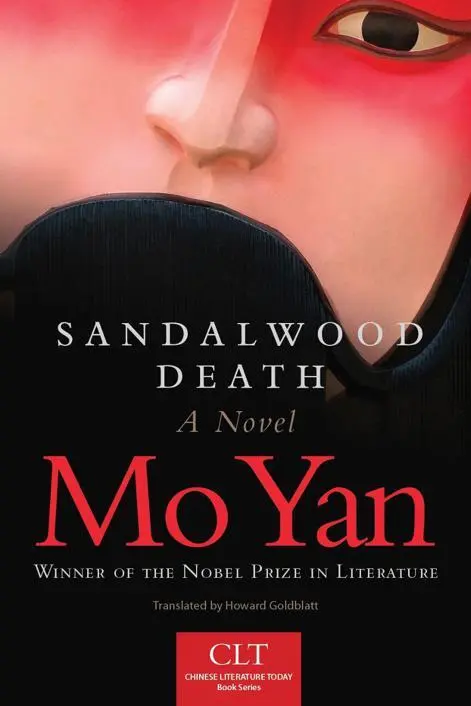
- Название:Sandalwood Death
- Автор:
- Издательство:University of Oklahoma Press
- Жанр:
- Год:2013
- Город:Norman
- ISBN:978-0-8061-4339-2
- Рейтинг книги:3 / 5. Голосов: 1
-
Избранное:Добавить в избранное
- Отзывы:
-
Ваша оценка:
Sandalwood Death: краткое содержание, описание и аннотация
Предлагаем к чтению аннотацию, описание, краткое содержание или предисловие (зависит от того, что написал сам автор книги «Sandalwood Death»). Если вы не нашли необходимую информацию о книге — напишите в комментариях, мы постараемся отыскать её.
Sandalwood Death Filled with the sensual imagery and lacerating expressions for which Mo Yan is so celebrated
brilliantly exhibits a range of artistic styles, from stylized arias and poetry to the antiquated idiom of late Imperial China to contemporary prose. Its starkly beautiful language is here masterfully rendered into English by renowned translator Howard Goldblatt.
Sandalwood Death — читать онлайн бесплатно полную книгу (весь текст) целиком
Ниже представлен текст книги, разбитый по страницам. Система сохранения места последней прочитанной страницы, позволяет с удобством читать онлайн бесплатно книгу «Sandalwood Death», без необходимости каждый раз заново искать на чём Вы остановились. Поставьте закладку, и сможете в любой момент перейти на страницу, на которой закончили чтение.
Интервал:
Закладка:
She glared at me, eyes wide open, mouth agape, face pale with fright, unable to say a word in response. My son, who was crouching in front of the rooster, cackled as he asked:
“Will we be able to keep this rooster, Dieh?”
“Yes, we can keep it.”
“How about all this rice and flour and meat?”
“Yes, we can keep it all.”
“Ha-ha…”
He laughed happily. That son of mine may have looked like a fool, but knowing the value of good things kept him from being one. “All this will be ours to keep, son, but we have a job to do for the nation. Tomorrow at this time will be our moment to shine.”
“Are you really going to kill my dieh?” my daughter-in-law asked piteously. A face that had always been radiant and sleek seemed suddenly covered by a coat of rust.
“That is his good fortune!”
“How do you plan to kill him?”
“With a sandalwood stake.”
“Swine…” Her shouts were eerie. “You bastard…”
She yanked open the gate and burst out of the compound, swaying her hips.
I sent the crazed young woman off with a resounding comment: “Dear daughter-in-law, I am going to see that your dieh’s name will live forever, that his legend will become the stuff of grand opera, just you wait and see!”
————
2
————
I told my son to shut the gate as I placed the length of sandalwood on top of the flesh-and-blood-stained slaughtering rack, and had him fetch a saw, which I used to cut the wood in two lengthwise. Saw teeth biting into the wood produced the harsh, ear-piercing sound of metal on metal; sparks flew from the blade, which was too hot to touch, and a strange burning odor assailed my nose. Picking up a plane, I then painstakingly shaved the two halves into stakes with blunted tips and tapered edges, slightly rounded, like the leaves of a chive plant. Once that was done, I used sandpaper, coarse at first, then fine, turning the stakes over and over as I worked, until they shone like mirrors. True, I had never carried out a sandalwood execution, but I knew instinctively that success in this epochal event lay in the quality of the instrument. A job of this magnitude required meticulous preparation, something I had learned from Grandma Yu. The sanding alone took me half the day—a sharp ax makes the best kindling, or, as the adage goes, “The best work requires the finest tools.” I had no sooner sanded the two treasures to perfection than a yayi knocked at the gate to report that Gaomi County Magistrate Qian Ding’s workers had erected something called an Ascension Platform on the parade ground in front of the Tongde Academy in the center of town, one that adhered to my specifications and was sure to become the stuff of legend for a century or more. The mat shed I had requested was also in place, and sesame oil was churning in the large cauldron, while beef stewed in its smaller companion. I sniffed the air, and there it was, the heavy fragrance of sesame oil and meat carried on the autumn wind.
After running out early in the morning, my son’s wife still had not returned. I could understand what was troubling her—it was, after all, her dieh who was to be executed, and she had to be experiencing emotional, even physical, pain because of it. But where could she have gone? To plead her case with her gandieh, Magistrate Qian? Maybe, but my dear daughter-in-law, your gandieh is like a clay bodhisattva who must worry about its own survival while crossing the river. I do not intend to curse him by predicting that the day your dieh breathes his last will also see his downfall.
I changed into a new set of official clothes: a black robe cinched with a red sash, a red felt cap with red tassels, and black leather boots. There is truth in the adage that “People are known by their clothes, horses by their saddles.” With new clothes, I was no longer an ordinary man. With a grin, my son asked me:
“What are we going to do, Dieh, sing Maoqiang opera?”
Maoqiang? Songs from your idiotic dog opera, maybe! I cursed inwardly. Talking to him was a waste of time, so I simply told him to get out of his greasy clothes, which were stained with pig fat and dog blood. Guess what he said to me.
“Close your eyes, Dieh, don’t look. That’s what she tells me to do when she changes clothes.”
Keeping my eyes slitted, I watched him take off his clothes. He had a coarse, ugly body, and that thing drooping above his scrotum was an obviously useless appendage.
Yet in his high-topped, soft-soled black leather boots, red waist sash, and red-tasseled cap, his size gave him a formidable, martial appearance. But then he made a face, tugged at his ear, and scratched his cheek, and he was just another monkey in human form.
With the two stakes over my shoulders, I told him to pick up the rooster and follow me out the gate on our way to the Tongde Academy. The streets were lined with would-be spectators, men and women, young and old, all standing wide-eyed and open-mouthed, like fish sucking air above water. With my head up and my chest thrown out, I appeared to be oblivious to their presence, though in fact I saw everything out of the corner of my eye. My son, on the other hand, kept looking right and left and greeting the crowds with a foolish grin, as the rooster struggled to get free, squawking frantically. The dull-witted people gaped as we passed. Xiaojia was stupid, all right, but the people were worse. The show hasn’t even begun, you clods, and if that’s how you look now, what are you going to be like tomorrow during the grand performance? It’s your good fortune to have a man like me in your midst. The finest play ever staged cannot compete with the spectacle of an execution, and no execution on earth can begin to compare with the sandalwood death. And where in China will you find another executioner talented enough to kill a man with it? With me in your midst, you will be treated to a show the likes of which no one has ever seen, nor likely ever will again. If that is not good fortune, what is? I ask you, if that is not good fortune, what is?
Old Zhao Jia walks with his stakes and says with respect to the gathered fold, I carry the law of the nation in my arms; it is weightier than gold. I call out to my son to pick up the pace and stop gawking like a fool. Tomorrow we will show them who we are, like carp transformed into dragons so bold. Three steps instead of two, two steps outpacing one, strides faster than a shooting star—the Tongde Academy awaits.
We look up, ahead is the parade ground, flat and even, its sand white and cold. An opera stage on one side, where Pear Garden actors will come to play. Kings and princes, generals and ministers, heroes and warriors, scholars and beauties, three religions and nine schools of thought… all brought together like a running-horse lantern of old.
There, in front of the stage, the County Magistrate has erected an Ascension Platform, fronted by soldiers, our presence to behold. Black and red batons on the shoulders of some, broadswords in the hands of others. In front of the platform, a mat shed secured with rush rises behind a cauldron in which sesame oil churns. Fellow countrymen, the grand opera is about to begin, the story to be told!
————
3
————
I tied the rooster to a shed post. The creature cocked its head and looked up at me, its eyes the color of yellow gold, sparkling and blinding bright. I turned to my son. “Xiaojia,” I said, “knead some dough with fresh water.” He cocked his head to look at me, gawking like the rooster.
“What for?”
“Do as I say, and don’t ask questions.”
I studied the shed while he was kneading the dough. The front was open, the back closed. It stood opposite the opera stage. Perfect, just the way I wanted it. The floor was laid well enough, with a gold-colored rush mat on top of the noisy layer of wheat stalks. New wheat, new rush, both exuding a fresh aroma. My sandalwood chair had been placed in the center of the tent, enticing my backside to sit in it. I went first to the cauldron, where I dropped the two spear-shaped stakes into the fragrant oil. They sank straight to the bottom, with only the squared-off butt ends floating to the top and breaking the surface. Ideally they should cook for three days and nights, but I did not have three days. A day and a night would work, since sandalwood this smooth would soak up little blood even without being cooked in oil. Fate has smiled on you, Qinjia, by allowing this to be the instrument of your death. I sat in my chair and looked up at the red sun setting in the west, ushering in dusk. The Ascension Platform, built of thick red pine, had a gloomy appearance in the twilight and exuded the aura of death, like a great frowning idol. I could not fault the County Magistrate’s preparations; the platform, encircled in mist and hooded by somber clouds, fairly epitomized the solemnity of the occasion. Magistrate Qian, you should take your rightful place in the Board of Public Works as a supervisor of grand projects. Your talents are hopelessly stifled in piddling little Gaomi County. Sun Bing, Qinjia, you too are one of Northeast Gaomi Township’s outstanding individuals, and though I do not like you, I cannot deny that you are a dragon among men, or perhaps a phoenix; it would be a crime for you not to die in spectacular fashion. Anything less than the sandalwood death, and this Ascension Platform would not be worthy of you. Sun Bing, your cultivation in a previous life has brought you the good fortune of falling into my hands, for I will immortalize your name and make you a hero for the ages.
Читать дальшеИнтервал:
Закладка:
Похожие книги на «Sandalwood Death»
Представляем Вашему вниманию похожие книги на «Sandalwood Death» списком для выбора. Мы отобрали схожую по названию и смыслу литературу в надежде предоставить читателям больше вариантов отыскать новые, интересные, ещё непрочитанные произведения.


Обсуждение, отзывы о книге «Sandalwood Death» и просто собственные мнения читателей. Оставьте ваши комментарии, напишите, что Вы думаете о произведении, его смысле или главных героях. Укажите что конкретно понравилось, а что нет, и почему Вы так считаете.