Jennifer DuBois - Cartwheel
Здесь есть возможность читать онлайн «Jennifer DuBois - Cartwheel» весь текст электронной книги совершенно бесплатно (целиком полную версию без сокращений). В некоторых случаях можно слушать аудио, скачать через торрент в формате fb2 и присутствует краткое содержание. Город: New York, Год выпуска: 2013, ISBN: 2013, Издательство: Random House, Жанр: Современная проза, Триллер, на английском языке. Описание произведения, (предисловие) а так же отзывы посетителей доступны на портале библиотеки ЛибКат.
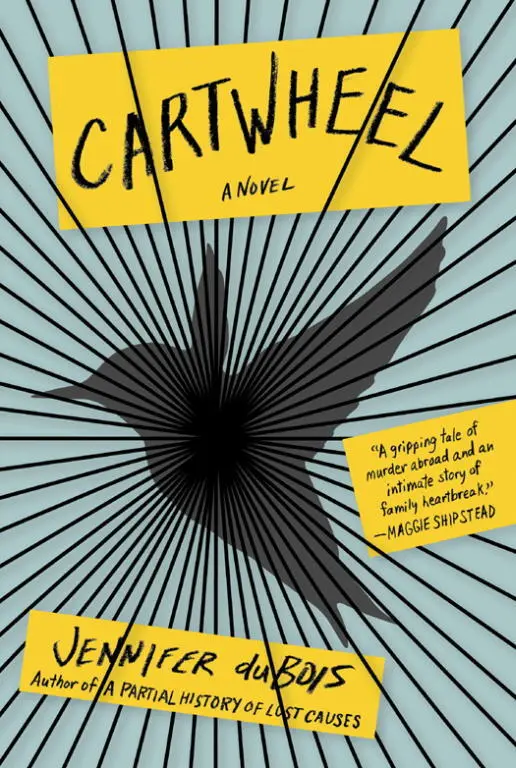
- Название:Cartwheel
- Автор:
- Издательство:Random House
- Жанр:
- Год:2013
- Город:New York
- ISBN:9780812995879
- Рейтинг книги:3 / 5. Голосов: 1
-
Избранное:Добавить в избранное
- Отзывы:
-
Ваша оценка:
Cartwheel: краткое содержание, описание и аннотация
Предлагаем к чтению аннотацию, описание, краткое содержание или предисловие (зависит от того, что написал сам автор книги «Cartwheel»). Если вы не нашли необходимую информацию о книге — напишите в комментариях, мы постараемся отыскать её.
is a suspenseful and haunting novel of an American foreign exchange student arrested for murder, and a father trying to hold his family together. Cartwheel When Lily Hayes arrives in Buenos Aires for her semester abroad, she is enchanted by everything she encounters: the colorful buildings, the street food, the handsome, elusive man next door. Her studious roommate Katy is a bit of a bore, but Lily didn’t come to Argentina to hang out with other Americans.
Five weeks later, Katy is found brutally murdered in their shared home, and Lily is the prime suspect. But who is Lily Hayes? It depends on who’s asking. As the case takes shape—revealing deceptions, secrets, and suspicious DNA—Lily appears alternately sinister and guileless through the eyes of those around her: the media, her family, the man who loves her and the man who seeks her conviction. With mordant wit and keen emotional insight,
offers a prismatic investigation of the ways we decide what to see—and to believe—in one another and ourselves.
In
, duBois delivers a novel of propulsive psychological suspense and rare moral nuance. No two readers will agree who Lily is and what happened to her roommate.
will keep you guessing until the final page, and its questions about how well we really know ourselves will linger well beyond.
Starred Review
A
Pick for Biggest Books of the Fall • A Pick for
’ Most Anticipated Books of 2013
From
“A tabloid tragedy elevated to high art.”
—
“[A] compelling, carefully crafted, and, most importantly, satisfying novel.”
—
Lily Hayes, 21, is a study-abroad student in Buenos Aires. Her life seems fairly unexceptional until her roommate, Katy, is brutally murdered, and Lily, charged with the crime, is remanded to prison pending her trial. But is she guilty, and who is Lily, really? To find answers to these questions, the novel is told from multiple points of view—not only that of Lily but also that of her family; of sardonic Sebastien, the boy with whom she has been having an affair; and of the prosecutor in the case. In the process, it raises even more questions. What possible motive could Lily have had? Why, left momentarily alone after her first interrogation, did she turn a cartwheel? And has she, as her sister asserts, always been weird? In her skillful examination of these matters, the author does an excellent job of creating and maintaining a pervasive feeling of foreboding and suspense.
Sometimes bleak, duBois’ ambitious second novel is an acute psychological study of character that rises to the level of the philosophical, specifically the existential. In this it may not be for every reader, but fans of character-driven literary fiction will welcome its challenges. Though inspired by the Amanda Knox case,
is very much its own individual work of the author’s creative imagination. —Michael Cart
Cartwheel — читать онлайн бесплатно полную книгу (весь текст) целиком
Ниже представлен текст книги, разбитый по страницам. Система сохранения места последней прочитанной страницы, позволяет с удобством читать онлайн бесплатно книгу «Cartwheel», без необходимости каждый раз заново искать на чём Вы остановились. Поставьте закладку, и сможете в любой момент перейти на страницу, на которой закончили чтение.
Интервал:
Закладка:
“Patience, mi amor,” Maria would whisper, patting him fondly on the thigh. “She will say something soon.”
On Wednesday, Andrew took Anna out to Tigre, north of the city, to see the ocean.
“It’s not really the ocean,” Anna said, looking up from the pamphlet she was reading. She was sprawled over a handrail because there was only standing room on the train. Andrew was trying to ignore the public service signs above her head, obviously warning against malarial mosquitoes. They were both wearing splashily patterned shorts and flip-flops, packed in some fit of optimism or delusion he could not now fathom.
“It’s just a delta,” said Anna.
Andrew shrugged. “It will still be fun.”
When they were little, Lily and Anna had loved the sea. Andrew and Maureen had usually taken them in the summers—going early to beat the heat, piling into the car with Cokes wilting in the back, sometimes getting there before the sun had even burned off the dew, while the fog still rolled in like tulle. Andrew would read The Economist while the girls buried and unburied him. Sometimes they’d go in the winter, when the weeds were scraggly and the snow stretched out like sand and the water was a dimpled sterling. Andrew and Maureen would fill a thermos with hot cocoa and get the girls comically bundled in brand-new pastel snowsuits. When she was pregnant with Lily, Maureen had wanted to keep some of Janie’s things for the next baby. But Andrew could not abide the thought of seeing another toddler in Janie’s clothes—it felt too nightmarish to contemplate—and so Maureen had conceded the point, because in those days there’d actually been a very simple rule about who conceded what: Whenever there was a way for one of them to ease the other’s pain in any way, they did. And so the new snowsuits had been bought, along with the new diaper bags and the new toddler shoes and a new arsenal of stuffed dogs and bears. Andrew had repainted the nursery. The Beatrix Potter décor was changed to Winnie-the-Pooh.
“What about it is going to be fun, exactly?” said Anna.
“We’ll rent a canoe,” said Andrew. In the pamphlet, Tigre was brimming with nuclear families paddling happily in red kayaks. It was strange to Andrew that other people came to this country for vacation. “We’ll ride on a boat. Don’t you still like boats?”
The train stopped and the doors opened. Anna was backlit by sun and Andrew had to squint to see her. “Tomorrow,” she said. “I want to go with you to meet with the lawyers.”
Tomorrow, Andrew and Maureen would be meeting the lawyers to discuss the DNA findings. Lily’s DNA, it seemed, had appeared on Katy’s mouth—which was not surprising, considering her CPR attempt—as well as on the murder weapon—which was actually not surprising, either, considering the murder weapon was a kitchen knife belonging to the Carrizos. Lily’s DNA had also appeared, a bit oddly, on one of Katy’s bras. Reassuringly, most of the DNA collected near Katy’s body was from someone else. All Andrew knew about this person was that he was a man, and already in the system, both of which facts were suspicious, and thus encouraging. After hanging up the phone, Maureen had stared at Andrew emptily and said, “Well, you might as well take Anna somewhere, since there’s nothing else we can do today.” He’d been glad for the chance. In the days since Maureen had arrived, Anna had moved mostly into Maureen’s hotel room, and the two of them had spent their evenings together, whispering and watching telenovelas and, Andrew realized once when he picked them up for breakfast, drinking their way through the minibar. This made Andrew feel strangely frustrated; it wasn’t that Andrew was the bad cop and Maureen was the good one, it was just that Maureen was both. Andrew could no more let Anna drink something out of the minibar than he could stop her from doing so, right in front of him, if she decided she wanted to. The fact that she didn’t was, he understood, a courtesy that she extended to him—like still calling him “Dad” and Maureen “Mom,” when Lily had long ago begun addressing them by their first names.
“It’s going to be boring, sweetie,” said Andrew, ushering Anna out of the train and into the depot, which smelled oppressively of pastries. All around were kiosks selling gum and soda and tabloids. Andrew tried hard not to look at the headlines.
“Boring?” said Anna. “Are you kidding me?”
“Excuse me, do you speak English?” A worried-looking couple with a map was standing in front of them.
“No,” said Andrew, hurrying Anna out of the depot. Outside, the sky was blazingly blue, the palm trees obnoxious.
“Dad, what the hell are you doing? They were just trying to ask directions.”
“Well, we can’t exactly give them directions, can we? Now, will you look at this?” Andrew gestured grandly. Before them, beer-colored delta water lapped desultorily against the hulls of rental boats. Nearby, a man was giving a bikinied woman a piggyback ride. Andrew could not understand what would impel an adult woman to allow herself to be carried like that. The entire town seemed to smell of coconut sun-block and Quilmes. Andrew could hear the woman’s thighs slapping against the man’s back.
“Dad,” said Anna. “I’m trying to talk to you.”
“Listen, sweetie—oh, shit.” A mosquito was buzzing menacingly close to Anna; Andrew bent to swat it away from her leg—which was denuded and well moisturized, he noticed: How did she possibly have the energy to keep shaving her legs?—and then stood back up. “It’s going to be a big conversation.”
“I know it’s a big conversation,” said Anna. “That’s exactly why I want to be there.” Another mosquito veered brazenly toward her other leg, and Andrew waved that one away, too—though this, he saw, was perhaps a lost cause. He couldn’t really protect Anna from malaria, or a lingering death, or an interminable unjust detention. But it had to be better to keep pretending that he could.
“Dad,” said Anna, “you have to stop that.”
Andrew stood. Across the street, he could see, was a little stand selling ice creams and Cokes. “Do you want an ice cream?”
“Jesus Christ, Dad. You’re trying to ply me with ice cream? I’m not nine.”
“Anna, I’m sorry. You can’t go to the meeting. They only want to talk to me and your mom, anyway.” This was not technically true. Andrew marched Anna across the street to the ice cream stand. “Uno helado, por favor,” he said to the vendor, smiling brightly.
“What flavor?”
“Um. Chocolate, please.”
“Why don’t you want me there, Dad?” said Anna. “Seriously. Tell me. Do you think you’re going to hear something you don’t want to in that conversation?”
“Well, of course we will.” Andrew lowered his voice. He wished he didn’t have to know that the ice cream vendor spoke English. “It’s a gruesome thing that’s happened, and we’re going to hear all about it. And it’s happened to a girl only a few years older than you. Which is part of why it’s not a good idea for you to come along. This trip is upsetting enough for you already.” Andrew rifled in his pocket for change.
“I know all that, Dad,” said Anna. “That’s not what I’m wondering.”
“What then?” Andrew handed her the ice cream and was relieved when she took it.
“I’m wondering if there’s something else we might hear that we don’t want to.” Anna sounded careful, and Andrew wondered fleetingly, uncomprehendingly, if she was talking about Lily’s sex life.
“I don’t know, sweetie,” he said. He saw now that it was a mistake to have brought Anna here. It was too much; she was too young; her just-begun life with all of its own rich dramas and disappointments was being put completely on hold, and for what? “But please don’t worry.” He pulled Anna to him, and she allowed this, barely, holding her ice cream away from her body with exaggerated awkwardness. Andrew could never get over how tall Anna was, how substantial and lanky; her body had grown into its own authoritative spin on his genetics, like she was the product of some kind of unholy tinkering with recombinant DNA. The possibility that a child of his could grow to nearly his height, could one day live to outlive him, was nearly as unthinkable as the fact that such a creature could ever die. It was possible, Andrew realized with terror, that he needed Anna here. She had, after all, already done more for Lily than he, or anyone else, had been able to. But none of that was any excuse to let her stay.
Читать дальшеИнтервал:
Закладка:
Похожие книги на «Cartwheel»
Представляем Вашему вниманию похожие книги на «Cartwheel» списком для выбора. Мы отобрали схожую по названию и смыслу литературу в надежде предоставить читателям больше вариантов отыскать новые, интересные, ещё непрочитанные произведения.












Обсуждение, отзывы о книге «Cartwheel» и просто собственные мнения читателей. Оставьте ваши комментарии, напишите, что Вы думаете о произведении, его смысле или главных героях. Укажите что конкретно понравилось, а что нет, и почему Вы так считаете.