Jennifer DuBois - Cartwheel
Здесь есть возможность читать онлайн «Jennifer DuBois - Cartwheel» весь текст электронной книги совершенно бесплатно (целиком полную версию без сокращений). В некоторых случаях можно слушать аудио, скачать через торрент в формате fb2 и присутствует краткое содержание. Город: New York, Год выпуска: 2013, ISBN: 2013, Издательство: Random House, Жанр: Современная проза, Триллер, на английском языке. Описание произведения, (предисловие) а так же отзывы посетителей доступны на портале библиотеки ЛибКат.
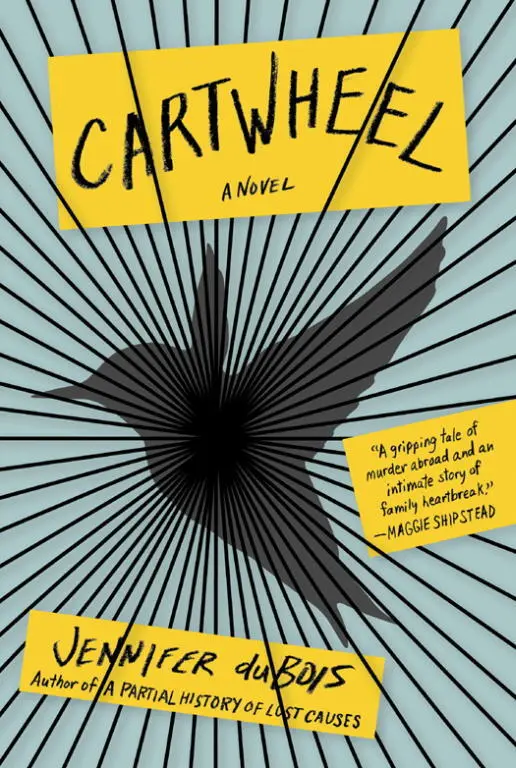
- Название:Cartwheel
- Автор:
- Издательство:Random House
- Жанр:
- Год:2013
- Город:New York
- ISBN:9780812995879
- Рейтинг книги:3 / 5. Голосов: 1
-
Избранное:Добавить в избранное
- Отзывы:
-
Ваша оценка:
Cartwheel: краткое содержание, описание и аннотация
Предлагаем к чтению аннотацию, описание, краткое содержание или предисловие (зависит от того, что написал сам автор книги «Cartwheel»). Если вы не нашли необходимую информацию о книге — напишите в комментариях, мы постараемся отыскать её.
is a suspenseful and haunting novel of an American foreign exchange student arrested for murder, and a father trying to hold his family together. Cartwheel When Lily Hayes arrives in Buenos Aires for her semester abroad, she is enchanted by everything she encounters: the colorful buildings, the street food, the handsome, elusive man next door. Her studious roommate Katy is a bit of a bore, but Lily didn’t come to Argentina to hang out with other Americans.
Five weeks later, Katy is found brutally murdered in their shared home, and Lily is the prime suspect. But who is Lily Hayes? It depends on who’s asking. As the case takes shape—revealing deceptions, secrets, and suspicious DNA—Lily appears alternately sinister and guileless through the eyes of those around her: the media, her family, the man who loves her and the man who seeks her conviction. With mordant wit and keen emotional insight,
offers a prismatic investigation of the ways we decide what to see—and to believe—in one another and ourselves.
In
, duBois delivers a novel of propulsive psychological suspense and rare moral nuance. No two readers will agree who Lily is and what happened to her roommate.
will keep you guessing until the final page, and its questions about how well we really know ourselves will linger well beyond.
Starred Review
A
Pick for Biggest Books of the Fall • A Pick for
’ Most Anticipated Books of 2013
From
“A tabloid tragedy elevated to high art.”
—
“[A] compelling, carefully crafted, and, most importantly, satisfying novel.”
—
Lily Hayes, 21, is a study-abroad student in Buenos Aires. Her life seems fairly unexceptional until her roommate, Katy, is brutally murdered, and Lily, charged with the crime, is remanded to prison pending her trial. But is she guilty, and who is Lily, really? To find answers to these questions, the novel is told from multiple points of view—not only that of Lily but also that of her family; of sardonic Sebastien, the boy with whom she has been having an affair; and of the prosecutor in the case. In the process, it raises even more questions. What possible motive could Lily have had? Why, left momentarily alone after her first interrogation, did she turn a cartwheel? And has she, as her sister asserts, always been weird? In her skillful examination of these matters, the author does an excellent job of creating and maintaining a pervasive feeling of foreboding and suspense.
Sometimes bleak, duBois’ ambitious second novel is an acute psychological study of character that rises to the level of the philosophical, specifically the existential. In this it may not be for every reader, but fans of character-driven literary fiction will welcome its challenges. Though inspired by the Amanda Knox case,
is very much its own individual work of the author’s creative imagination. —Michael Cart
Cartwheel — читать онлайн бесплатно полную книгу (весь текст) целиком
Ниже представлен текст книги, разбитый по страницам. Система сохранения места последней прочитанной страницы, позволяет с удобством читать онлайн бесплатно книгу «Cartwheel», без необходимости каждый раз заново искать на чём Вы остановились. Поставьте закладку, и сможете в любой момент перейти на страницу, на которой закончили чтение.
Интервал:
Закладка:
Again and again, the tapes ended; again and again, Eduardo climbed into bed next to Maria. It was her return, he knew, that had enabled him to see the truth in Lily—that had given him the courage to keep looking until he saw it—without being blinded by the wrong stories or paralyzed by their repetition. The television people were obsessed with Lily Hayes, as well as entirely convinced of her guilt. But it had become clear to Eduardo over the weeks that they were convinced for all the wrong reasons; their certainty might be correct, but it was essentially reactionary, unearned. The world did not know Lily like he did. Stills from the security footage were paraded alongside pictures from Lily’s own camera, and the TV was forever running images that were widely thought the worst: There was Lily at the church, her bosom spilling wildly; and there she was mid-kiss with Sebastien on the day of Katy’s death; and there she was in front of a condom display, her eyebrow raised into a bemused isosceles triangle, only a few hours later. Those photos were bad, of course. But, Eduardo thought, they were not as bad as the others, the ones that didn’t feature Lily herself—the woman with the blood blister, the small naked boy. That’s where the real Lily Hayes was—not as a subject of the photographs, but as their merciless off-stage director. It was too bad, Eduardo often thought, that the TV didn’t run those photos. But expecting the media to realize their significance would be like expecting a dog to look where you were pointing, instead of at your finger.
Whatever the quality of the world’s certainty, Eduardo still liked to imagine delivering the justice that it wanted—this was, of course, only human. And he knew that if Maria hadn’t returned to him, he could have drowned in the potential consequences of success, as well as the potential costs of failure. It was true that Eduardo had failed before. Not often, but occasionally—once quite notably, when an accused murderer and rapist, fully prosecuted in the media, had been let off because a junior policeman had behaved cavalierly with the crime scene semen. This had not been enough to disqualify the case in and of itself, but the fervor—the “zealotry,” a stern TV commentator had said—with which the DNA had been collected had meant that the most important piece of evidence had been disallowed in court. Eduardo’s arguments were worth nothing then. After the verdict, he had walked out of the courtroom and into a cluster of journalists punching away on their obnoxious little BlackBerrys, which they’d all managed to buy before the shortage. Eduardo had been all over town looking for one—to Movistar in Palermo, to Claro in Recoleta—but to no avail, and so he had to walk all the way back to the office to begin sending the necessary apologetic emails.
And if Maria had not returned to him, Eduardo could imagine losing himself now under the weight of his fears, the shadow corollaries of his each and every hope. If she had never left him, in fact—if Eduardo had never known the pain of that loss—things could be even worse than that: He might have become consumed with worldly ambition, the wish to have this success propel him solidly into the professional realm he deserved to inhabit—the realm she deserved to have him inhabit—so that their lives might thrum, at last, to some sort of hazy, satisfying conclusion. But losing Maria and then getting her back again had given Eduardo a deeper vision of loss, just as Dostoyevsky’s mock executioners must have given him—as he rose, shaking, to find himself still alive—a keener understanding of the resurrection. Eduardo was wiser now, and he was able to look, and listen, and be ready for whatever he might learn.
All day? You thought she was asleep all day?
I was asleep .
Eduardo’s certainty was no longer growing. But it was moving. It was shifting from his cerebellum to his gut: His hair pricked now when he heard Lily’s voice on the tapes. He did not yet know how the killing had transpired, exactly, or what strange combination of drugs and lust had fueled it. But now—when he looked at pictures of Lily’s oddly faraway expression, that strange flatness around her eyes—he was beginning to understand, more viscerally than he ever had before, that she really had done the thing he was saying she had.
You were asleep, or you thought she was asleep?
I don’t know. Both .
You were simultaneously asleep and under the impression that Katy was asleep?
Their conversations threaded around so much that Eduardo would sometimes grow confused by their redundancies, their repetitions, their minor adjustments in syntax; he’d feel himself getting lost in the sifting of relevant and irrelevant changes.
And then you attempted CPR .
Yes .
Had you ever performed CPR before?
No .
Had you ever taken a class on how to perform CPR?
No .
So tell me again exactly what you were trying to do?
And yet Eduardo persisted, letting Lily’s voice echo within him as he got ready in the mornings—staring into the chrome mirror with one eye closed, shaving incipient whiskers off his chin. Every day Eduardo looked the same, and yet there was a part of him that believed he was watching himself grow better, and that one day all of this virtue would suddenly reveal itself somehow.
Tell me about Sebastien LeCompte .
I have told you everything I know .
Remind me .
Literally everything. I have told you things I don’t even know .
You’ve told me things you don’t know?
Because you made me guess .
You’ve lied to me, you’re saying .
No!
Eduardo knew he should never be grateful for his work, since having work to do meant that evil had been done, and that suffering had occurred. And so he tried not to think of this new momentum as a kind of happiness, though of course that’s what it was.
You didn’t like Katy. There’s no crime in that .
I did like Katy .
You didn’t .
And even if I hadn’t—
Even if you hadn’t, what?
The truth would emerge, like secrets rising out of the sea, like fossils stepping out of their clay, like everything that makes us understand our world and, at long last, ourselves.
But you were nice to Katy, nonetheless .
Yes .
Nonetheless what?
What?
You just said you were nice to Katy nonetheless .
You said that .
In every moment, Eduardo was tiptoeing into the bedroom; in every moment, Maria was putting down her book in a hurry. She was fiercely private about what she read for reasons she would never discuss. Eduardo had learned long ago that Maria’s secrecy could hurt him if he let it, and that ignoring this secrecy was his only armor, inadequate though it was.
“What does she say?” Maria would ask, putting down her delicate gold-chained bifocals, hiding her book underneath the sheets. Her toenails were buffed to opaline; her skin was nearly translucent. In the light of the reading lamp, she seemed to glow from within.
“I can’t tell you that,” Eduardo would say.
“She isn’t saying anything. I can tell.”
“She’s not saying anything she hasn’t said already. I’m listening to tapes.”
But this wasn’t entirely true. Lily may not have said anything new, but Maria had taught Eduardo to listen to her anew—and upon reflection, he had realized that the most damning thing that Lily had said in the interviews was not something that either of them had even realized was damning at the time. Argentina had always felt like a dream, she’d said. Nothing that had happened to her there had ever seemed totally real. And the night she killed Katy, Eduardo now saw, must have seemed the least real thing of all—merely the part of the dream that curdles into nightmare in the final dark moments of the night. It must have seemed as bad as that, and nothing worse. It was Maria who had taught Eduardo to see this; it was Maria who had taught him to look beyond the signifier to the signified. He would tell her some of these things one day. He would thank her for them.
Читать дальшеИнтервал:
Закладка:
Похожие книги на «Cartwheel»
Представляем Вашему вниманию похожие книги на «Cartwheel» списком для выбора. Мы отобрали схожую по названию и смыслу литературу в надежде предоставить читателям больше вариантов отыскать новые, интересные, ещё непрочитанные произведения.












Обсуждение, отзывы о книге «Cartwheel» и просто собственные мнения читателей. Оставьте ваши комментарии, напишите, что Вы думаете о произведении, его смысле или главных героях. Укажите что конкретно понравилось, а что нет, и почему Вы так считаете.