Jennifer DuBois - Cartwheel
Здесь есть возможность читать онлайн «Jennifer DuBois - Cartwheel» весь текст электронной книги совершенно бесплатно (целиком полную версию без сокращений). В некоторых случаях можно слушать аудио, скачать через торрент в формате fb2 и присутствует краткое содержание. Город: New York, Год выпуска: 2013, ISBN: 2013, Издательство: Random House, Жанр: Современная проза, Триллер, на английском языке. Описание произведения, (предисловие) а так же отзывы посетителей доступны на портале библиотеки ЛибКат.
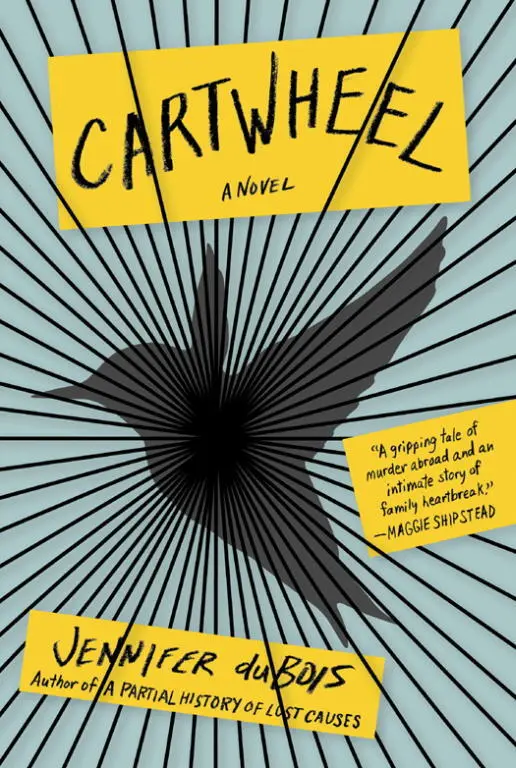
- Название:Cartwheel
- Автор:
- Издательство:Random House
- Жанр:
- Год:2013
- Город:New York
- ISBN:9780812995879
- Рейтинг книги:3 / 5. Голосов: 1
-
Избранное:Добавить в избранное
- Отзывы:
-
Ваша оценка:
Cartwheel: краткое содержание, описание и аннотация
Предлагаем к чтению аннотацию, описание, краткое содержание или предисловие (зависит от того, что написал сам автор книги «Cartwheel»). Если вы не нашли необходимую информацию о книге — напишите в комментариях, мы постараемся отыскать её.
is a suspenseful and haunting novel of an American foreign exchange student arrested for murder, and a father trying to hold his family together. Cartwheel When Lily Hayes arrives in Buenos Aires for her semester abroad, she is enchanted by everything she encounters: the colorful buildings, the street food, the handsome, elusive man next door. Her studious roommate Katy is a bit of a bore, but Lily didn’t come to Argentina to hang out with other Americans.
Five weeks later, Katy is found brutally murdered in their shared home, and Lily is the prime suspect. But who is Lily Hayes? It depends on who’s asking. As the case takes shape—revealing deceptions, secrets, and suspicious DNA—Lily appears alternately sinister and guileless through the eyes of those around her: the media, her family, the man who loves her and the man who seeks her conviction. With mordant wit and keen emotional insight,
offers a prismatic investigation of the ways we decide what to see—and to believe—in one another and ourselves.
In
, duBois delivers a novel of propulsive psychological suspense and rare moral nuance. No two readers will agree who Lily is and what happened to her roommate.
will keep you guessing until the final page, and its questions about how well we really know ourselves will linger well beyond.
Starred Review
A
Pick for Biggest Books of the Fall • A Pick for
’ Most Anticipated Books of 2013
From
“A tabloid tragedy elevated to high art.”
—
“[A] compelling, carefully crafted, and, most importantly, satisfying novel.”
—
Lily Hayes, 21, is a study-abroad student in Buenos Aires. Her life seems fairly unexceptional until her roommate, Katy, is brutally murdered, and Lily, charged with the crime, is remanded to prison pending her trial. But is she guilty, and who is Lily, really? To find answers to these questions, the novel is told from multiple points of view—not only that of Lily but also that of her family; of sardonic Sebastien, the boy with whom she has been having an affair; and of the prosecutor in the case. In the process, it raises even more questions. What possible motive could Lily have had? Why, left momentarily alone after her first interrogation, did she turn a cartwheel? And has she, as her sister asserts, always been weird? In her skillful examination of these matters, the author does an excellent job of creating and maintaining a pervasive feeling of foreboding and suspense.
Sometimes bleak, duBois’ ambitious second novel is an acute psychological study of character that rises to the level of the philosophical, specifically the existential. In this it may not be for every reader, but fans of character-driven literary fiction will welcome its challenges. Though inspired by the Amanda Knox case,
is very much its own individual work of the author’s creative imagination. —Michael Cart
Cartwheel — читать онлайн бесплатно полную книгу (весь текст) целиком
Ниже представлен текст книги, разбитый по страницам. Система сохранения места последней прочитанной страницы, позволяет с удобством читать онлайн бесплатно книгу «Cartwheel», без необходимости каждый раз заново искать на чём Вы остановились. Поставьте закладку, и сможете в любой момент перейти на страницу, на которой закончили чтение.
Интервал:
Закладка:
“What?” he said.
“Go find a stick,” she said severely. “Make sure it’s a good one.”
Sebastien gave her a baleful look and walked off into the woods. Lily ran off into some scrubby weeds and found a twig. She ran back, breathless. Her hands were dirty. This was friendship; this was the stuff of memory and future nostalgia. They reconvened on the bridge.
“Okay,” she said, peering into the water. Below them, the river was roiling obsidian; the reflection cast by the moon was shaky and insubstantial. “Let go.”
They let go. Lily grabbed Sebastien and pulled him to the other side. A stick emerged a moment later, and then another. “I can’t tell which is which,” said Lily. She was laughing a bit more buoyantly than she ordinarily might. This was her little impulsive adventure, after all, and she knew she had to make it feel as though they were having joyful and terrifically arbitrary fun. In the modern world, this was usually the girl’s job. She’d seen enough movies to know.
“It’s mine,” said Sebastien. “I’d recognize it anywhere. Mine won.”
“You cheated!” said Lily. She hit him. She’d been planning on accusing him of cheating all along, no matter what happened.
“You let me win!” he said.
Lily spanked him playfully and then grabbed his hands and pulled him to the ground. She was trying to be a spritely elf of high spirits and curiosity. She was trying to be a person who might cause trouble sometimes—but only because she was so lively and nonconformist, only because she was so special, and not because she ever meant any harm.
Lily strung her fingers through Sebastien’s. They lay in the grass for a long time and Sebastien told her many things about the constellations. And although Lily knew for a fact that at least some of the things he was saying were wrong, she decided to pretend that she did not.
That night, lying in bed—after taking off her shoes in the entrance, carefully picking her way across the linoleum, and closing the door to the basement with the most exquisitely gentle of clicks—Lily could not sleep. Within her, a tremendous sea of unease was twisting into a cyclone; the dreamy magic of the evening was over, and she was left with a stark and uncomfortable fact: Beatriz hated her. Beatriz hated her. And not just for things she did, but for things she had not done. Katy managed to fly below the radar, and why was that? Was it only because her face was so pretty, and so pretty in such a sweet way? Was it because she never ventured an opinion at dinner? Or was there something she was actually doing right, something that Lily could actually learn from? Was it true that Katy was somehow paying more attention?
Lily sat bolt upright. “How did you know they were being sued?” she said.
It was possible that Katy was asleep—it was late, the lights were out, and Katy had not spoken when Lily had entered and climbed the ladder to the top bunk, her toes painfully monkeying around one rung and then the next—but somehow, Lily did not think so: The room vibrated with some other awareness, and Lily suddenly felt sure that Katy had been waiting for her.
There was silence. Lily felt the minor heave of Katy rolling over. “Sebastien told me,” she said at last.
At this, Lily nearly bonked her head on the ceiling. “Sebastien told you? How?”
“I went over there to ask him.”
Lily lay back down. Her heart was pounding. She tried to keep her voice steady and light. “I didn’t know you guys were friends.”
Lily could feel Katy shrug. “We’re not, really.”
Not really friends, as Lily well knew, could mean any number of things. It could mean enemies, or frenemies, or fuck buddies, or fuck frenemies, or any countless variations thereof. It would be far too horrid to ask for clarification, of course, so Lily did not. “I thought you couldn’t stand him,” she said instead.
“Well, I said we weren’t really friends. And anyway, no, I can totally stand him.”
A realization was opening up in Lily, a knowledge of galactic vastness and obviousness. Of course. She thought of the way Katy always steered the conversation toward Sebastien—who really cared that much about some other girl’s sex life? She remembered the night after that first dinner, when Sebastien and Katy had stood on the porch together—Sebastien looking flustered, Katy smoking a cigarette (who would have thought?). Lily had seen them from the basement bathroom window, though she hadn’t cared enough to really think about it at the time. But she saw now that Sebastien had probably preferred Katy from the start and had settled for Lily only as a consolation prize. And perhaps the two of them had had some ongoing whatever—attraction or flirtation or fling—its exact nature did not really matter; it did not really change anything. Sebastien might even really love Lily, for all she knew, with a sort of diffuse, redirected, anonymous love. That’s how most boys were, in her experience; they could love with real tenderness, but their love was almost always aimed at a woman’s most generic qualities—her sweetness or softness or relative beauty, her archetypal feminine characteristics, whatever Freudian maternal shadows she cast—and so it was fungible, nonspecific. Empty, finally, even if it was technically real. Just look at Harold and the accounting major! Lily had been wise to practice a strategy of passive resistance, of conscientious objection, throughout that entire relationship. Boys were all the same, even Sebastien, who had seemed so promisingly weird. All he really wanted was a woman (any woman!) who was sweet and reasonable and attractive. And Katy was all of these things—she was, in fact, more of these things—than Lily would ever be.
“Anyway, he may not be my favorite person in the world,” Katy was saying. “But it’s very obvious he’s totally nuts about you.”
To this, Lily said nothing. She rolled over. She stared at the ceiling for a long while. She did not sleep. And this time, she was positively sure that Katy was not sleeping, either.
CHAPTER TEN
March
On Wednesday, the DNA results came in.
As Eduardo had expected, there was nothing of Sebastien LeCompte anywhere in the house. As Eduardo had also expected, there was nothing of Javier Aguirre, the nightclub owner whom Lily had named. What was more, Aguirre had supplied an ironclad alibi—a night at a strip club, complete with security footage you did not want to see and bookended by ATM withdrawals. The DNA that was all over the crime scene—in the semen in Katy’s body, in the spots of blood on the carpet, in the contents of the astonishingly unflushed toilet bowl—derived from a man named Ignacio Toledo, who’d been a sometime bartender at Fuego and had apparently not shown up to work since Katy was killed.
Toledo had been arrested twice before—once for possessing paco cocaine and once for vandalizing a car, though what he’d really been trying to do, no doubt, was steal it. He’d testified against his friends both times and had spent eighteen months in Villa Concepción for the second conviction. He didn’t have a history of violence, at least not that the state had noted, but that did not matter. We all create our histories as we live them; every killer had once lived many years as an innocent. And if there were two great democratizers of violence, in Eduardo’s experience, they were prison time and paco cocaine.
As Eduardo had further expected, there were also several substantial signs of Lily Hayes at the scene of the crime—on Katy’s mouth (the defense would try to explain this via the improbable CPR), on one of Katy’s bras (Eduardo couldn’t quite imagine what they would come up with for that one), and, most incriminatingly, on the knife. Eduardo knew what the defense would say about that: It was a kitchen knife, after all, to which the whole household had had access. In the interviews Eduardo had conducted, neither Beatriz nor Carlos Carrizo could summon a single memory of Lily cooking anything, ever; furthermore, Lily herself had never once mentioned cooking in Eduardo’s previous conversations with her, during which he’d established an extensive accounting of all the usual aspects of her daily life. Still, the panel would likely find it perfectly plausible that Lily might have handled the kitchen knife at some point during her stay with the Carrizos—and really, who could be perfectly sure that she had not? In the end, in fact, it was the bra clasp that was murkier—and in some ways, more important. Here was an object that Lily should have had no occasion to handle, and here was proof that she had.
Читать дальшеИнтервал:
Закладка:
Похожие книги на «Cartwheel»
Представляем Вашему вниманию похожие книги на «Cartwheel» списком для выбора. Мы отобрали схожую по названию и смыслу литературу в надежде предоставить читателям больше вариантов отыскать новые, интересные, ещё непрочитанные произведения.











Обсуждение, отзывы о книге «Cartwheel» и просто собственные мнения читателей. Оставьте ваши комментарии, напишите, что Вы думаете о произведении, его смысле или главных героях. Укажите что конкретно понравилось, а что нет, и почему Вы так считаете.