Jennifer DuBois - Cartwheel
Здесь есть возможность читать онлайн «Jennifer DuBois - Cartwheel» весь текст электронной книги совершенно бесплатно (целиком полную версию без сокращений). В некоторых случаях можно слушать аудио, скачать через торрент в формате fb2 и присутствует краткое содержание. Город: New York, Год выпуска: 2013, ISBN: 2013, Издательство: Random House, Жанр: Современная проза, Триллер, на английском языке. Описание произведения, (предисловие) а так же отзывы посетителей доступны на портале библиотеки ЛибКат.
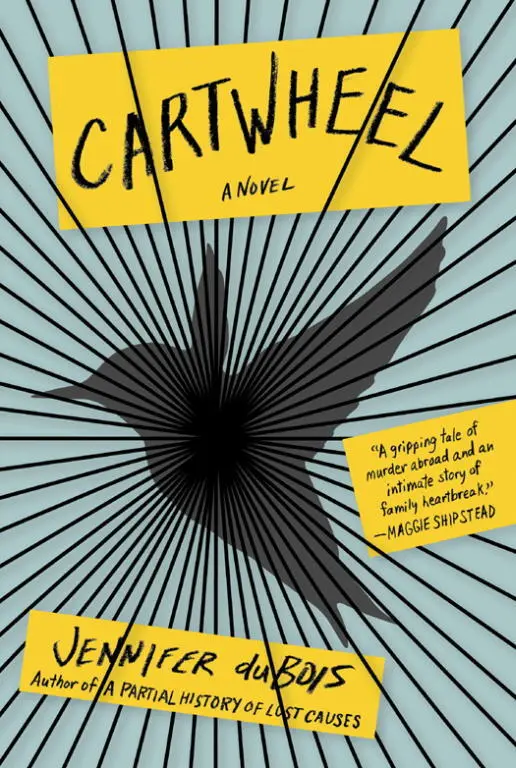
- Название:Cartwheel
- Автор:
- Издательство:Random House
- Жанр:
- Год:2013
- Город:New York
- ISBN:9780812995879
- Рейтинг книги:3 / 5. Голосов: 1
-
Избранное:Добавить в избранное
- Отзывы:
-
Ваша оценка:
Cartwheel: краткое содержание, описание и аннотация
Предлагаем к чтению аннотацию, описание, краткое содержание или предисловие (зависит от того, что написал сам автор книги «Cartwheel»). Если вы не нашли необходимую информацию о книге — напишите в комментариях, мы постараемся отыскать её.
is a suspenseful and haunting novel of an American foreign exchange student arrested for murder, and a father trying to hold his family together. Cartwheel When Lily Hayes arrives in Buenos Aires for her semester abroad, she is enchanted by everything she encounters: the colorful buildings, the street food, the handsome, elusive man next door. Her studious roommate Katy is a bit of a bore, but Lily didn’t come to Argentina to hang out with other Americans.
Five weeks later, Katy is found brutally murdered in their shared home, and Lily is the prime suspect. But who is Lily Hayes? It depends on who’s asking. As the case takes shape—revealing deceptions, secrets, and suspicious DNA—Lily appears alternately sinister and guileless through the eyes of those around her: the media, her family, the man who loves her and the man who seeks her conviction. With mordant wit and keen emotional insight,
offers a prismatic investigation of the ways we decide what to see—and to believe—in one another and ourselves.
In
, duBois delivers a novel of propulsive psychological suspense and rare moral nuance. No two readers will agree who Lily is and what happened to her roommate.
will keep you guessing until the final page, and its questions about how well we really know ourselves will linger well beyond.
Starred Review
A
Pick for Biggest Books of the Fall • A Pick for
’ Most Anticipated Books of 2013
From
“A tabloid tragedy elevated to high art.”
—
“[A] compelling, carefully crafted, and, most importantly, satisfying novel.”
—
Lily Hayes, 21, is a study-abroad student in Buenos Aires. Her life seems fairly unexceptional until her roommate, Katy, is brutally murdered, and Lily, charged with the crime, is remanded to prison pending her trial. But is she guilty, and who is Lily, really? To find answers to these questions, the novel is told from multiple points of view—not only that of Lily but also that of her family; of sardonic Sebastien, the boy with whom she has been having an affair; and of the prosecutor in the case. In the process, it raises even more questions. What possible motive could Lily have had? Why, left momentarily alone after her first interrogation, did she turn a cartwheel? And has she, as her sister asserts, always been weird? In her skillful examination of these matters, the author does an excellent job of creating and maintaining a pervasive feeling of foreboding and suspense.
Sometimes bleak, duBois’ ambitious second novel is an acute psychological study of character that rises to the level of the philosophical, specifically the existential. In this it may not be for every reader, but fans of character-driven literary fiction will welcome its challenges. Though inspired by the Amanda Knox case,
is very much its own individual work of the author’s creative imagination. —Michael Cart
Cartwheel — читать онлайн бесплатно полную книгу (весь текст) целиком
Ниже представлен текст книги, разбитый по страницам. Система сохранения места последней прочитанной страницы, позволяет с удобством читать онлайн бесплатно книгу «Cartwheel», без необходимости каждый раз заново искать на чём Вы остановились. Поставьте закладку, и сможете в любой момент перейти на страницу, на которой закончили чтение.
Интервал:
Закладка:
“Why did you tell us that Javier Aguirre did this?” Eduardo asked Lily. She was flanked by her two lawyers, who had been hired days ago by the Hayes family but only recently become cognizant, it seemed, of their client’s ongoing propensity for unsupervised chats with the prosecution. Eduardo knew both of them slightly: Velazquez, whose bald head gleamed so forcefully it looked spackled, and Ojeda, who was so fat that you had the sense that, if you were very, very quiet, you might actually be able to hear him getting fatter. Ojeda was good at his job—he was brilliant and ruthless and clinically efficient—and he deployed his fat, Eduardo was sure, as a method of getting people to underestimate his capabilities. Eduardo couldn’t help but feel a grim admiration for this tactic, as well as a certain affinity with it. Velazquez and Ojeda would forbid Lily, of course, from speaking with Eduardo in any more conversations pertaining to her role as a defendant. But her mention of Javier Aguirre as a possible suspect meant that any hypothetical prosecution of him would mean Eduardo’s calling Lily as one of his own witnesses, and even Lily’s lawyers could not stop him from speaking with her about that.
“I didn’t,” said Lily.
“You could be charged with slander, you know. There could be a civil case.”
“I didn’t tell you that he did it.”
“Do you want me to read you the transcript?”
“You forced me to say someone!”
Eduardo pretzeled his face into an expression of bewilderment. “How did I force you? Were you threatened? Were you in any manner physically coerced?”
Lily looked down. Her unwashed hair made heavy curtains around her face; behind it, her eyes were quartzitic and glittering. She did not answer.
Eduardo leaned forward. “Why, Lily? Why did you name Javier? Did you have problems with Javier? Problems at work?”
Lily shook her head. “I never had a problem with Javier.”
“He did fire you, though.”
“For the party, yes.”
“I’ve heard you were having problems before that.”
Lily bolted upright. “Who said that?” she said. It would have been touching were it not so perverse: She actually still cared about how her job performance had been perceived.
“You dropped things, I understand. Your drawer came up short.”
“I was new!”
“You gave us this name, Javier Aguirre, and that has led us down the wrong track.”
“I didn’t mean to.”
“But we’ve been on the right track all along, haven’t we, Lily?”
“All right,” said Velazquez, standing up. “That’s enough of this.”
At night, Eduardo listened to the recordings of his interviews with Lily, hoping to hear something new. It seemed to him that time had forked lately, that his life was running on parallel tracks. In every moment there was Maria: her smooth back, the aquiline sweep of her nose, the perfect and enduring certainty of her sleep. And in every moment, simultaneously, there was Lily; fragments of Eduardo’s conversations with her coursed through his consciousness likes tides.
You slept all day, you’re saying? And you didn’t think it was odd that Katy didn’t appear? Not even once? You didn’t think to look for her?
I did look for her. Jesus Christ. I found her!
Again and again, Eduardo listened. Again he pressed play, and again he was walking into the jail, his dress shoes squeaking against the floors, the sense of obdurate underlying filth everywhere made more potent by the astringent smell of cleanser all around him. In every moment, it seemed, he was staring at those same taupe walls, the light through the high windows above them alternately gray and dull or yolky and rapturous, depending on the time of day. In every moment, it seemed, he was standing underneath the enormous PROHIBIDO FUMAR sign, wishing he could have a cigarette, his head growing marginally lighter with either fury or discouragement or settled, piercing clarity.
But you didn’t think to look for her earlier .
I thought she was asleep .
On the tapes, Lily’s voice had a slight elusive lisp that Eduardo had never noticed in real life. And the tapes had other, less trivial secrets to reveal. Slowly, Lily’s connection to Ignacio Toledo was taking shape in Eduardo’s mind. At first, Ignacio Toledo did not seem to fit into Lily’s life. But once you looked closer—once you knew Lily Hayes like Eduardo did—you saw that, in fact, he did.
Most important, perhaps, he was the opposite of Sebastien LeCompte. Sebastien LeCompte was handsome, for a particular taste, as well as wealthy beyond imagining. But he was also, by all accounts, impossible: sphinxlike, maddeningly detached, forever circling around life and speech, both, in half-ironic, riddle-filled whirlpools. What better rebellion for someone like Lily than a night with a man who was none of these things—a man who was uncomplicatedly masculine, straightforwardly working class? This was the girl, after all, who’d taken photos of a pantsless boy, a deformed woman: a girl on a quest for authentic Argentinean grotesqueries, things she could do and see so that later she could tell about having seen and done them. Next to Sebastien LeCompte, Ignacio Toledo would seem completely real and more than a little dangerous.
Lily would not have known how dangerous, of course, when their night began. But then, she would begin the night not knowing how dangerous she herself could be. And so the evening would begin with a minor cruelty: her rage at the breakup with Sebastien and his involvement with Katy would lacquer over her smaller rage at being fired from Fuego, and she would go there to find Ignacio Toledo, the one person with whom she could exact revenge on everyone—Sebastien and Katy, Javier, even Beatriz Carrizo (who would surely have blanched at the thought of such a man in her house for tea, let alone for homicide)—all at once. It was masterfully efficient, really, even if Lily had not been entirely aware of what was impelling her moves that night, as Eduardo presumed she had not been—her motives were massed within the mammoth blue iceberg of her subconscious, looming undetected below the blind, white fragment of her thoughts. And so Lily would go to the club as it was closing, perhaps not quite knowing why, but feeling reckless and competent and bold. You look upset, Ignacio Toledo might say to her, and offer her a drink on the house. I’m not supposed to be here, she might say. He would raise his eyebrow and press a finger to his lips and say, I won’t tell.
From then on they would be coconspirators—first in a second drink, maybe, and then a third. Afterward they would leave the club, and at some point Toledo would produce the paco—and although Lily did not take it (her drug tests revealed only marijuana), its nearness would give her a proxy shot of adrenaline, a mutinous thrill at witnessing something so much closer to real subversion than whatever was voguish among the high-achieving white children of Vermont. Eventually Ignacio Toledo would propose some plan for the evening, and Lily would agree to it. She probably hadn’t known him well—that much was probably true. But she’d wanted to have an adventure; she’d wanted to go out and explore the dark corners of the city. And, at this point in the evening, Ignacio Toledo probably still felt like something of a chaperone.
Eduardo did not doubt that they had not planned to kill Katy. The unflushed toilet alone made this clear. But they’d gone back to the house—drunk and high and wanting something from Katy that she would not give, or perhaps trying to give something to her that she would not take: drugs or sex or money (hers or, perhaps, the Carrizos’) or some combination thereof. And perhaps Katy had threatened to call the Carrizos, or perhaps the cops, and suddenly Lily—her aggression deformed by drugs, her inhibitions shattered by alcohol—felt all of her resentments surge forth into a rage. This violence was not inevitable for her; she was not a person who would have killed somebody eventually anyway, no matter what course her life took. But she had always been a person who could have killed somebody—as, in Eduardo’s experience, a terrifying number of people were. It was this potential, ultimately, that she’d brought to the crime. Ignacio Toledo brought the drugs, the criminal history—maybe even the idea, the initial spark of brutality that set that whole room ablaze. But Lily had brought the template: the latent sociopathy, the entitlement. And, in the end, she’d brought the opportunity. After all, she had provided the house—there was no sign of a break-in—and, in doing so, she had provided Katy.
Читать дальшеИнтервал:
Закладка:
Похожие книги на «Cartwheel»
Представляем Вашему вниманию похожие книги на «Cartwheel» списком для выбора. Мы отобрали схожую по названию и смыслу литературу в надежде предоставить читателям больше вариантов отыскать новые, интересные, ещё непрочитанные произведения.












Обсуждение, отзывы о книге «Cartwheel» и просто собственные мнения читателей. Оставьте ваши комментарии, напишите, что Вы думаете о произведении, его смысле или главных героях. Укажите что конкретно понравилось, а что нет, и почему Вы так считаете.