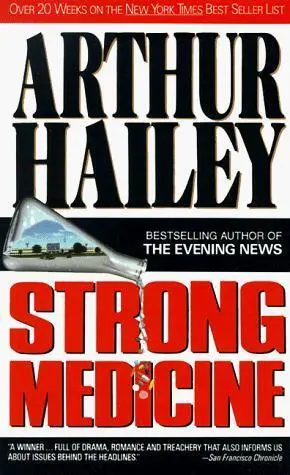
Arthur Hailey - Strong Medicine
Здесь есть возможность читать онлайн «Arthur Hailey - Strong Medicine» весь текст электронной книги совершенно бесплатно (целиком полную версию без сокращений). В некоторых случаях можно слушать аудио, скачать через торрент в формате fb2 и присутствует краткое содержание. Жанр: Современная проза, на английском языке. Описание произведения, (предисловие) а так же отзывы посетителей доступны на портале библиотеки ЛибКат.
- Название:Strong Medicine
- Автор:
- Жанр:
- Год:неизвестен
- ISBN:нет данных
- Рейтинг книги:5 / 5. Голосов: 1
-
Избранное:Добавить в избранное
- Отзывы:
-
Ваша оценка:
Strong Medicine: краткое содержание, описание и аннотация
Предлагаем к чтению аннотацию, описание, краткое содержание или предисловие (зависит от того, что написал сам автор книги «Strong Medicine»). Если вы не нашли необходимую информацию о книге — напишите в комментариях, мы постараемся отыскать её.
Strong Medicine — читать онлайн бесплатно полную книгу (весь текст) целиком
Ниже представлен текст книги, разбитый по страницам. Система сохранения места последней прочитанной страницы, позволяет с удобством читать онлайн бесплатно книгу «Strong Medicine», без необходимости каждый раз заново искать на чём Вы остановились. Поставьте закладку, и сможете в любой момент перейти на страницу, на которой закончили чтение.
Интервал:
Закладка:
Yvonne jumped up and threw her arms around him, "Oh, my love, you're wonderful, and the idea is so exciting. This has to be the best thing that ever happened to me.”
"Well," he said, "since you mention it, I've been feeling the same way about you.”
At Felding-Roth, New Jersey, the mood of mild euphoria which developed soon after Celia's rejoining the company did not last long. The animal-raid news from Britain, reported by Martin PeatSmith, first shattered it. Then, closer to home, a sudden, dramatic tragedy cast an overhanging pall of gloom. It was an accident-at least, "accident" was how the Boonton police eventually classified it-and it happened on a workday, three weeks exactly after Celia's return. A few minutes before 9a.m, Celia's chauffeured company car brought her to the catwalk level of the Felding-Roth parking garage, near the entrance to the glassed-in ramp that led to the main office building. Celia's driver had pulled in close to the ramp, on the left, because-as he told it later-he had observed in his rear-view mirror, while at street level, Mr. Hawthorne's Rolls-Bentley a short distance behind. Knowing that the company president would be driving to his normal parking slot, which was against an outer wall and to the right of where Celia's car had stopped, the driver left access to it clear. Celia did not see Sam's car until she got out of her own, with the chauffeur holding the door open. At that time she saw first the distinctive hood cresting the top of the ramp from the parking floor below, then the rest of the car as it reached the catwalk level. Expecting to walk with Sam across to the executive elevator, as on other days, Celia paused while the handsome automobile-for many years Sam's pride and joy-moved forward at a safe, slow speed. Then it happened. With a sudden roar from the powerful Rolls-Royce engine, accompanied by a screech of tires, the heavy car shot forward, attaining high speed instantly as no lesser vehicle ever could. It passed Celia and her driver in a blur of silver-gray, went through the parking slot assigned to Sam, and without stopping smashed into the wall directly ahead. The shoulder-high wall, open at the top, was the only separation between the parking floor and the outside air, with the ground some fifty feet below. With a reverberating crash, the wall crumbled and the car went through it, disappearing. Immediately after, and for what seemed to Celia the longest time, there was a silence. Then from below, and out of sight, came a heavy thud, and a tortured rending of metal and a shattering of glass. The chauffeur raced to the ragged opening in the wall, and Celia's first impulse was to follow him. She curbed it. Instead, thinking quickly, she got back inside her car, which had a mobile telephone, and used it to call police emergency. She gave the address and asked for police officers, a fire truck, and an ambulance to be sent to the scene urgently. Then, making a second call to Felding-Roth's switchboard, she instructed that any medical doctors available-the company employed several-were to hurry to the west side ground level of the parking garage. Only after that did Celia go to the gaping hole through which Sam's car had crashed, and look downward. What she saw horrified her. The once-handsome automobile was upside down and totally wrecked. Clearly, it had fallen first on its front end which, from the force of impact after the fifty-foot fall, had been thrust back into the main body of the car. The concertinaed whole had then rolled over onto the roof, which collapsed too. Smoke was rising from the wreckage, though it had not caught fire. A twisted wheel was spinning crazily. Fortunately, where the car had fallen was part of a vacant lot. No one had been below. There was nothing to damage but some shrubs and grass. Several people were now running toward the demolished vehicle, and Celia could hear approaching sirens. It seemed impossible, however, that anyone inside what was left of the Rolls-Bentley could have survived. And that was how it was. It took more than an hour to pry Sam's body loose, a grisly task over which the fire department rescue squad did not hurry since a doctor, reaching inside, had confirmed the obvious-Sam was dead. Celia, taking charge, had telephoned Lilian, breaking the news as gently as she could, though urging Lilian not to go to the scene. "If you like," Celia volunteered, "I'll come over now.”
There was a silence, then Lilian said, "No. Let me stay here for a while. I need to be alone.”
Her voice sounded remote and disembodied, as if coming from another planet. She had suffered already and now would suffer more. What women have to bear, Celia thought. Lilian said, "After a while I'll go to Sam. You'll let me know where he's been taken, Celia?" "Yes. And I'll either come to get you or meet you there.”
"Thank you.”
Celia attempted to phone Juliet, then Juliet's husband, Dwight, but could not reach either. Next she summoned Julian Hammond, the public affairs vice president, to her office and instructed, "Issue a press statement immediately about Sam's death. Describe it as a tragic accident. I want the word 'accident' stressed, to head off other speculation. You might say something about the probability that his accelerator jammed, causing the car to go out of control.”
Hammond protested, "No one will believe that.”
Wanting to weep, controlling her emotions by a thread, Celia snapped, "Don't argue! Do it the way I say. And now.” The last service she would do for Sam, she thought as Hammond left, was-if she could-to save him the indignity of being labeled a suicide. But to those closest to him, suicide it plainly was. What seemed most likely was that Sam, finally overwhelmed by his burden of despair and guilt about Montayne, had seen the parking garage wall ahead, thought suddenly of a way to end his life, and floored the accelerator pedal, steering for the relatively fragile wall. It would be typical of Sam, his friends said privately, to have remembered the vacant lot below and therefore the absence of danger to anyone else. Celia had some questions and guilt feelings of her own. Had Sam, she wondered, contemplated on previous occasions doing what he did, but allowed sanity to prevail? Then, seeing Celia that day as his car topped the ramp--Celia confident and in control, wielding authority which would have remained his had circumstances not reversed their roles so drastically-had Sam then... ? She could not bring herself to complete the question, the answer to which she would never know. One other thought kept coming back to her: The occasion in Sam's office, the first day of Celia's return, when he had said, “.
...there's something else. Something you don't know.” And a moment later, "I'll never tell you.” What was Sam's other secret? Celia tried to guess, but failed. Whatever it was must have died with him. At the family's request, Sam's funeral was private. Celia was the only company representative. Andrew accompanied her. Seated on an uncomfortable folding chair in an undertaker's chapel, while an unctuous clergyman who had not known Sam intoned religious platitudes, Celia tried to blot out the present and recall the richer past. Twenty-two years ago-Sam hiring her as a detail woman... Sam at her wedding... Her selection of him as the one to follow on the company ladder... At the New York sales meeting, risking hisjob in her defense- "I'm standing up here to be counted. If we let Mrs. Jordan leave this way, we're all shortsighted fools"... Sam, overcoming opposition, placing her on the fast track... promoting her to 0-T-C, later to Latin-American Director.- "International is where the future is.”
....Sam, on his own promotion and his two secretaries.- "I think they dictate letters to each other.”
....Sam the Anglophile, who was farseeing about a British research institute: "Celia, I want you as my right hand.”
Читать дальшеИнтервал:
Закладка:
Похожие книги на «Strong Medicine»
Представляем Вашему вниманию похожие книги на «Strong Medicine» списком для выбора. Мы отобрали схожую по названию и смыслу литературу в надежде предоставить читателям больше вариантов отыскать новые, интересные, ещё непрочитанные произведения.







Обсуждение, отзывы о книге «Strong Medicine» и просто собственные мнения читателей. Оставьте ваши комментарии, напишите, что Вы думаете о произведении, его смысле или главных героях. Укажите что конкретно понравилось, а что нет, и почему Вы так считаете.