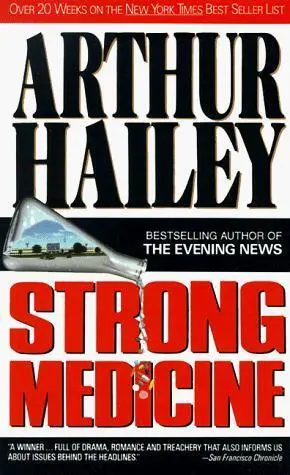
Arthur Hailey - Strong Medicine
Здесь есть возможность читать онлайн «Arthur Hailey - Strong Medicine» весь текст электронной книги совершенно бесплатно (целиком полную версию без сокращений). В некоторых случаях можно слушать аудио, скачать через торрент в формате fb2 и присутствует краткое содержание. Жанр: Современная проза, на английском языке. Описание произведения, (предисловие) а так же отзывы посетителей доступны на портале библиотеки ЛибКат.
- Название:Strong Medicine
- Автор:
- Жанр:
- Год:неизвестен
- ISBN:нет данных
- Рейтинг книги:5 / 5. Голосов: 1
-
Избранное:Добавить в избранное
- Отзывы:
-
Ваша оценка:
Strong Medicine: краткое содержание, описание и аннотация
Предлагаем к чтению аннотацию, описание, краткое содержание или предисловие (зависит от того, что написал сам автор книги «Strong Medicine»). Если вы не нашли необходимую информацию о книге — напишите в комментариях, мы постараемся отыскать её.
Strong Medicine — читать онлайн бесплатно полную книгу (весь текст) целиком
Ниже представлен текст книги, разбитый по страницам. Система сохранения места последней прочитанной страницы, позволяет с удобством читать онлайн бесплатно книгу «Strong Medicine», без необходимости каждый раз заново искать на чём Вы остановились. Поставьте закладку, и сможете в любой момент перейти на страницу, на которой закончили чтение.
Интервал:
Закладка:
"How do you know?" he asked. "I just do.”
Another touted candidate, Lady Amanda Knatchbull, found more favor.”She could be okay," Yvonne conceded.”But if only Charles will be patient, I'm sure someone else will come along who's more right for him, even perfect.”
"He's probably worrying himself, so why not write and tell him?" Martin suggested. As if she hadn't heard, Yvonne declared thoughtfully and with a touch of poetry, "What he needs is an English rose.”
One night after Yvonne and Martin had made love, he teased her, "Were you pretending I was the Prince of Wales?" She answered mischievously, "How did you know?" Despite her penchant for chitchat, Yvonne was no birdbrain, Martin discovered. She showed interest in other things, including the theory behind the mental aging project, which Martin patiently explained and which she seemed to understand. She was curious about his devotion to the writings of John Locke, and several times he found her with an open copy of Locke's Essay, her forehead creased in concentration. "It isn't easy to understand," Yvonne admitted. "No, not for anyone," he said.”You have to work at it.”
As to their liaison and possible gossip, Martin was sure that some was circulating-Harlow was too small a place for that not to happen. But at the research institute he and Yvonne were discreet, never communicating with each other unless their work required it. Apart from that, Martin took the view that his private life was his own affair. He had given no thought as to how long the relationship between himself and Yvonne would continue, but from their casual remarks it was clear that neither saw it as demanding, or more than temporary - An enthusiasm they shared was the progress of the Harlow research. As Martin wrote in one of his rare reports to New Jersey: "The structure of Peptide 7 is now known. The gene has been made, inserted into bacteria, and large amounts have been prepared.”
The process, he noted, was "much like the preparation of human insulin.”
At the same time, tests for Peptide Ts safety and effectiveness continued via injections into animals. A vast amount of animal data was accumulating, to the point where permission for human trials would be sought within the next few months. Perhaps inevitably, rumors about the institute's research leaked out and reached the press. Though Mar-tin declined requests to give interviews, arguing that anything printed would be premature, reporters found other sources and newspaper accounts appeared anyway. On the whole they were accurate. Speculation about a "wonder drug to delay growing old, now being tried on animals" was given prominence, as well as "the drug's remarkable weight-reducing effect.”
All of this aroused Martin's anger because clearly someone on the scientific staff had been indiscreet. On Martin's instruction, Nigel Bentley attempted to find out who had talked, but without success. "Actually," the administrator pointed out, "the publicity hasn't done much harm, if any. The scientific world already has a good idea of what you're doing-remember those two consultants you had in. And titillating the public now could help sales of Peptide 7 later on.”
Martin was unconvinced, but let the matter drop, One unwelcome effect of the publicity was a flood of letters, pamphlets and petitions from "animal-rights" crusaders--extremists who objected to experiments of any kind on animals. Some described Martin and his Harlow staff as "sadists," "torturers," "barbarians" and "heartless criminals.”
As Martin told Yvonne after reading samples of the more vituperative mail at home, "All countries have their anti-experimentation kooks, but Britain is the worst.”
He picked up another letter, then put it down in disgust.”These people don't just want animal suffering kept to a minimum-which I'm in favor of, and I believe in laws to enforce it. But they want our kind of science, which has to use animals, to come to a screeching halt.”
Yvonne asked, "Do you think there'll be a time when research won't need animals at all?" "Someday perhaps, yes. Even now, in places where we used to use animals we're using methods like tissue cultures, quantum pharmacology, and computers instead. But doing without animals entirely...”
Martin shook his head.”It could happen, but not for a long time.”
"Well, don't let it get to you.”
Yvonne collected the protest letters and stuffed them back into a briefcase.”Besides, think of our animals. Because of Peptide 7, they're healthier and smarter.,, But her words failed to change Martin's mood. The recent mail influx had depressed him. Overall at the institute, however, the contrast to the early days of groping-when there was so little progress and only negative results-was so great that Martin confided to Rao Sastri, "I'm worried. When anything goes this well, a major setback can be just around the corner.”
His words proved prophetic-and sooner than expected. It was the following weekend---early Sunday morning, shortly after 1a.m. -when a telephone call awakened Martin. Yvonne was still asleep beside him. When Martin answered, the caller was Nigel Bentley. "I'm at the institute," the administrator said.”The police called me. I think you'd better come.”
"What's wrong?" "It's bad news, I'm afraid.”
Bentley's voice sounded grim.”But I'd rather you see for yourself Can you get here quickly?" "I'm on my way.”
By now, Yvonne was awake. As Martin began to throw on clothes, she hurriedly dressed too. They went together, in Martin's car. At the institute, other vehicles were outside, two of them police cars with blue lights flashing. A third flashing light was on a fire engine, just leaving. The institute's front doors were open. Bentley met them inside. A uniformed police inspector was with him. If Bentley was surprised to see Yvonne, he effectively concealed it. "We've been raided," he announced.”By animal lovers.”
Martin's brow creased.”Animal lovers?" "Actually, sir," the policeman said, "the people who did it call themselves the Animal Rescue Army. They've given us trouble before.”
The inspector, approaching middle age, had the resigned, sardonic manner of one who had watched many human follies and expected to see more. Martin said impatiently, "Did what? What's happened?" "They broke in," Bentley answered, "And then they released all the animals. Some are still loose in the building, but most were taken outside, the cages opened, and of course they're gone. Then they collected all the files and records they could find, carried them outside, and poured petrol on.”
"They started a fire, Doctor," the inspector said.”Someone in another building saw it and phoned in an alarm. When the fire brigade came and put it out is when we got here too. We were in time to catch two suspects, a woman and a man. The man's been in prison, he admits, for another similar offense.”
"The two the police caught are being held in my office," Bentley continued. "There seems to have been a gang of six. They overpowered our watchman and locked him in a cupboard. They also knew how to deactivate the burglar alarm.” "The whole operation was carefully planned," the police inspector said. "That's one of the hallmarks of these people.”
Martin scarcely heard. His eyes were on four rats which had scampered into a corner of the reception area and were huddled there. Now, frightened by voices, the rats ran through another open door. Martin followed, heading for the laboratories and animal rooms. Mess and confusion confronted him. Animal cages had either been removed or were open and empty. Loose-leaf reference books were gone. File drawers had been pulled out, some of their contents scattered on the floor. Many files were missing. Presumably they had been burned outside. Bentley, the inspector, and Yvonne had followed Martin. Yvonne murmured, "Oh, my God!" Martin, emotional, despairing, could only ask, "Why? Oh, why?" The inspector suggested, "Maybe you should put that question to the pair we've arrested, Doctor.”
Читать дальшеИнтервал:
Закладка:
Похожие книги на «Strong Medicine»
Представляем Вашему вниманию похожие книги на «Strong Medicine» списком для выбора. Мы отобрали схожую по названию и смыслу литературу в надежде предоставить читателям больше вариантов отыскать новые, интересные, ещё непрочитанные произведения.


Обсуждение, отзывы о книге «Strong Medicine» и просто собственные мнения читателей. Оставьте ваши комментарии, напишите, что Вы думаете о произведении, его смысле или главных героях. Укажите что конкретно понравилось, а что нет, и почему Вы так считаете.