Arthur Hailey - Evening News
Здесь есть возможность читать онлайн «Arthur Hailey - Evening News» весь текст электронной книги совершенно бесплатно (целиком полную версию без сокращений). В некоторых случаях можно слушать аудио, скачать через торрент в формате fb2 и присутствует краткое содержание. Жанр: Современная проза, на английском языке. Описание произведения, (предисловие) а так же отзывы посетителей доступны на портале библиотеки ЛибКат.
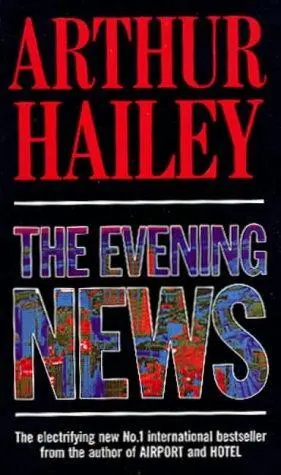
- Название:Evening News
- Автор:
- Жанр:
- Год:неизвестен
- ISBN:нет данных
- Рейтинг книги:3.5 / 5. Голосов: 2
-
Избранное:Добавить в избранное
- Отзывы:
-
Ваша оценка:
Evening News: краткое содержание, описание и аннотация
Предлагаем к чтению аннотацию, описание, краткое содержание или предисловие (зависит от того, что написал сам автор книги «Evening News»). Если вы не нашли необходимую информацию о книге — напишите в комментариях, мы постараемся отыскать её.
Evening News — читать онлайн бесплатно полную книгу (весь текст) целиком
Ниже представлен текст книги, разбитый по страницам. Система сохранения места последней прочитанной страницы, позволяет с удобством читать онлайн бесплатно книгу «Evening News», без необходимости каждый раз заново искать на чём Вы остановились. Поставьте закладку, и сможете в любой момент перейти на страницу, на которой закончили чтение.
Интервал:
Закладка:
In the early morning Miguel, who had slept only fitfully, watched TV news again. The Sloane kidnapping was still the top item, though there were no reports of new leads.
Soon after, Miguel informed Luis that at eleven o'clock the two of them would be driving into Manhattan in the hearse.
The hearse was the group's sixth vehicle, a Cadillac in good condition, bought second hand. So far they had only used it twice. The remainder of the time the hearse had stayed out of sight at the Hackensack house, where it was referred to by the others as el angel negro , the black angel. The vehicle's inside floor, where a casket normally rested, was of handsome rosewood; built-in rubber rollers ensured that a casket's passage would be smooth. Interior sides and roof were lined with dark blue velvet.
Miguel had originally planned to use the hearse only as a final means of transportation before the air journey to Peru, but now, clearly, it was their safest vehicle. The cars and the GMC truck had had too much exposure, especially during the Larchmont surveillance, and it was possible that descriptions of them had by this time been given to police and circulated.
* * *
The weather had changed to pouring rain, with fiercely blowing gusts, the sky a sullen gray.
With Luis driving, they took a circuitous route from Hackensack, several times changing direction and twice stopping to be sure they were not followed. Luis handled the hearse with extra care because of slick roads and poor forward visibility beyond the monotonously slapping windshield wipers. Having gone south on the New Jersey side of the Hudson River as far as Weehawken, they entered the Lincoln Tunnel and emerged in Manhattan at 11:45 A.M.
Both Miguel and Luis were wearing dark suits and ties, appropriate to their presence in a hearse.
After leaving the tunnel they headed east on Fortieth Street. The heavy rain made for bumper-to-bumper crosstown traffic and painfully slow progress. Miguel watched pedestrians moving slowly and uncomfortably on crowded sidewalks.
The paradox of riding through New York City in a hearse amused him. On one hand the vehicle was far too conspicuous for their purpose; on the other it commanded respect. At a previous intersection, a uniformed traffic agent—a "brownie,” as New Yorkers called them—had even stopped other vehicles and waved them by.
Miguel also noticed that many people who glanced at the hearse immediately looked away. He had observed the same thing before and wondered: Was it the reminder of death, the great oblivion, that disturbed them? He had never feared his own death, though he had no intention of making it easy for others to hasten its arrival.
But whatever the reason, it didn't matter. What did was that no one in the crowds around them was likely to consider that this particular hearse, so close that they could touch it, contained two of the most sought-after criminals in the country, perpetrators of a crime that was the nation's hottest news story. The thought intrigued Miguel. It was also reassuring.
They turned north onto Third Avenue, and a little short of Forty-fourth Street Luis pulled over to the curb and let Miguel out. Turning his collar up against the driving rain, Miguel walked the last two blocks east to United Nations headquarters. Despite his earlier thoughts about the hearse, arriving in it would court attention he didn't need. In the meantime Luis had instructions to keep moving and come back to the drop-off point in an hour. If Miguel did not appear, Luis would return every subsequent half hour.
On the corner of Forty-fourth, Miguel bought an umbrella from a street vendor but found it hard to handle in the wind. A few minutes later he crossed First Avenue to the white-fronted UN General Assembly Building. Because of the rain, the many flagpoles stood forlornly bare, bereft of flags. Passing an iron grille fence and the delegates' entrance, he ascended steps to a wide platform where visitors were admitted. Miguel, empty handed, was quickly cleared through a checkpoint inside where others were having their handbags and packages opened for inspection.
In the large hall beyond, benches were filled with waiting visitors, their faces and clothes as diverse as the UN itself. A Bolivian woman in a bowler hat sat stoically. Beside her a small black child played with a stuffed white lamb. Nearby sat an old, weathered man wearing Afghan-type headgear. Two bearded Israelis argued over papers spread between them. And interspersed throughout the crowd were white-skinned Americans and British tourists.
Ignoring those waiting, Miguel walked toward a prominent "Guided Tours” sign at the far end of the hall. Beside it, holding an attaché case, Jose Antonio Salaverry was waiting.
Just like a weasel, Miguel thought, as he took in Salaverry's narrow, pinched face, receding hair and thin mustache. The Peruvian diplomat, usually exuding self importance, today appeared ill at ease.
They exchanged the slightest of nods, then Salaverry led the way to an information desk where, with a delegate's authority, he signed Miguel in, using a bogus name. Miguel received a visitor's pass.
As the two walked down an avenue flanked by pillars, a garden was visible through glass panels, and beyond it the East River. An escalator took them upward to the next floor where they entered the Indonesian Lounge, available only to diplomats and guests.
The large, impressive room, where heads of state were entertained, contained magnificent art including the curtain of the Holy Kaabe entry to Mecca, a black tapestry inlaid with gold and silver and presented by the Saudis. A deep green carpet complemented white leather sofas and chairs, the furnishings ingeniously arranged so that several meetings could take place at once, with none intruding on another. Miguel and Salaverry seated themselves in a small private section. As they faced each other, Jose Antonio Salaverry's thin lips twisted with displeasure.”I warned you it was dangerous to come here! There is already enough risk without creating more.”
Miguel asked calmly, "Why is coming here a risk?” He needed to find out how much this weakling knew.
”You fool! You know why. The television, the newspapers, are full of what you have done, those people you have seized. The FBI, the police, are throwing everything into the search for you.” Salaverry swallowed, then asked anxiously, "When are you going—all of you getting out of the country?”
"Assuming what you say is true, why do you want to know? What difference does it make to you?”
"Because Helga is frantic with anxiety. So am I”
So the loose-tongued idiot had shared what he knew with his whoring woman banker. It meant that the original breach of security had widened and was now an imminent danger which had to be erased. Though Salaverry had no means of knowing, his foolish admission had sealed the fate of his woman and himself.
”Before I answer,” Miguel said, "give me the money.”
Salaverry manipulated a combination lock on his attache case. From the case he removed a bulging pressboard wallet tied with tape, and passed it over.
Miguel opened the wallet, surveyed the money inside, then retied the tape.
Salaverry asked petulantly, "Don't you want to count it?”
Miguel shrugged.”You would not dare cheat me.” He considered, then said with apparent casualness, "So you want to know when I and certain others will leave.”
"Yes, I do.”
"Where will you and the woman be tonight?”
"In my apartment. We are too upset to go out.”
Miguel had been to the apartment and remembered the address. He told Salaverry, "Stay there. I cannot telephone because of reasons which will become clear. Therefore a messenger will come to you tonight with the information you want. He will use the name Plato. When you hear that name, it is safe to let him in.”
Читать дальшеИнтервал:
Закладка:
Похожие книги на «Evening News»
Представляем Вашему вниманию похожие книги на «Evening News» списком для выбора. Мы отобрали схожую по названию и смыслу литературу в надежде предоставить читателям больше вариантов отыскать новые, интересные, ещё непрочитанные произведения.
Обсуждение, отзывы о книге «Evening News» и просто собственные мнения читателей. Оставьте ваши комментарии, напишите, что Вы думаете о произведении, его смысле или главных героях. Укажите что конкретно понравилось, а что нет, и почему Вы так считаете.