Arthur Hailey - Evening News
Здесь есть возможность читать онлайн «Arthur Hailey - Evening News» весь текст электронной книги совершенно бесплатно (целиком полную версию без сокращений). В некоторых случаях можно слушать аудио, скачать через торрент в формате fb2 и присутствует краткое содержание. Жанр: Современная проза, на английском языке. Описание произведения, (предисловие) а так же отзывы посетителей доступны на портале библиотеки ЛибКат.
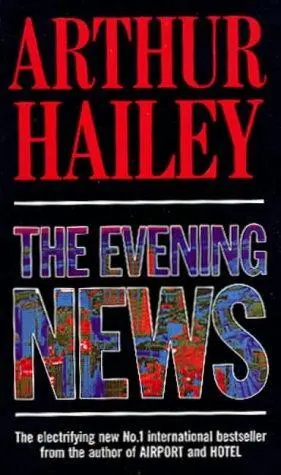
- Название:Evening News
- Автор:
- Жанр:
- Год:неизвестен
- ISBN:нет данных
- Рейтинг книги:3.5 / 5. Голосов: 2
-
Избранное:Добавить в избранное
- Отзывы:
-
Ваша оценка:
Evening News: краткое содержание, описание и аннотация
Предлагаем к чтению аннотацию, описание, краткое содержание или предисловие (зависит от того, что написал сам автор книги «Evening News»). Если вы не нашли необходимую информацию о книге — напишите в комментариях, мы постараемся отыскать её.
Evening News — читать онлайн бесплатно полную книгу (весь текст) целиком
Ниже представлен текст книги, разбитый по страницам. Система сохранения места последней прочитанной страницы, позволяет с удобством читать онлайн бесплатно книгу «Evening News», без необходимости каждый раз заново искать на чём Вы остановились. Поставьте закладку, и сможете в любой момент перейти на страницу, на которой закончили чтение.
Интервал:
Закладка:
Zileri, in his mid to late thirties, was good-looking and clean-cut, with a trim, athletic build. His attitude was guarded, but businesslike and direct. He told Partridge, "I understand you intend to pay a surprise visit to Nueva Esperanza, and that is all I need, or wish, to know.”
"That's fine,” Partridge said, "except we hope to have three more passengers flying back than we will have going out.”
"The airplane you are chartering is a Cheyenne II. There will be two pilots and room for seven passengers. How you fill those seven seats is your affair. Now, may we talk money?”
"Talk it with me,” Rita said.”What's your price?”
"You will pay in U.S. dollars?” Zileri queried.
Rita nodded.
”Then the regular price on each round trip will be one thousand four hundred dollars. If there is extra time at destination, required for circling, there will be an additional charge. As well, for each landing in the vicinity of Nueva Esperanza which is drug country controlled by Sendero Luminoso—there will be a special danger fee of five thousand dollars. Before we leave on Saturday, I would like a six-thousand-dollar cash deposit.”
"You'll have it,” Rita said, "and if you write all that out, making two copies, I'll sign, and keep one.”
"It will be done before you leave. Do you wish to know some details of my air service?”
"I suppose we should,” Partridge said politely.
With a touch of pride, Zileri recited an obviously standard spiel.”The Cheyenne II—we have three—is twin-engined and propeller-driven. It is a remarkably reliable aircraft and can land in a short space—important in the jungle. All our pilots, including myself, are American-trained. We know most regions, of Peru well, also the local flight controllers, civil and military, and they are used to us. Incidentally, on this flight I will be piloting you myself.”
"All that's fine,” Partridge acknowledged.”What we also need is some advice.”
"Fernandez has told me.” Zileri went to a chart table where a large-scale map of the southern portion of San Martin Province was spread open. The others joined him.
”I've assumed you will want to land sufficiently far 'from Nueva Esperanza so your arrival will not be noted.”
Partridge nodded.”Assumption right.”
"Then, on the outward journey from Lima, I recommend landing here.” With a pencil Zileri indicated a point on the map.
”Isn't that a roadway?”
"Yes, the main jungle highway, but there is little traffic, often none. But at several points like this one it's been widened and resurfaced by drug shippers so that planes can land. I've landed there before.”
Partridge wondered for what purpose. Conveying drugs, or people who dealt in them? He had heard there were few Peru air operators who were not involved with the drug trade, even if only in peripheral ways.
”Before we go in to land,” Zileri continued, "we will make sure the highway is not in use and there is no one on the ground. From that point a rough trail goes close to Nueva Esperanza.”
Fernandez interjected, "I have a good map where the trail is marked.”
"Now about your return with extra passengers,” Zjieri said.”Fernandez and I have discussed this and have a suggested plan.”
"Go ahead,” Partridge told him.
The discussion continued, decisions and salient facts emerging.
Three possible pickup points existed for the return journey. First, the bighway where the initial landing was intended. Second, Sion airstrip which, after 'leaving Nueva Esperanza, could be reached by river, plus a three-mile overland journey. Third, a very small landing strip, used by drug traffickers and known to few people, midway between the two; that, too, was reached mainly by river.
The reason for options was, as Fernandez explained, "We do not know what will happen at Nueva Esperanza, or which way will be clear, or best, for us to leave by.”
The airplane making the pickup could easily pass over all three places and respond to a signal from the ground. Partridge's group would carry a flare gun with green and red flares. A green flare would mean: Land normally, everything is clear,— a red flare: Land as quickly as possible, we are in danger!
If close—in rifle or machine—gun fire was observed from the air, it was agreed that the airplane would not land, but would return to Lima.
Since it was not known exactly when the return flight would be required, an airplane would be sent to fly over the area, first on Sunday morning at 8 A.m. and, failing any contact between ground and air, again on Monday at the same time. After that, any action would be decided by Rita who would remain in Lima during the expedition and in touch with New York, an arrangement Partridge considered essential.
At the end of operational planning, a contract was signed by Rita, on behalf of CBA News, and by Oswaldo Zileri, after which Zileri and the CBA trio formally shook hands. Looking at Partridge directly, the pilot said, "We shall keep our part of the agreement and do our best for you.”
Partridge had an instinct that he would.
* * *
After making the air arrangements, and returning to Cesar's Hotel, Partridge held a meeting in his suite with all. the CBA group members to decide who would make the Nueva Esperanza journey. Three definite selections were: Partridge; Minh Van Canh, since some visual record was essential; and Fernandez Pabur. Allowing for three extra passengers returning, this left a fourth place open.
The choice was between Bob Watson, the TV-video editor; the sound man, Ken O'Hara; or Tomis, the mostly silent bodyguard.
Fernandez favored Torads and had argued earlier, "He is strong and can fight.” Bob Watson, smoking one of his pungent cigars, urged, "Take me, Harry! In a brawl, I kin take care of myself. Found that out in Miami riots.” O’Hara simply said, "I want to go very much.”
In the end, Partridge chose O'Hara because he was a known quantity, had shown he could keep his head in a tense situation and was resourceful. Also, while they would not be carrying sound equipment—Minh would use a Betacam incorporating sound—Ken O'Hara had an instinctive way with anything mechanical, an asset that might prove useful.
Partridge left Fernandez to organize equipment and under his direction the items were accumulated in the hotel: lightweight hammocks, mosquito netting and repellent, dried foods sufficient for two days, filled water bottles, water sterilizing tablets, machetes, small compasses, binoculars, some plastic sheeting. Since each person would carry his own requirements, using a backpack, a balance was struck between necessity and weight.
Fernandez also urged that each carry a gun and Partridge agreed. It was a fact of TV life that correspondents and crews overseas sometimes went armed, though keeping weapons out of sight. Networks neither condoned nor discouraged the practice, leaving it to the judgment of people on the spot. In this case the need seemed overwhelming and was aided by the fact that all four who would be going had had experience with firearms at various points in their lives.
Partridge decided he would stay with his nine-millimeter Browning, with a silencer. He also had a Fearsum commando "killing”knife, given him by a major in the British SAS.
Minh, who would have camera equipment to carry as well as a weapon, wanted something powerful but light; Fernandez announced he could obtain an Israeli Uzi submachine gun. O'Hara said he would take whatever was available; it turned out to be a U.S. M-16 automatic rifle. Apparently any weaponry was purchasable in Lima, with no questions asked of those who had the money.
* * *
Since Wednesday, when he had learned that Nueva Esperanza was the target, Partridge had asked himself. Should he inform the Peruvian authorities, specifically the anti-terrorism police? On Thursday he had even gone back for advice to Sergio Hurtado, the radio broadcaster who had warned him not to seek help from the armed forces and police. During their meeting on Partridge's first day in Peru, Sergio had said: " Avoid them as allies because they have ceased to be trustworthy, if they ever were. When it comes to murder and mayhem, they are no better than Sendero and certainly as ruthless.”
Читать дальшеИнтервал:
Закладка:
Похожие книги на «Evening News»
Представляем Вашему вниманию похожие книги на «Evening News» списком для выбора. Мы отобрали схожую по названию и смыслу литературу в надежде предоставить читателям больше вариантов отыскать новые, интересные, ещё непрочитанные произведения.





Обсуждение, отзывы о книге «Evening News» и просто собственные мнения читателей. Оставьте ваши комментарии, напишите, что Вы думаете о произведении, его смысле или главных героях. Укажите что конкретно понравилось, а что нет, и почему Вы так считаете.