Arthur Hailey - Evening News
Здесь есть возможность читать онлайн «Arthur Hailey - Evening News» весь текст электронной книги совершенно бесплатно (целиком полную версию без сокращений). В некоторых случаях можно слушать аудио, скачать через торрент в формате fb2 и присутствует краткое содержание. Жанр: Современная проза, на английском языке. Описание произведения, (предисловие) а так же отзывы посетителей доступны на портале библиотеки ЛибКат.
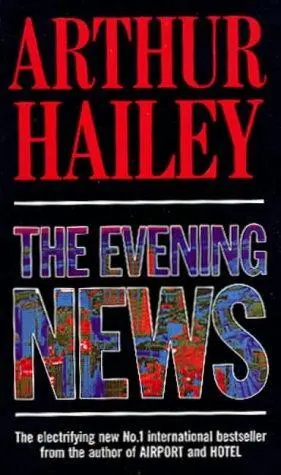
- Название:Evening News
- Автор:
- Жанр:
- Год:неизвестен
- ISBN:нет данных
- Рейтинг книги:3.5 / 5. Голосов: 2
-
Избранное:Добавить в избранное
- Отзывы:
-
Ваша оценка:
Evening News: краткое содержание, описание и аннотация
Предлагаем к чтению аннотацию, описание, краткое содержание или предисловие (зависит от того, что написал сам автор книги «Evening News»). Если вы не нашли необходимую информацию о книге — напишите в комментариях, мы постараемся отыскать её.
Evening News — читать онлайн бесплатно полную книгу (весь текст) целиком
Ниже представлен текст книги, разбитый по страницам. Система сохранения места последней прочитанной страницы, позволяет с удобством читать онлайн бесплатно книгу «Evening News», без необходимости каждый раз заново искать на чём Вы остановились. Поставьте закладку, и сможете в любой момент перейти на страницу, на которой закончили чтение.
Интервал:
Закладка:
CBA SAYS NO TO SLOANE KIDNAPPERS
Glen Dawson's by-line story began:
CBA will say an emphatic "No” to demands by the Sloane family's kidnappers that it cancel its televised National Evening News for a week, replacing it with propaganda videotapes supplied by the Peru Maoist rebel group Sendero Luminoso.
Sendero Luminoso, or Shining Path, has admitted holding the kidnap victims at a secret location in Peru.
Theodore Elliott, chairman and chief executive officer of Globanic Industries, the parent company of CBA, declared today, "What we're not going to do is let a bunch of crazy Commies push us around “
Speaking at Globanic's headquarters at Pleasantville, New York, he added, "As for running those Shining Path tapes, not a hope in hell.”
A Star reporter was present during the Elliott statement.
Alden Rhodes, Under Secretary of State for Economic Affairs, who was with Mr Elliott when the statement was made, declined to comment when questioned by the Star, though he did say, "I thought he wanted it kept confidential.“
An attempt late this morning to reach Mr. Elliott for additional information was unsuccessful
"Mr. Elliott is not available, "the Star was informed by Mrs. Diana Kessler, an assistant to the Globanic chairman. In response to questions, Mrs. Kessler insisted, "Mr. Elliott has no further comment.”
There was more—principally background and the history of the kidnap.
Even before the Baltimore Star hit the streets, the wire services had the story, giving credit to the Star Later that evening the Star was quoted on all network news broadcasts, including CBA's where the premature news was received with near-despair.
Next morning in Peru, where the kidnap story was already prominent in the news, newspapers, as well as radio and TV, featured the disclosure with special emphasis on Theodore Elliott's "bunch of crazy Commies"—'grupo de Comunistas locos "—description of Sendero Luminoso.
6
"I like Vicente,” Nicky said.”He's our friend.”
"I think he is too,” Angus called over from his cell. He was lying on the thin, soiled mattress of his makeshift bed and filling empty time by watching two large beetles on the wall.
”Then un -think, both of you!” Jessica snapped.”Liking anyone here is stupid and naive.”
She stopped, wanting to bite her tongue and call the words back. There was no need to have spoken sharply.
”I'm sorry,” she said.”I didn't mean that to come out the way it did.”
The trouble was that after fifteen days of close confinement in their tiny cages, the strain was telling on them all, wearing their spirits down. Jessica had done her best to keep morale, if not high, at least at a level above despair. She also made sure they all performed daily exercises, which she led. But clearly, despite best intentions, the close physical restriction, monotony and loneliness were having an inevitable effect.
Additionally, the greasy, unpalatable food was one more burden that sapped their physical resources.
Compounding those miseries, and despite their efforts to stay washed, they were usually dirty, odorous, and frequently sweating, with their soiled clothes sticking to them.
It was all very well, Jessica thought, to remind herself that her anti-terrorism course mentor, Brigadier Wade, had suffered a good deal more and for a longer period in his below-ground hellhole in Korea. But Cedric Wade was an exceptional, committed person serving his country in time of war. There was no war here to stiffen the mind or sinews. They were merely civilians caught in a petty skirmish . . . for what purpose? Jessica still didn't know.
Just the same, the thought of Brigadier Wade and Nicky's remark about liking Vicente, plus Angus's endorsement, reminded her of something she had learned from Wade. Now seemed a good time to bring it up.
Speaking softly while glancing warily at the guard on duty, she asked, "Angus and Nicky, have either of you heard of the Stockholm syndrome?”
"I think so,” Angus said.”Not sure, though.”
"Nicky?”
"No, Mom. What is it?”
The guard was the one who sometimes brought a comic book; he seemed engrossed in one now and indifferent to their talking. Jessica also knew he spoke no English.
”I'll tell you,” Jessica said.
In memory she could hear Brigadier Wade's voice informing the small study group of which she had been part, "One thing that happens in almost every terrorist hijack or kidnap situation is that after a while at least some of the hostages come to like the terrorists. Sometimes hostages go so far as to think of the terrorists as their friends and the police or troops outside, who are trying to rescue the hostages, as the enemy. That's the Stockholm syndrome.”
All of which was true, Jessica confirmed subsequently through additional reading. She had also been curious enough to go back and learn how the process got its label.
Now, dipping into memory and using her own words, she described the strange story while Nicky and Angus listened.
* * *
It happened in Stockholm, Sweden, on August 23, 1973.
That morning, at Norrmalmstorg, a central city square, an escaped convict. Jan-Erik Olsson, age thirty-two, entered Sveriges Kreditbanken, one of Stockholm's larger banks. From beneath a folded jacket Olsson produced a submachine gun which he fired into the ceiling, creating panic amid a shower of concrete and glass.
The ordeal that followed lasted six days.
In the course of it no one participating had any notion that for years and probably centuries to come, an outcropping of the experience they were sharing would become famous as the Stockholm syndrome—a medical and scientific phrase destined to be as familiar worldwide to students and practitioners as Cesarean section, anorexia, penis envy or Alzheimer's disease.
Three women and a man, all bank employees, were taken hostage by Olsson and an accomplice, Clark Olofsson, age twenty-six. The hostages were Birgitta Lundblad, thirty-one, a pretty blond; Kristin Ehnmark, twenty-three, spirited and black haired; Elisabeth Oldgren, twenty-one, small, fair and gentle; and Sven Sefstrom, twenty-five, a tall, slender bachelor. For most of the next six days this sextet was confined to a safe deposit vault from where the criminals presented their demands by telephone—for three million kronor in cash ($710,000), two pistols and a getaway car.
During the siege, the hostages suffered. They were forced to stand with ropes around their necks so that falling would strangle them. From time to time, as a machine gun was thrust into their ribs, they expected death. For fifty hours they were without food. Plastic wastebaskets became their only toilets. Within the vault, claustrophobia and fear were all-pervading.
Yet all the while a strange closeness between hostages and captors grew. There was a moment when Birgitta could have walked away but didn't. Kristin managed to give information to the police, then acknowledged, "I felt like a traitor.” The male hostage, Sven, described his captors as "kind. “Elisabeth agreed.
Stockholm's police, waging a war of attrition to free the prisoners, encountered hostility from them. Kristin said by telephone that she trusted the robbers, adding "I want you to let us go away with them . . . They have been very nice.”Of Olsson, she declared, "He is protecting us from the police.” When told " The police will not harm you, “Kristin replied, "I do not believe it “
It was revealed later that Kristin held hands with the younger criminal, Olsson. She told an investigator, "Clark gave me tenderness.”And after the hostages' release, while being taken by stretcher to an ambulance, Kristin called to Olsson, "Clark, I'll see you again.”
Читать дальшеИнтервал:
Закладка:
Похожие книги на «Evening News»
Представляем Вашему вниманию похожие книги на «Evening News» списком для выбора. Мы отобрали схожую по названию и смыслу литературу в надежде предоставить читателям больше вариантов отыскать новые, интересные, ещё непрочитанные произведения.










Обсуждение, отзывы о книге «Evening News» и просто собственные мнения читателей. Оставьте ваши комментарии, напишите, что Вы думаете о произведении, его смысле или главных героях. Укажите что конкретно понравилось, а что нет, и почему Вы так считаете.