Arthur Hailey - Evening News
Здесь есть возможность читать онлайн «Arthur Hailey - Evening News» весь текст электронной книги совершенно бесплатно (целиком полную версию без сокращений). В некоторых случаях можно слушать аудио, скачать через торрент в формате fb2 и присутствует краткое содержание. Жанр: Современная проза, на английском языке. Описание произведения, (предисловие) а так же отзывы посетителей доступны на портале библиотеки ЛибКат.
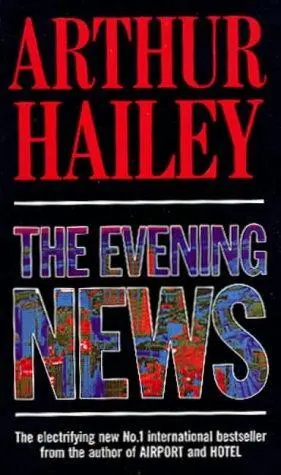
- Название:Evening News
- Автор:
- Жанр:
- Год:неизвестен
- ISBN:нет данных
- Рейтинг книги:3.5 / 5. Голосов: 2
-
Избранное:Добавить в избранное
- Отзывы:
-
Ваша оценка:
Evening News: краткое содержание, описание и аннотация
Предлагаем к чтению аннотацию, описание, краткое содержание или предисловие (зависит от того, что написал сам автор книги «Evening News»). Если вы не нашли необходимую информацию о книге — напишите в комментариях, мы постараемся отыскать её.
Evening News — читать онлайн бесплатно полную книгу (весь текст) целиком
Ниже представлен текст книги, разбитый по страницам. Система сохранения места последней прочитанной страницы, позволяет с удобством читать онлайн бесплатно книгу «Evening News», без необходимости каждый раз заново искать на чём Вы остановились. Поставьте закладку, и сможете в любой момент перейти на страницу, на которой закончили чтение.
Интервал:
Закладка:
Sleep came. When he awoke again the Lear was on final approach to Bogota.
2
The contrasts of Lima, Harry Partridge thought, were as stark and grimly apparent as the crises and conflicts, political and economic, that bitterly, often savagely, divided all Peru.
The immense, dry, sprawling capital city was split into several segments,, each displaying opulent wealth or squalid poverty, with hatreds like poisoned arrows speeding between the two extremes. Unlike most other cities he knew, there was seldom any middle ground. Grandiose homes surrounded by manicured gardens, all built on Lima's best land, adjoined hideous barriadas—slums jam—packed together—on the worst.
The multitude of "have-not” slum dwellers, many crowded into filthy cardboard shacks, was so visibly wretched, the anger looking out from sullen eyes so fierce, that during past visits to Peru, Partridge had had a sense of revolution in ferment. Now, from what he had already learned during his first day here, some form of insurrection seemed ready to explode.
Partridge, Minh Van Canh and Ken O'Hara had landed at Lima's Jorge Chivez Airport at 1:40 P.m. On disembarking they were met by Fernandez Pabur, CBA's regular stringer in Peru and—when required, as now—the network's fixer.
He had whisked them through Immigration and Customs ahead of others waiting—it seemed likely that at some point money had changed hands—and then escorted them to a Ford station wagon, with waiting driver.
Fernandez was heavyset, dark, swarthy and energetic, probably about thirty-five, with a protruding mouth and prominent white teeth which he flashed every few seconds in what he clearly hoped was a dazzling smile. In fact, being patently false, it wasn't—but Partridge didn't care. What he liked about Fernandez, whom he had used on other occasions, was that the fixer knew instinctively what was needed and got results.
The first result was a suite for Partridge in the elegant five star Cesar's Hotel in Miraflores, and good rooms for the other two.
At the hotel, while Partridge washed and put on a clean shirt, Fernandez phoned ahead at Partridge's request to set up the first appointment. It was with an old acquaintance, Sergio Hurtado, news editor and broadcaster for Radio Andes network.
An hour later, the radio man and Partridge were together in a small broadcast studio which doubled as an office.
”Harry my friend, I have only depressing tidings to convey,” Sergio was saying, responding to a question.” in our country the rule of law has disappeared. Democracy is not even a faqade; it is nonexistent. We are bankrupt in every sense. Massacres are commonplace, politically inspired. There are private death squads of the President's party; people simply disappear. I tell you we are nearer to a total bloodbath than ever before in the history of Peru. I wish none of this were true. Alas, it is!”
Although coining from a grotesquely obese body, the deep mellifluous voice was compelling and persuasive as ever, Partridge noted. Small wonder that Sergio commanded the country's largest audience, since radio was still the paramount news medium, more important and influential than television. TV viewers were a well-to-do concentration in larger cities only.
Sergio's chair creaked complainingly as he shifted his mountain of flesh. His jowls were like outsize sausages. His eyes, which across the years had receded as his face grew larger, were now porcine. Nothing was wrong with his brain, however, nor his distinguished American education which had included Harvard. Sergio appreciated U.S. reporters visiting him, as many did, seeking his well-informed opinions.
After an agreement that their conversation would be off the record until the following evening, Partridge described the chronology of the Sloane kidnap, then asked, "Do you have any advice for me, Sergio? Is there anything you have heard which might be helpful?”
The broadcaster shook his head.”I have heard nothing, which is not surprising. Sendero is good at secrecy, mainly because they kill any of their people who talk indiscreetly; staying alive is an incentive not to gossip. But I will help you, if I can, by putting out feelers. I have information sources in many places.”
"Thank you.”
"As to your news tomorrow night, I will obtain a satellite tape and adapt it for myself. Meanwhile we are not short of disaster subjects of our own. This country, politically, financially, every other way, is going down the tubes.”
"We hear mixed reports about Sendero Lurninoso. Are they really getting stronger?”
"The answer is yes—and not only stronger every day, but controlling more and more of the country, which is why the task you have set yourself is difficult, some might say impossible. Assuming your kidnapped people are here, there are a thousand out-of-the-way places where they may be hidden, But I am glad you came to me first because I will give you some advice.”
"Which is?”
"Do not seek official help,—that is, from the Peru armed forces or the police. In fact, avoid them as allies because they have ceased to be trustworthy, if they ever were. When it comes to murder and mayhem, they are no better than Sendero and certainly as ruthless.”
"Are there recent examples?”
"Plenty. I'll point you toward some if you wish.”
Partridge had already begun thinking about reports he would send back for the National Evening News. He had previously arranged that after the arrival Saturday of Rita Abrams and the editor, Bob Watson, they would put together a piece for Monday's broadcast. In it, Partridge hoped to have sound bites from Sergio Hurtado and others.
Now he asked, "You said democracy is nonexistent. Was that rhetoric or really true?”
"Not only true, but to huge numbers of people here the presence or absence of democracy makes no difference in their lives.”
“Pretty strong stuff, Sergio.”
"Only because of your finite viewpoint, Harry. Americans see democracy as a remedy for all ills—to be taken three times daily like prescription medicine. It works for them. Ergol—it should work for the world. What America na1vely forgets is that for democracy to function, most of a populace must have something personally that is worth preserving. Generally speaking, most Latin Americans don't. Of course, the next question is—why?”
"So I'll buy it. Why?”
"The areas of the world in deepest trouble, including ours, have two main groups of people—the reasonably educated and affluent on the one hand; on the other, the ignorant and hopeless poor who are largely unemployable. The first group breeds only moderately, the second breeds like flies, inexorably growing larger—a human time bomb ready to destroy the first.” Sergio gestured airily behind him.”Go outside and see it happening.”
"And you have a solution?”
"America could have. Not by distributing arms or money, but by flooding the world with birth-control teaching teams, sent out the way Kennedy dispatched the Peace Corps. Oh, it would take several generations, but curbing population growth could save the world.”
Partridge queried, "Aren't you forgetting something?”
"If you mean the Catholic church, I remind you I am a Catholic myself. I also have many Catholic friends—of stature, educated and with money. Strangely, almost all have small families. I have asked myself. Have they curbed their sexual passions? Knowing both the men and women, I am sure that they have not. Indeed, some speak out frankly, disavowing church dogma on birth control—which is man-made dogma, incidentally.” He added, "With American leadership, voices in opposition to that dogma could grow and grow.”
"Speaking of speaking out,” Partridge said.”Would you be willing to repeat most of what we've talked about on camera?”
Читать дальшеИнтервал:
Закладка:
Похожие книги на «Evening News»
Представляем Вашему вниманию похожие книги на «Evening News» списком для выбора. Мы отобрали схожую по названию и смыслу литературу в надежде предоставить читателям больше вариантов отыскать новые, интересные, ещё непрочитанные произведения.









Обсуждение, отзывы о книге «Evening News» и просто собственные мнения читателей. Оставьте ваши комментарии, напишите, что Вы думаете о произведении, его смысле или главных героях. Укажите что конкретно понравилось, а что нет, и почему Вы так считаете.